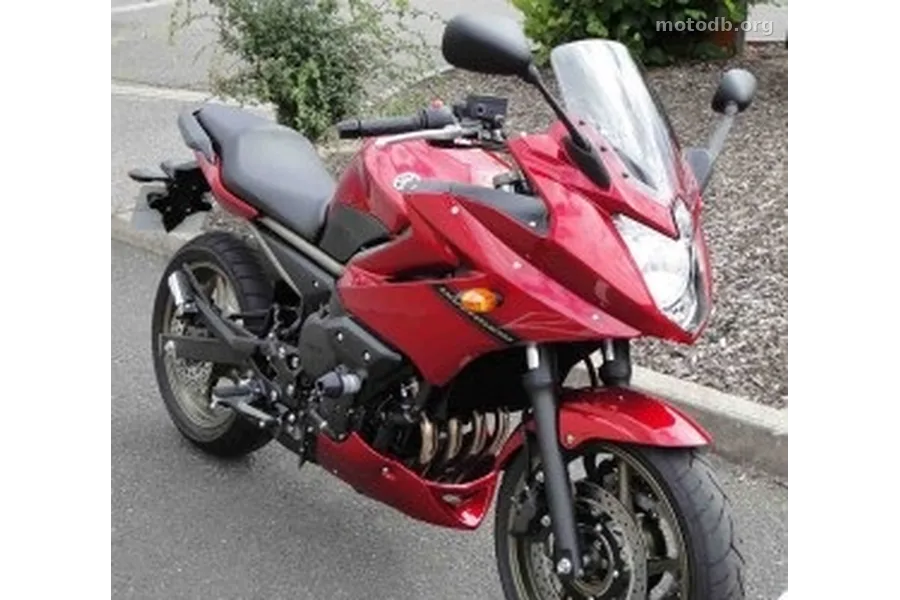
Key performance
Technical specifications
- Torque
- 59.7 Nm @ 6100 tr/min → 59.7 Nm @ 8500 tr/min
- Fuel system
- Injection → Injection. EFI
- Frame
- Steel, Diamond Shaped → Steel, diamond shaped
- Clutch
- Wet, Multiple Disc → Wet, multiple-disc
- Front suspension
- Telescopic forks → Telescopic fork
- Rear suspension
- Linked monoshock with spring preload adjustment → Swingarm (monocross)
Engine
- Displacement
- 600 cc
- Power
- 78.0 ch @ 10000 tr/min (55.8 kW)
- Torque
- 59.7 Nm @ 8500 tr/min
- Engine type
- In-line four, four-stroke
- Cooling
- Liquid
- Compression ratio
- 12.2:1
- Bore × stroke
- 65.5 x 44.5 mm (2.6 x 1.8 inches)
- Valves/cylinder
- 4
- Camshafts
- 2 ACT
- Fuel system
- Injection. EFI
- Valve timing
- Double Overhead Cams/Twin Cam (DOHC)
- Lubrication
- Wet sump
- Ignition
- TCI
- Starter
- Electric
Chassis
- Frame
- Steel, diamond shaped
- Gearbox
- 6-speed
- Final drive
- Chain (final drive)
- Clutch
- Wet, multiple-disc
- Front suspension
- Telescopic fork
- Rear suspension
- Swingarm (monocross)
- Front wheel travel
- 130 mm (5.1 inches)
- Rear wheel travel
- 130 mm (5.1 inches)
Brakes
- Front brakes
- Double disc
- Rear brakes
- Single disc
- Front tyre
- 120/70-ZR17
- Front tyre pressure
- 2.25 bar
- Rear tyre
- 160/60-ZR17
- Rear tyre pressure
- 2.50 bar
Dimensions
- Seat height
- 785.00 mm
- Wheelbase
- 1440.00 mm
- Ground clearance
- 140.00 mm
- Length
- 2120.00 mm
- Width
- 770.00 mm
- Fuel capacity
- 17.00 L
- Weight
- 211.00 kg
- New price
- 6 999 €
Overview
Is it possible for a motorcycle to be useful without being boring? Yamaha has long sought the answer with the XJ6 Diversion, this entry-level road bike launched in 2009. It fills a strategic gap, that of an accessible machine for young license holders or thrifty touring riders, without the technical and price excesses of the Fazer. At €6999, it positions itself as a reasonable proposition compared to the Kawasaki ER-6f or the Honda CBF 600. Its premise is simple: to offer honest versatility with a 600 cc inline four-cylinder engine, available in a faired (the Diversion F) or naked version. For many, the Yamaha XJ6 Diversion represents the gateway to the world of inline four-cylinder engines, a Yamaha XJ6 Diversion used motorcycle often sought after for its value-for-money.
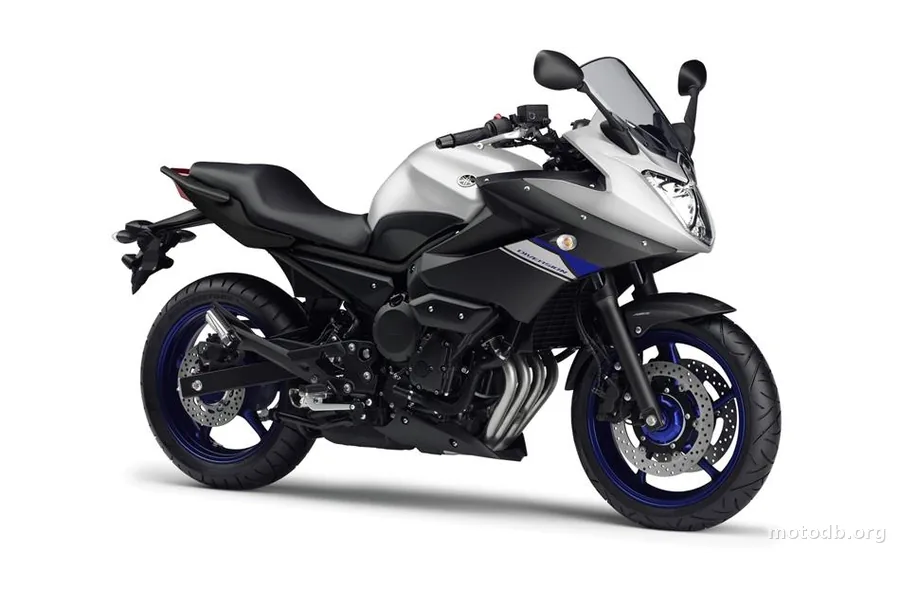
Technically, it embraces a philosophy of assumed simplicity. No perimeter aluminum frame, but a good old steel tube diamond. No spectacular inverted fork, but a conventional 41 mm one. The brakes are classic discs associated with two-piston calipers, with ABS available as an option. The engine is an interesting point: derived from that of the FZ6 (and therefore the R6), it has been recalibrated for road use. Yamaha reworked the cylinder head, camshafts, and injection to favor torque at low and mid-revs. The 78 horsepower at 10,000 rpm and 59.7 Nm at 8,500 rpm are not figures that will overwhelm a GSX-R, but they are perfectly suited to daily and touring use. The transmission has been redesigned to be smoother, a crucial point when compared to older generations of XJ. This approach makes the Yamaha XJ6 Diversion a very effective urban and touring machine, even if its 17-liter tank requires regular stops.
On the road, the philosophy is confirmed. The wheelbase of 1440 mm and the rake of 26 degrees give reassuring stability without sacrificing maneuverability. The weight of 211 kg fully fueled is well distributed, and the seat height of 785 mm suits most riders. It does not seek absolute performance; its maximum speed of approximately 200 km/h is more an indicator of potential than a daily objective. The partial fairing of the Diversion F offers honest protection from the weather, a crucial detail for those who use their machine all year round. This is where the faired version, sometimes called the Yamaha XJ6 Diversion F, makes sense, while the naked remains a more urban option. For those who want to personalize their mount, Yamaha XJ6 Diversion accessories or even a simple Yamaha XJ6 Diversion rearview mirror allow adapting the machine to their needs.
Compared to its contemporaries, the 2011 XJ6 Diversion does not seek to compete on the field of pure technology. It rather responds to a demand for robustness and ease of use. Its direct competitor, the Suzuki Bandit 650, plays in the same category with a more powerful but less refined engine. The Kawasaki ER-6f, with its twin cylinder, offers a lighter and more economical alternative. The Yamaha stands out with this inline four-cylinder that offers a sound and linearity characteristic of the brand. For a beginner coming from a 500 or for a motorcyclist looking for an everyday machine without extravagance, it does an excellent job. Yamaha XJ6 Diversion F tests from the time often highlighted this impression of balance and reliability.
Today, the Yamaha XJ6 Diversion 2011, 2012 or 2013 represents a smart option on the used market. It avoids the complexities of sportbikes while offering a solid and enjoyable platform. Its evolution since the first Yamaha XJ6 Diversion 1992, 1994 or 1996 shows a constant desire to serve a wide audience. It is a motorcycle that will not surprise you with bursts of performance, but that will accompany you faithfully, city or national road, without ever asking you to become a mechanic or a track rider. It is the antithesis of the motorcycle as a technological showcase; it is a mobility tool, well designed, and ultimately quite rewarding for those who value regularity over top speed.
Standard equipment
- Assistance au freinage : ABS en option
Practical info
- La moto est accessible aux permis : A
Reviews & comments
No reviews yet. Be the first to share your opinion!