Key performance
Technical specifications
Engine
- Displacement
- 600 cc
- Power
- 78.0 ch @ 10000 tr/min (56.6 kW)
- Torque
- 59.7 Nm @ 6100 tr/min
- Engine type
- In-line four, four-stroke
- Cooling
- Liquid
- Compression ratio
- 12.2:1
- Bore × stroke
- 65.5 x 44.5 mm (2.6 x 1.8 inches)
- Valves/cylinder
- 4
- Camshafts
- 2 ACT
- Fuel system
- Injection
- Valve timing
- Double Overhead Cams/Twin Cam (DOHC)
- Lubrication
- Wet sump
- Ignition
- TCI
- Starter
- Electric
Chassis
- Frame
- Steel, Diamond Shaped
- Gearbox
- 6-speed
- Final drive
- Chain (final drive)
- Clutch
- Wet, Multiple Disc
- Front suspension
- Telescopic forks
- Rear suspension
- Linked monoshock with spring preload adjustment
- Front wheel travel
- 130 mm (5.1 inches)
- Rear wheel travel
- 130 mm (5.1 inches)
Brakes
- Front brakes
- Double disc. Hydraulic
- Rear brakes
- Single disc. Hydraulic
- Front tyre
- 120/70-ZR17
- Front tyre pressure
- 2.25 bar
- Rear tyre
- 160/60-ZR17
- Rear tyre pressure
- 2.50 bar
Dimensions
- Seat height
- 785.00 mm
- Wheelbase
- 1440.00 mm
- Ground clearance
- 140.00 mm
- Length
- 2120.00 mm
- Width
- 770.00 mm
- Height
- 1210.00 mm
- Fuel capacity
- 17.00 L
- Weight
- 211.00 kg
- New price
- 7 499 €
Overview
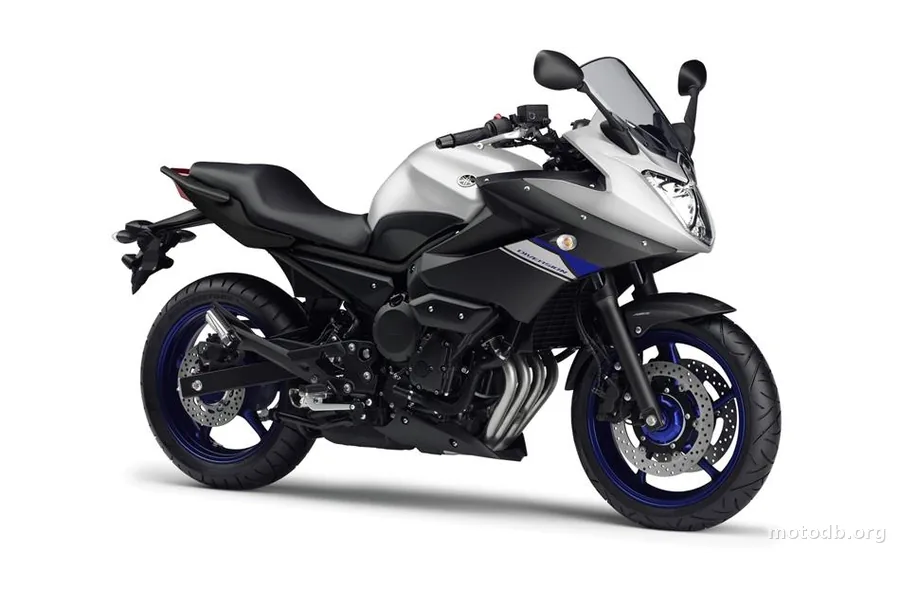
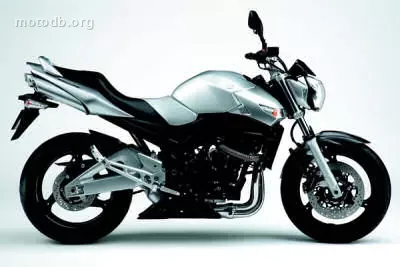
The XJS 600 Diversion was Yamaha’s entry-level sport tourer that many young riders enjoyed. Easy, inexpensive, uncomplicated, perhaps a little short on power but ready for anything without fuss, this versatile machine was hardworking and never faltered. But anti-pollution standards, trends, and age eventually led to its gentle decline at the beginning of the 21st century, creating a void in the Yamaha lineup that the Fazer, a more technical and higher-end model, could not fill. But a pleasant surprise arrived. 2009 saw the birth of a new 600cc sport tourer: the XJ6 Diversion. And as a good surprise never comes alone, this basic motorcycle is paired with a naked version, ideal for auto schools and young riders.
Like their predecessors, these two versions are technically very similar. The main, and almost sole, difference between the two versions is the Diversion’s fairing. Angular but not sharp, it gives a touch of sportiness and, above all, provides sensible protection. Making the road accessible to everyone, and especially young riders, that's what it's all about.
With all the technology that modern sportbikes are throwing at us, we’ve almost forgotten simple solutions. Not the XJ6 Diversion. Like its XJS grandmother, it adopts a more relaxed design than technological showcase models. Here, no variable intake, no perimeter Deltabox frame, no traction control, radial brake calipers, or MotoGP-type inverted fork... No, here, we use what’s needed to ride, not to chase numbers, and although this 600 doesn’t have the chassis of a hypersport (radical and unlivable on public roads), it enjoys a more accessible price than the Fazer (very close to that of its competitors) and a much better road capability. Arguing? The XJ6 Diversion will moderately appreciate it. The pleasure of riding? It regains its smile. The technical solutions implemented here confirm this trend. The motorcycle uses a classic diamond-type steel tubular frame, less expensive than an aluminum perimeter frame like the FZ6’s. These 31.8 mm diameter tubes, 2.3 mm thick, create a simple frame that almost completely disappears under the bodywork. The exhaust is also very discreet, hidden under the engine and behind the sump. The wheelbase and rake reveal sensible and reassuring values. A new fork, new aluminum rims, and a new swingarm are part of the package. The latter doesn’t look like much, but that’s not what it’s asked to do. The brake discs are slightly thinner than those of the FZ6. They are paired with conventional 2-piston calipers, optionally doubled with ABS (+ 400 euros). Ah, I see some grimaces in the back… Is it the normal 41 mm fork that bothers you? Does it not have enough impact? Do you prefer an inverted one like on a 600 GSX-R, with a sharpened chassis… Yes, but that’s not the machine’s philosophy; and the extra cost is 4,000 euros.
For the engine, there’s no question of reusing the XJS’s antique air-cooled engine. The new Diversion uses a modern, clean, and compact 4-cylinder engine. Derived from the FZ6 and originally from the R6, this powerhouse has been modified and adapted for versatile use and availability. Engine response, torque, and mapping are optimized for the low and mid-range, those most commonly used on this type of machine. Let's hope that this new model has more character than the old 600 8-valve air-cooled engine, supple and kind but lacking relief. Cylinder head, camshafts, injection, clutch, and gearbox selection have been revised. Enough to make it a more than sympathetic urban machine, hoping it will make us forget the harsh gear changes of the old XJ 600.
The XJ had disappeared… and was reborn under an equivocal name. Same philosophy but more modern, more appealing, it arrives just in time to compete with the new Kawasaki ER-6f, Suzuki Bandit 650, and Honda CBF 600, which has recently been renewed.
2013 marked a slight evolution for the XJ6 Diversion: new passenger grips for better grip, LED dashboard lighting, anti-slip material to cover the seat, a chain tension indicator, and transparent turn signals. The Race Blu color scheme, a 2013 tribute to MotoGP machines, is carried over to 2014 and 2015.
The main engine characteristics:
• 600cc inline four-cylinder engine with liquid cooling, four valves, and double ACT • Redesigned intake and exhaust • High-compression cylinder head • Narrower intake ducts • Redesigned cam profile • Significant torque at low and mid-range • Monoblock cylinder and upper crankcase • Bore x stroke 65.5 mm x 44.5 mm • Forged aluminum pistons • Multi-jet injector system • 4-2-1 exhaust with central silencer located under the frame • Three-way catalytic converter and lambda probe on the exhaust • Revised gear selection mechanism
Regarding the chassis:
• Diamond-type steel tube frame • Optimized lateral rigidity • Wheelbase of 1,440 mm • Protective fairing • Rake of 26 degrees and rake of 103.5 mm increasing maneuverability • Refined and compact hexagonal fuel tank • Compact swingarm • Conventional 41 mm diameter fork • Monocross rear suspension • 298 mm front discs and 245 mm rear disc diameter, 4.5 mm thickness • 120/70-ZR17 front tire and 160/60-ZR17 rear tire • 520 low-resistance chain (530 for the FZ6) • Cast aluminum rims • Timeless style emphasizing the redistribution of masses • Linear ABS available as an option • New dashboard lighting • Adjustable handlebar position
M.B - Photos manufacturer
Standard equipment
- Assistance au freinage : ABS de série
Practical info
- Véhicule accessible au permis A2 ou bridable à 47.5ch / 35 Kw
- La moto est accessible aux permis : A, A2
Reviews & comments
No reviews yet. Be the first to share your opinion!