Key performance
Technical specifications
Engine
- Displacement
- 998 cc
- Power
- 200.0 ch @ 13500 tr/min (147.1 kW)
- Torque
- 113.8 Nm @ 11500 tr/min
- Engine type
- 4 cylindres en ligne, 4 temps
- Cooling
- liquide
- Compression ratio
- 13 : 1
- Bore × stroke
- 79 x 50.9 mm
- Valves/cylinder
- 4
- Camshafts
- 2 ACT
- Fuel system
- Injection
Chassis
- Frame
- périmétrique Diamond en aluminium
- Gearbox
- boîte à 6 rapports
- Final drive
- Chaîne
- Front suspension
- Fourche téléhydraulique inversée Öhlins Ø 43 mm, déb : 120 mm
- Rear suspension
- Mono-amortisseur Öhlins, déb : 120 mm
Brakes
- Front brakes
- Freinage 2 disques Ø 320 mm, fixation radiale, étrier 4 pistons
- Rear brakes
- Freinage 1 disque Ø 220 mm, étrier simple piston
- Front tyre
- 120/70-17
- Front tyre pressure
- 2.50 bar
- Rear tyre
- 200/55-17
- Rear tyre pressure
- 2.90 bar
Dimensions
- Seat height
- 860.00 mm
- Fuel capacity
- 17.00 L
- Weight
- 202.00 kg
- New price
- 27 999 €
Overview
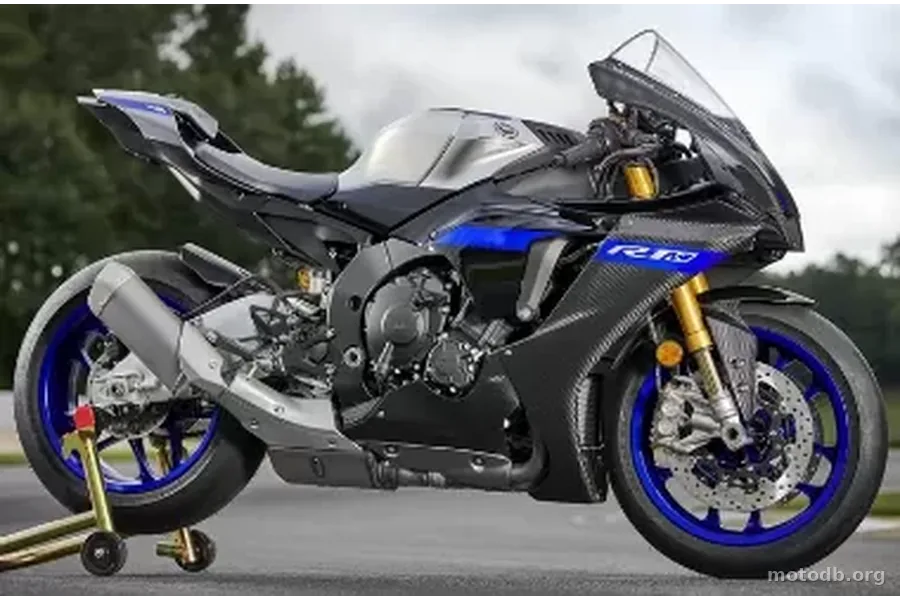
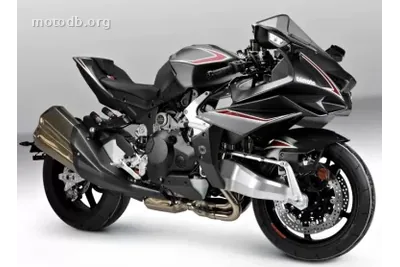
What separates a cutting-edge sportbike from a true track weapon? Sometimes, a simple suffix. At Yamaha, the letter M transforms the R1 into an object of desire reserved for riders who want to flirt with the limits without going through the prototype route. The 2023 Yamaha R1M 1000 stays true to this philosophy: take an already formidable base and sharpen it with equipment typically found on factory machines.
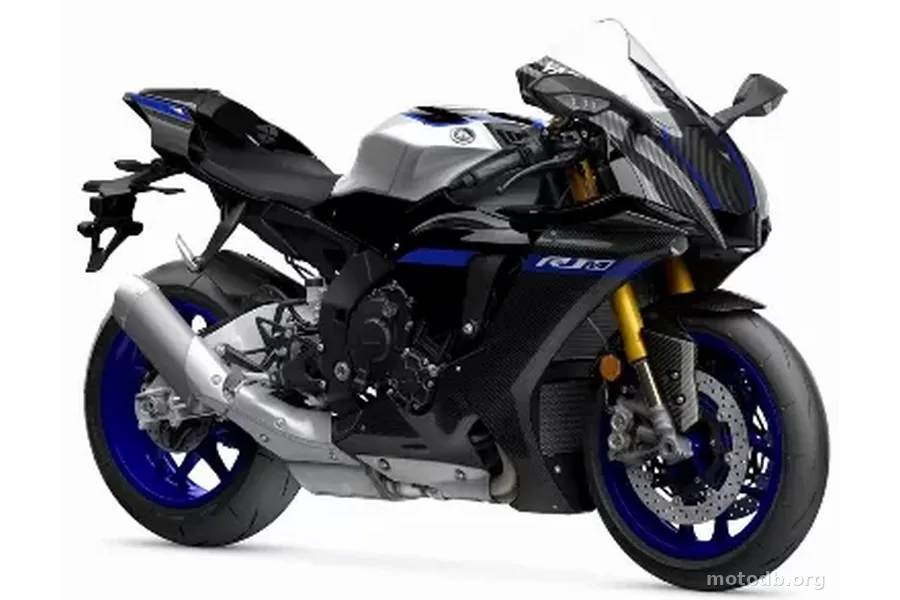
Beneath the full carbon fiber fairing, the 998 cc inline four-cylinder produces 200 horsepower at 13,500 rpm with 113.8 Nm of torque at 11,500 rpm. Figures that place it neck and neck with the BMW S 1000 RR or the Ducati Panigale V4, its natural rivals on the smooth tarmac of racetracks. All contained within 202 kg wet weight, kept in check thanks to the Diamond perimeter aluminum frame and the widespread use of carbon across the entire fairing, rear cowl included. If you're wondering what the top speed of the Yamaha R1M 1000 is, the answer comes in three round digits: 300 km/h. Enough to turn any straight into a mere formality before the next braking point.
What truly sets the R1M apart from its "standard" sibling is the quality of its connection to the road. Öhlins supplies a semi-active suspension system called Electronic Racing Suspension. The 43 mm pressurized NPX inverted fork integrates a gas cylinder that eliminates oil cavitation during rebound, ensuring consistent damping regardless of how harsh the inputs. The setup offers 120 mm of travel at both front and rear. Two operating modes coexist: an automatic setting that adapts the suspension in real time, and a manual mode for those who prefer to fine-tune each parameter themselves. This level of sophistication comes at the cost of one extra kilo on the scales compared to the standard R1. One gram more per horsepower — we'll manage.
On the electronics front, Yamaha has pushed the envelope far. The YRC Setting app allows configuration of seven distinct control systems, from traction control to engine braking management, and the creation of custom maps. The Y-TRAC system records full telemetry, from engine speed to lean angles, through acceleration and braking phases. Data can be downloaded to a smartphone and overlaid onto the track layout via Google Maps. A tool that turns every track session into an analysis worthy of a Superbike pit stand. Braking, handled by four-piston radial calipers biting 320 mm discs, completes a chassis package built for pure performance. The 17-liter tank does, however, require frequent refueling in track use, where a Panigale V4 offers one liter more.
At €27,999, the R1M is not aimed at beginners or weekend riders. It's a machine for seasoned track enthusiasts, sold by reservation, numbered like a collector's piece. Its individual badge engraved on the airbox cover serves as a reminder of that exclusivity. Against European competition, it plays the card of onboard electronics and semi-active suspension at a price that remains restrained for this category. The BMW M 1000 RR asks for more, the Panigale V4 S sits in the same waters. For anyone seeking a Japanese inline-four capable of rivaling the best sportbikes on the market at the track while retaining road homologation, the R1M remains a compelling choice. Not the most flamboyant, but devastatingly effective. A blade, not a showpiece.
Standard equipment
- Assistance au freinage : ABS in curves
- Nombre de mode de conduite : 4
- Taille de l'écran TFT couleur : 10,92 cm / 4.3 pouces
- Shifter
- Indicateur de vitesse engagée
- Aide au départ arrêté (Launch Control)
- Contrôle de traction
- Suspensions réglables électroniquement
- Contrôle anti wheeling
- Carénage carbone
- Jantes magnésium
- Contrôle de glisse
- Contrôle du frein moteur
Practical info
- La moto est accessible aux permis : A
Reviews & comments
No reviews yet. Be the first to share your opinion!