Key performance
Technical specifications
Engine
- Displacement
- 998 cc
- Power
- 200.0 ch @ 13500 tr/min (147.1 kW)
- Torque
- 113.8 Nm @ 11500 tr/min
- Engine type
- 4 cylindres en ligne, 4 temps
- Cooling
- liquide
- Compression ratio
- 13 : 1
- Bore × stroke
- 79 x 50.9 mm
- Valves/cylinder
- 4
- Camshafts
- 2 ACT
- Fuel system
- Injection
Chassis
- Frame
- périmétrique Diamond en aluminium
- Gearbox
- boîte à 6 rapports
- Final drive
- Chaîne
- Front suspension
- Fourche téléhydraulique inversée Ø 43 mm, déb : 120 mm
- Rear suspension
- Mono-amortisseur, déb : 120 mm
Brakes
- Front brakes
- Freinage 2 disques Ø 320 mm, fixation radiale, étrier 4 pistons
- Rear brakes
- Freinage 1 disque Ø 220 mm, étrier simple piston
- Front tyre
- 120/70-17
- Rear tyre
- 190/55-17
Dimensions
- Seat height
- 855.00 mm
- Fuel capacity
- 17.00 L
- Weight
- 201.00 kg
- New price
- 20 499 €
Overview
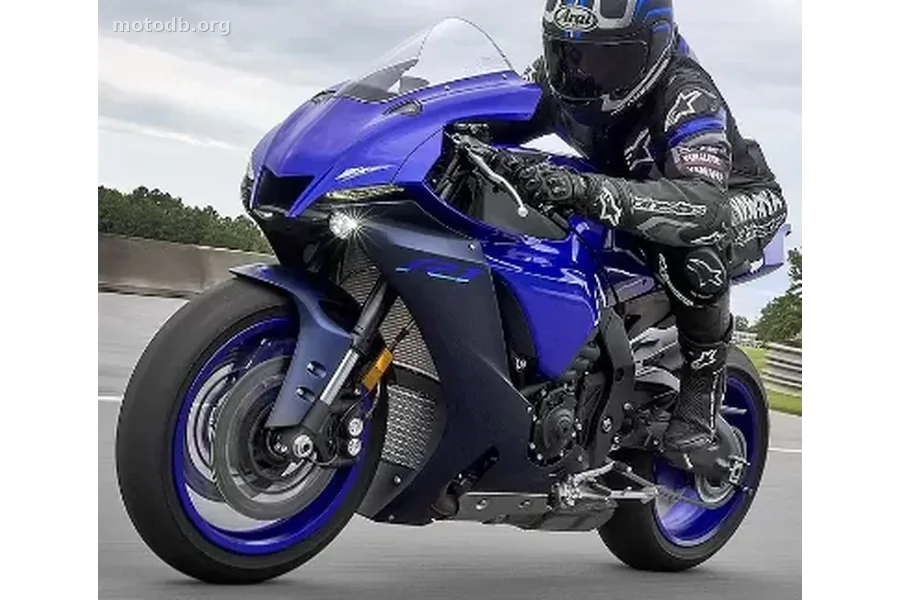
Remember the era when the R1 laid down the law on racetracks around the world, its crossplane spitting out that raspy sound that made your hair stand on end. In 2023, the Iwata sportbike renews its copy without revolution, unlike the Ducati Panigale V4 or the BMW M 1000 RR, which have put a few more chips on the table. Yamaha stands its ground, betting on the maturity of an already highly refined platform, and still eyes WSBK as its natural stage. A status-quo strategy that might seem lukewarm against a competition that's stirring, but one that makes sense when you take a close look at what the machine still has to offer.
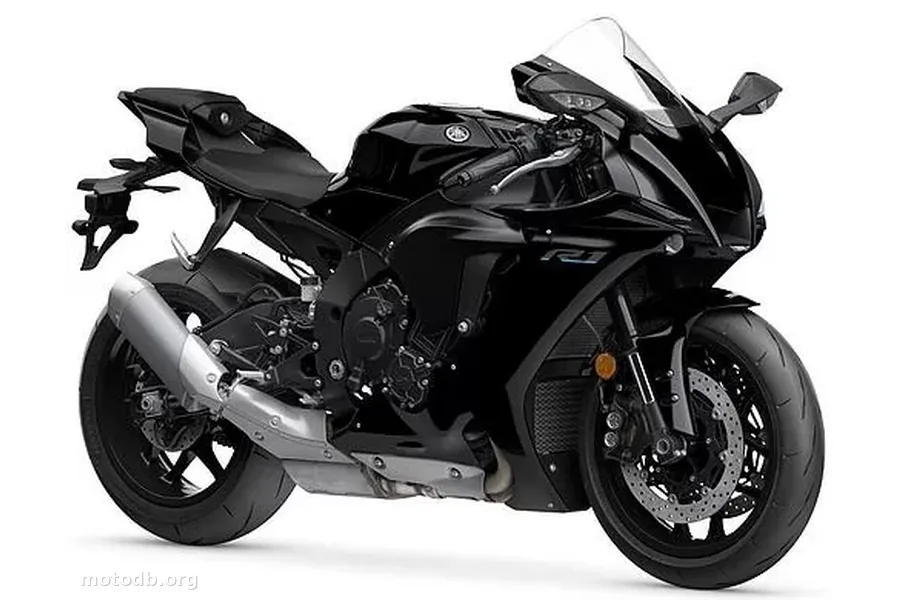
Beneath the fairing heavily inspired by the MotoGP M1, you'll find the same crossplane inline four-cylinder 998 cc, still calibrated at 200 horsepower at 13,500 rpm for 113.8 Nm of torque at 11,500 rpm. For comparison, that's exactly the power output of the previous version, and those wondering what the horsepower of the 2022 Yamaha R1 1000 is will get the same answer. The crossplane keeps its unique signature, that staircase torque delivery that sets the R1 apart from a noticeably more linear CBR 1000 RR-R Fireblade or ZX-10R. The usable range sits high up, with the short 79 x 50.9 mm bore and the 13:1 compression ratio confirming the ultra-sport DNA. On paper, 300 km/h top speed, and in practice, a cavalry that only truly unleashes beyond 8,000 rpm.
The Diamond aluminum perimeter frame and the 43 mm inverted Kayaba fork with its 120 mm of travel remain a benchmark in terms of feedback. The R1 weighs 201 kg fully fueled, right in the average for the category, neither as razor-sharp as an Aprilia RSV4 nor as heavy as some German productions. The 120/70 and 190/55 tires in 17 inches, the dual 320 mm front discs with radial four-piston calipers, the electronic arsenal managed by the six-axis inertial measurement unit, it's all there to exploit this potential. The seat perched at 855 mm is a reminder that this isn't a laid-back roadster; modest builds will quickly find their limits in slow maneuvers, but the riding position makes full sense as soon as you pass through the gates of a racetrack.
Then there's the thorny question of pricing. What is the price of a Yamaha R1 1000? Count on 20,499 euros for the new model year, a positioning that places it below the BMW M 1000 RR and neck and neck with the Honda CBR 1000 RR-R SP. For those scanning the listings, what is the price of the 2023 Yamaha R1 1000 in France? The new-bike range remains stable, and the recurring question of the price of the 2024 Yamaha R1 1000 gets the same answer as long as Yamaha doesn't roll out a new road-homologated model. What is the price of a used Yamaha R1 1000? The secondary market ranges between 12,000 and 17,000 euros depending on model year and mileage, and Algerian platforms such as ouedkniss moto Yamaha R1 1000 display even more volatile valuations depending on origin and condition.
Clear-cut verdict. The 2023 R1 is no longer aimed at occasional riders looking for a versatile sportbike — that slot is now occupied by middle-class machines like the R7 or Aprilia RS 660. This 1000 is a circuit weapon, heavy and underused on open roads, frustrating in the city with its tall seat and significant heat output. Intermediate and seasoned trackday riders will find a solid technical base, perfectible but proven, whose main handicap remains the lack of recent evolution against competitors pushing further with active aerodynamics and electronically controlled braking.
Standard equipment
- Assistance au freinage : ABS de série
Practical info
- La moto est accessible aux permis : A
Reviews & comments
No reviews yet. Be the first to share your opinion!