Key performance
Technical specifications
Engine
- Displacement
- 49 cc
- Power
- 3.0 ch @ 5500 tr/min (2.2 kW)
- Torque
- 3.9 Nm @ 4500 tr/min
- Engine type
- Monocylindre, 2 temps
- Cooling
- Air
- Compression ratio
- 6.0:1
- Bore × stroke
- 40.0 x 39.2 mm (1.6 x 1.5 inches)
- Fuel system
- Carburettor. Mikuni VM12
- Lubrication
- Separate 2-stroke oil tank
- Ignition
- CDI
- Starter
- Kick
Chassis
- Frame
- Steel tube backbone
- Gearbox
- Automatic
- Final drive
- Shaft drive (cardan) (final drive)
- Clutch
- Wet centrifugal automatic clutch
- Front suspension
- Telescopic fork 26mm
- Rear suspension
- Unit swingarm
- Front wheel travel
- 61 mm (2.4 inches)
- Rear wheel travel
- 51 mm (2.0 inches)
Brakes
- Front brakes
- Expanding brake (drum brake)
- Rear brakes
- Expanding brake (drum brake)
- Front tyre
- 2.50-10
- Front tyre pressure
- 1.00 bar
- Rear tyre
- 2.50-10
- Rear tyre pressure
- 1.00 bar
Dimensions
- Seat height
- 475.00 mm
- Wheelbase
- 856.00 mm
- Ground clearance
- 94.00 mm
- Length
- 1245.00 mm
- Width
- 610.00 mm
- Height
- 706.00 mm
- Fuel capacity
- 2.01 L
- Weight
- 41.00 kg
- Dry weight
- 39.00 kg
- New price
- 2 199 €
Overview
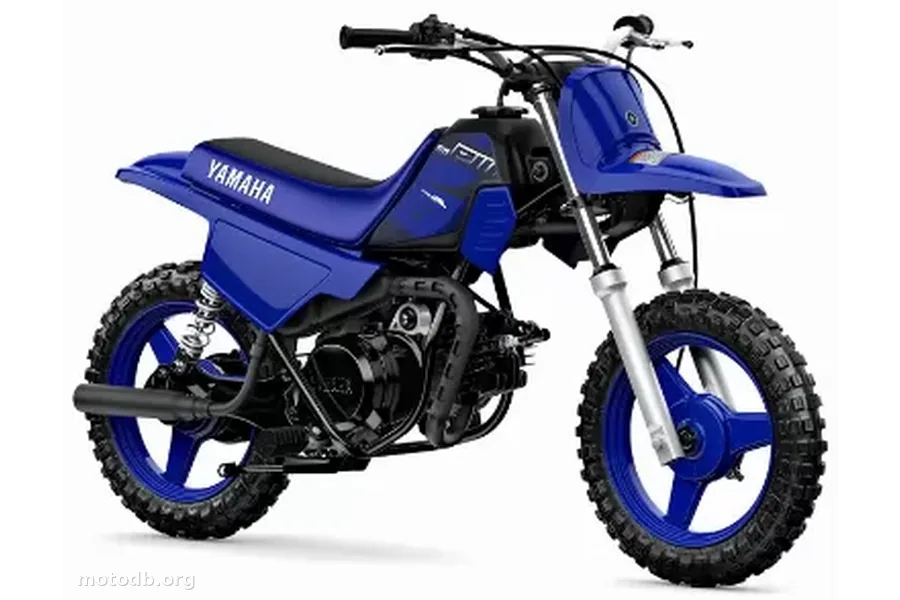
What other motorcycle can boast having put three generations of riders in the saddle without ever changing the recipe? Since 1980, the Yamaha PW50 has remained the mandatory rite of passage for every kid who dreams of handlebars and dirt tracks. "PW" simply stands for "Pee Wee," a deliberate nod to the Lilliputian size of this Yamaha PW50 mini bike that has forged its legend on vacant lots and meadows around the world. With its 49 cc, single-cylinder two-stroke engine, and 41 kg wet weight, it's more mechanical toy than motorcycle. Except it really is one. A kick-starter to actuate, a carburetor spitting fuel vapors, knobby tires in 2.50-10, a throttle grip, and two brake levers. The kid who climbs onto this little Yamaha instinctively understands he's riding a real machine, not a battery-powered plastic quad.
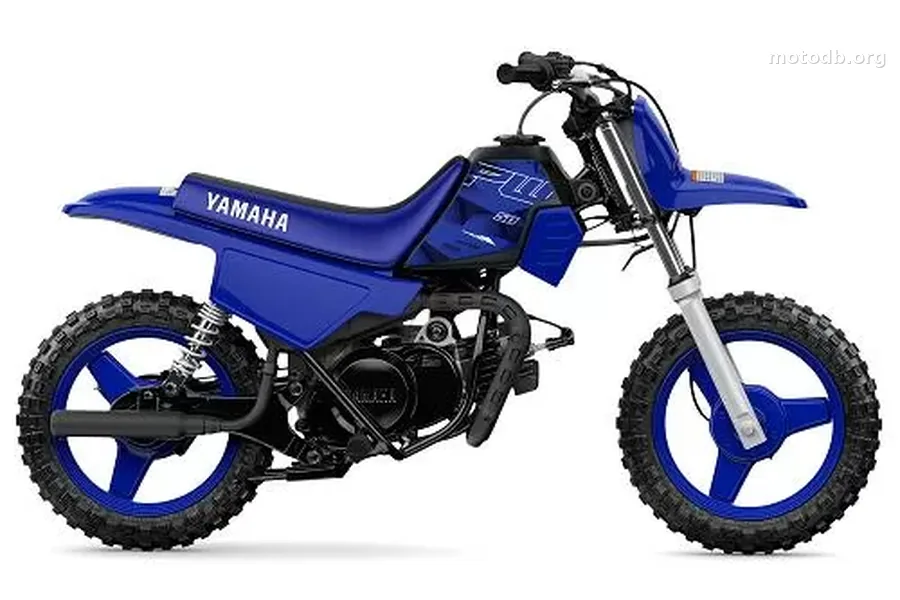
The strength of this PW50 is having thought through every detail to reassure parents without restricting the young rider's fun. The transmission is fully automatic, with a centrifugal clutch managing three gears without the child having to worry about it. All concentration goes into the line, braking, and throttle management. Better yet, an adjustable speed limiter controlled by a screw lets you regulate throttle opening. You start gently, then unleash the horsepower as skills progress. With 3 horsepower at 5,500 rpm and 3.9 Nm of torque at 4,500 rpm, the Yamaha PW50's top speed caps out between 45 and 50 km/h. More than enough to thrill a four- or five-year-old while keeping a comfortable safety net. Compared to a Honda CRF50F that barely tops out at 40–48 km/h on its four-stroke, the little Yam retains a livelier temperament. The KTM 50 SX climbs up to 65 km/h, but clearly targets competition and is aimed at riders who are already experienced.
The 475 mm seat height lets the youngest riders put their feet on the ground without stress. The simple, sturdy steel tube frame absorbs learning crashes without flinching. The front and rear drum brakes don't offer phenomenal stopping power, but they're more than sufficient for the purpose. The 26 mm telescopic fork and rear swingarm with mono-shock adequately filter out the bumps of a dirt path. The Yamaha PW50 is ideal from age 3 or 4 depending on the child's size and confidence, and many keep riding it until seven or eight before moving up to a 65. It clearly represents the first rung on the ladder, the one that leads to a KTM 65 SX for competition or a Husqvarna TC 85 for pure motocross.
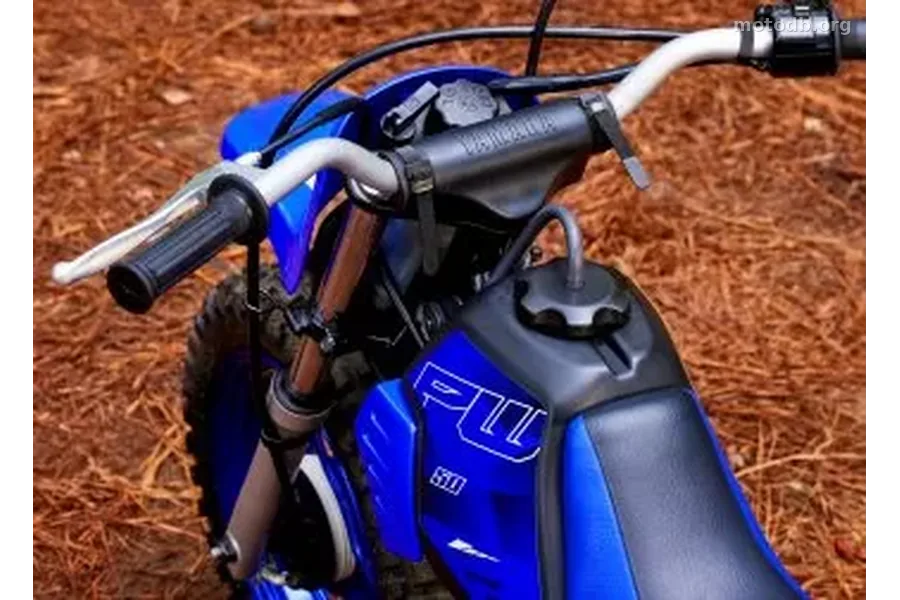
On the maintenance side, Yamaha played the simplicity card. The separate oil injection eliminates the chore of mixing oil and fuel. The shaft-driven final drive does away with the chain, its grease splatter, and the pinch risk for little fingers. Yamaha PW50 parts are easy to find, from spark plugs to pistons to tires. The small 2-liter tank limits range, but on a riding ground, nobody's heading out on a rally. Routine maintenance comes down to checking tire pressure, cleaning the air filter, and replacing the spark plug from time to time. Nothing that requires a mechanic's certification.
Then there's the question of the new Yamaha PW50's price. At €2,199 in 2023, the price tag has climbed significantly compared to the early years of production. For a motorcycle whose design has barely evolved in over forty years, the bill stings a little. But the PW50 benefits from strong resale value on the used market, which softens the real expense. It gets passed from brother to sister, cousin to neighbor, and often ends up accumulating more owners than a collector car. That's perhaps its finest achievement: crossing the decades without showing a wrinkle, remaining the absolute benchmark for putting a child in the saddle.
Reviews & comments
No reviews yet. Be the first to share your opinion!