Key performance
Technical specifications
- Power
- — → 3.0 ch @ 5500 tr/min (2.2 kW)
- Torque
- — → 3.9 Nm @ 4500 tr/min
- Engine type
- Single cylinder, two-stroke → Monocylindre, 2 temps
- Cooling
- Air → par air
- Compression ratio
- 6.0:1 → 6 : 1
- Bore × stroke
- 40.0 x 39.2 mm (1.6 x 1.5 inches) → 40 x 39.2 mm
- Fuel system
- Carburettor. VM12 → —
- Lubrication
- Autolube oil injection system → —
- Ignition
- CDI → —
- Frame
- — → poutre en tube d'acier
- Gearbox
- Automatic → boîte à 3 rapports
- Final drive
- Shaft drive (cardan) (final drive) → Cardan
- Clutch
- Wet centrifugal automatic clutch → —
- Front suspension
- Telescopic fork → Fourche téléhydraulique Ø 26 mm, déb : 60 mm
- Rear suspension
- Unit swingarm → Moteur oscillant + double amortisseur, déb : 50 mm
- Front wheel travel
- 61 mm (2.4 inches) → —
- Rear wheel travel
- 51 mm (2.0 inches) → —
- Front brakes
- Expanding brake (drum brake) → Freinage tambour Ø 80 mm
- Rear brakes
- Expanding brake (drum brake) → Freinage tambour Ø 80 mm
- Front tyre
- 2.50-10 → 2/50-10
- Front tyre pressure
- — → 1.00 bar
- Rear tyre
- 2.50-10 → 2/50-10
- Rear tyre pressure
- — → 1.00 bar
- Seat height
- 485.00 mm → 475.00 mm
- Wheelbase
- 856.00 mm → —
- Ground clearance
- 104.00 mm → —
- Length
- 1245.00 mm → —
- Width
- 574.00 mm → —
- Height
- 714.00 mm → —
- Fuel capacity
- 1.90 L → 2.00 L
- Dry weight
- — → 39.00 kg
- New price
- — → 2 199 €
Engine
- Displacement
- 49 cc
- Power
- 3.0 ch @ 5500 tr/min (2.2 kW)
- Torque
- 3.9 Nm @ 4500 tr/min
- Engine type
- Monocylindre, 2 temps
- Cooling
- par air
- Compression ratio
- 6 : 1
- Bore × stroke
- 40 x 39.2 mm
Chassis
- Frame
- poutre en tube d'acier
- Gearbox
- boîte à 3 rapports
- Final drive
- Cardan
- Front suspension
- Fourche téléhydraulique Ø 26 mm, déb : 60 mm
- Rear suspension
- Moteur oscillant + double amortisseur, déb : 50 mm
Brakes
- Front brakes
- Freinage tambour Ø 80 mm
- Rear brakes
- Freinage tambour Ø 80 mm
- Front tyre
- 2/50-10
- Front tyre pressure
- 1.00 bar
- Rear tyre
- 2/50-10
- Rear tyre pressure
- 1.00 bar
Dimensions
- Seat height
- 475.00 mm
- Fuel capacity
- 2.00 L
- Weight
- 39.00 kg
- Dry weight
- 39.00 kg
- New price
- 2 199 €
Overview
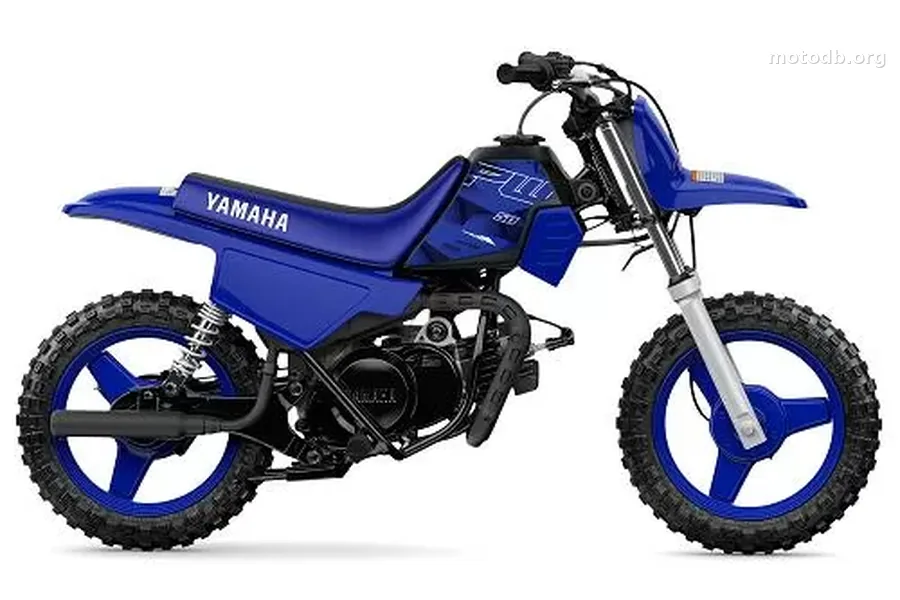
The PW is certainly the most well-known motorcycle model for very young riders. A true institution, or even a given for some when it comes to introducing youngsters to motorized two-wheeled vehicles.
Small and cute, it has everything to please. Its size is truly adapted to the youngest, its ease of use, and above all, it’s really a motorcycle, not a rickety contraption with two wheels.
The formula is impressive from the start. Like the PW is the size of 3 apples and no heavier than a good exercise bike, a parent can almost carry it under their arm. Then, hop, it slides into the car trunk. After that, the child can truly take on the status of a mini-rider. The Yam doesn’t pretend: knobby tires, carburetor, single-cylinder engine started with a kick, the smell of gasoline, a throttle and brakes to manage – it’s truly a pocket-sized machine.
But no need to panic for the (more or less) anxious parents. The PW 50 does part of the work; especially the more complicated technical aspects. First, the gearbox is completely automatic. This allows the young rider to focus on their riding. The complexities of the gears are not for right now and there’s no need to stress about it. The 3 gears shift automatically thanks to a centrifugal clutch. Next, a screw allows you to adjust the throttle opening, limiting the fury of the 2-stroke single-cylinder engine. You can thus gradually release the power as the child learns and gains confidence.
Like the seat is only 47.5 cm from the ground, taking control won’t be impressive. At first, all you have to do is grab the handlebars, make sure they understand that you only need to manage the brakes with the two controls on the handlebars, don’t accelerate when braking, and apply the throttle as you feel it. The motorcycle is easy, not tricky at all, lightweight and very fun. A little caution at the beginning, though. The mechanical behavior is exhilarating for most, but can intimidate the easily impressed. Make sure the child is comfortable to avoid being surprised. It’s not a balance bike. The PW 50 reacting to the same physical laws as any other motorcycle, it will later require the same technical learning to better enjoy it. The gaze, the supports, the power management, the movement of the suspensions, etc...
Yamaha has also planned to simplify the maintenance of its favorite toy. No need to stress about mixing oil: the PW has a separate oil tank and takes care of managing the cocktail. The shaft drive avoids grease projections, getting your hands dirty... or getting them caught in the chain.
Extremely popular, the PW 50 is also a motorcycle that is so well-designed that it has hardly changed since its birth in 1980 in the United States – It arrived in France a year later. The design and technical solutions have been the same for 40 years. Only a few trim pieces will be updated in 1984. The graphics are renewed almost every year, like all cross machines.
With its small air-cooled engine, a very simple steel frame, drum brakes and a design focused on the essentials, the PW began its career with another striking argument: the price. In addition to being the go-to initiation motorcycle for children, it wasn’t expensive. The price has since (a little too much) inflated.
M.B - Manufacturer photos
Reviews & comments
No reviews yet. Be the first to share your opinion!