Key performance
Technical specifications
- Power
- — → 3.0 ch @ 5500 tr/min (2.2 kW)
- Torque
- — → 3.9 Nm @ 4500 tr/min
- Engine type
- Single cylinder, two-stroke → Monocylindre, 2 temps
- Cooling
- Air → Air4zuWB
- Compression ratio
- 6.0:1 → RJ7pejU06.0:1
- Bore × stroke
- 40.0 x 39.2 mm (1.6 x 1.5 inches) → 40.0 x 39.2 mm (1.6 x 1.5 irarIeyJ1UMRonches)
- Fuel system
- Carburettor. VM12 → Carburettor.QfMSpUTrWe Mikuni VM12
- Lubrication
- Autolube oil injection system → SeparLp8tUoate 2-stroke oil tank
- Ignition
- CDI → Cuiv0BLXlnPNDnhNDI
- Starter
- — → Kick4wEG3rQdErxzZ
- Frame
- — → Steel tube 9K6J0IP5FMe8nwbackbone
- Gearbox
- Automatic → NsUF5xPZSBDMiAutomatic
- Final drive
- Shaft drive (cardan) (final drive) → Shaft dxrjzbBfgZDbHaDrive (cardan) (final drive)
- Clutch
- Wet centrifugal automatic clutch → Wet ceCp5pXBrRTrBlNTpntrifugal automatic clutch
- Front suspension
- Telescopic fork → Telescmxrq5oEQLR71topic fork 26mm
- Rear suspension
- Unit swingarm → Unit swing2iSqZhlufarm
- Front wheel travel
- 61 mm (2.4 inches) → 61 mm (2.4 inch1QEoJuJVBms9QAes)
- Rear wheel travel
- 51 mm (2.0 inches) → 51 mm (2.0 incVVqSWK1hes)
- Front brakes
- Expanding brake (drum brake) → Expanding brake (drum brakeO9EHFyTp0o6q)
- Rear brakes
- Expanding brake (drum brake) → Expanding brahMApH6w8lsg6QDke (drum brake)
- Front tyre
- 2.50-10 → 2.50siOYU-10
- Front tyre pressure
- — → 1.00 bar
- Rear tyre
- 2.50-10 → 2.50-10Hu7AVHaa4wvwi0o
- Rear tyre pressure
- — → 1.00 bar
- Seat height
- 485.00 mm → 475.00 mm
- Wheelbase
- 856.00 mm → —
- Ground clearance
- 104.00 mm → 94.00 mm
- Width
- 574.00 mm → 610.00 mm
- Height
- 714.00 mm → 706.00 mm
- Fuel capacity
- 1.90 L → 2.01 L
- Weight
- 39.00 kg → 40.80 kg
- Dry weight
- — → 39.00 kg
- New price
- — → 2 199 €
Engine
- Displacement
- 49 cc
- Power
- 3.0 ch @ 5500 tr/min (2.2 kW)
- Torque
- 3.9 Nm @ 4500 tr/min
- Engine type
- Monocylindre, 2 temps
- Cooling
- Air4zuWB
- Compression ratio
- RJ7pejU06.0:1
- Bore × stroke
- 40.0 x 39.2 mm (1.6 x 1.5 irarIeyJ1UMRonches)
- Fuel system
- Carburettor.QfMSpUTrWe Mikuni VM12
- Lubrication
- SeparLp8tUoate 2-stroke oil tank
- Ignition
- Cuiv0BLXlnPNDnhNDI
- Starter
- Kick4wEG3rQdErxzZ
Chassis
- Frame
- Steel tube 9K6J0IP5FMe8nwbackbone
- Gearbox
- NsUF5xPZSBDMiAutomatic
- Final drive
- Shaft dxrjzbBfgZDbHaDrive (cardan) (final drive)
- Clutch
- Wet ceCp5pXBrRTrBlNTpntrifugal automatic clutch
- Front suspension
- Telescmxrq5oEQLR71topic fork 26mm
- Rear suspension
- Unit swing2iSqZhlufarm
- Front wheel travel
- 61 mm (2.4 inch1QEoJuJVBms9QAes)
- Rear wheel travel
- 51 mm (2.0 incVVqSWK1hes)
Brakes
- Front brakes
- Expanding brake (drum brakeO9EHFyTp0o6q)
- Rear brakes
- Expanding brahMApH6w8lsg6QDke (drum brake)
- Front tyre
- 2.50siOYU-10
- Front tyre pressure
- 1.00 bar
- Rear tyre
- 2.50-10Hu7AVHaa4wvwi0o
- Rear tyre pressure
- 1.00 bar
Dimensions
- Seat height
- 475.00 mm
- Ground clearance
- 94.00 mm
- Length
- 1245.00 mm
- Width
- 610.00 mm
- Height
- 706.00 mm
- Fuel capacity
- 2.01 L
- Weight
- 40.80 kg
- Dry weight
- 39.00 kg
- New price
- 2 199 €
Overview
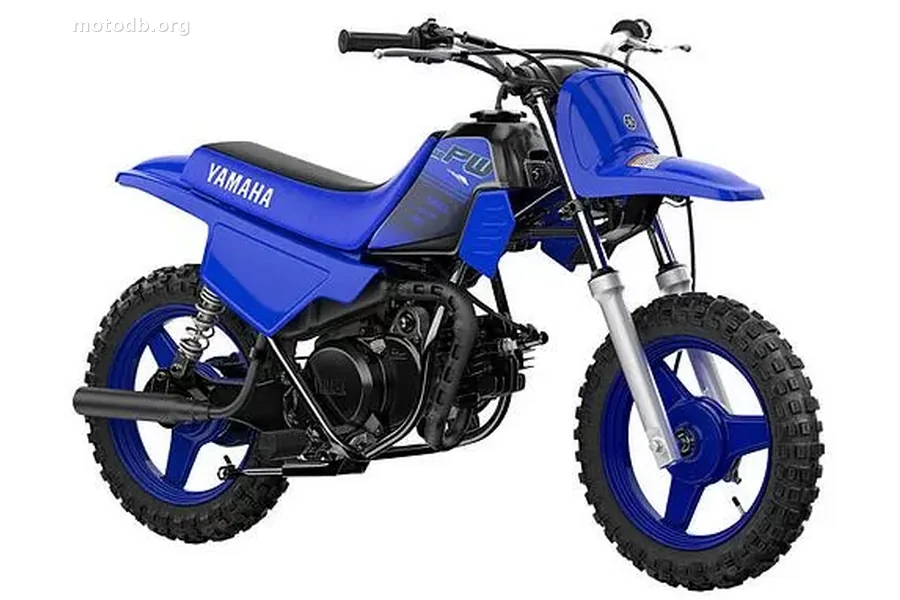
What does PW stand for in Yamaha PW50? Two letters for "Pee Wee," the affectionate nickname Americans give to toddlers. And that's exactly what this Yamaha PW50 mini bike has represented since 1980: the first real motorcycle for kids who want to play in the big leagues. Not a battery-powered plastic toy, not a glorified scooter. A genuine bike with its 49 cc 2-stroke single-cylinder engine, its kick starter, its premix smell, and its knobby tires mounted on 10-inch rims. The kind of machine that turns a 3 or 4-year-old into a budding rider, eyes shining under the helmet.
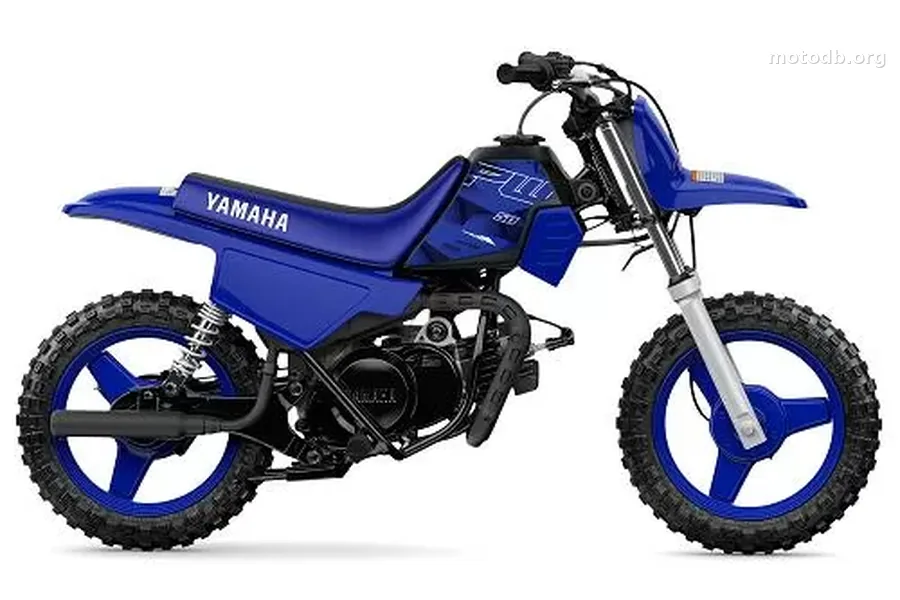
The 2024 Yamaha PW50 hasn't changed its recipe, and that's precisely its strength. With 3 horsepower delivered at 5,500 rpm and 3.9 Nm of torque at 4,500 rpm, we're far from serious firepower. But relative to the machine's 39 kg dry weight, it's more than enough to give a child real thrills. The Yamaha PW50's top speed caps out around 45 to 50 km/h, placing it between the Honda CRF50F (roughly 40–48 km/h) and the KTM 50 SX, which climbs up to 65 km/h. Except the PW50 was designed with safety and ease of use as priorities, not raw performance. A screw-adjustable speed limiter lets parents control the maximum speed and make sure young riders don't exceed their abilities. You unlock the power gradually, matching the pace of learning. That's a detail that makes all the difference compared to a KTM 65 SX, the ultimate race machine but far less forgiving, or a Husqvarna TC85, a smaller sibling built for competition.
The automatic centrifugal clutch transmission eliminates the headache of shifting gears. The Yamaha PW50 is ideal from age 3 or 4, depending on the child's size and confidence. Its low seat height of 475 mm allows the youngest riders to easily put their feet on the ground, and the automatic transmission avoids any complications. No clutch lever, no gear selector. The child focuses on the essentials: looking where they're going, modulating the throttle, braking with the handlebar controls. The front and rear drum brakes offer nothing spectacular, but their progressive feel is perfectly suited to a child's hands. The tubular steel frame takes falls without flinching, and the 26 mm telescopic fork absorbs bumps on terrain without harshness. The 94 mm ground clearance remains modest, consistent with the machine's beginner-oriented purpose.
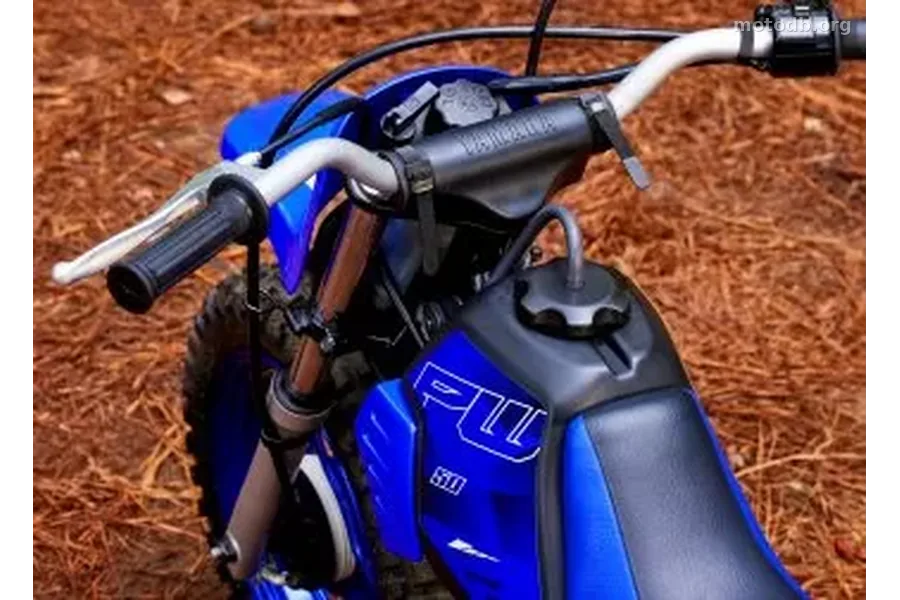
On the maintenance side, Yamaha thought of parents as much as children. The separate oil injection system eliminates the need to mix oil and fuel: a dedicated reservoir handles the ratio automatically. The shaft drive eliminates the chain, its grease splatter, and the pinch risk. Yamaha PW50 parts are easy to find, from Yamaha PW50 spark plugs to pistons to tires. The small 2-liter tank limits range, but we're talking about a bike that putters around a field, not a Paris-Dakar contender. Then there's the question of price. What does a new 2024 Yamaha PW50 cost? Expect to pay 2,199 euros. The price has risen significantly compared to the early years, and when you compare it to the Yamaha PW50 price a few seasons ago, the increase stings. For a machine that has barely evolved technically since its original 1981 Yamaha PW50 owner's manual, the pill is a bit bitter to swallow. That said, its legendary reliability and strong resale value on the used market temper the observation. A well-maintained PW50 resells for nearly its purchase price. Among the three best motorcycles for children, the Yamaha PW50 remains the safety-first choice, the one you recommend without hesitation to families who want to introduce their little ones to riding without any unpleasant surprises.
Reviews & comments
No reviews yet. Be the first to share your opinion!