Key performance
Technical specifications
- Power
- — → 3.0 ch @ 5500 tr/min (2.2 kW)
- Torque
- — → 3.9 Nm @ 4500 tr/min
- Fuel system
- — → Carburettor. Mikuni VM12
- Lubrication
- — → Separate 2-stroke oil tank
- Starter
- Electric → Kick
- Frame
- — → Steel tube backbone
- Clutch
- Automatic → Wet centrifugal automatic clutch
- Front suspension
- Telescopic fork → Telescopic fork 26mm
- Front tyre pressure
- — → 1.00 bar
- Rear tyre pressure
- — → 1.00 bar
- Seat height
- 485.00 mm → 475.00 mm
- Ground clearance
- 104.00 mm → 94.00 mm
- Width
- 574.00 mm → 610.00 mm
- Height
- 714.00 mm → 706.00 mm
- Weight
- 38.60 kg → 41.00 kg
- Dry weight
- — → 39.00 kg
Engine
- Displacement
- 49 cc
- Power
- 3.0 ch @ 5500 tr/min (2.2 kW)
- Torque
- 3.9 Nm @ 4500 tr/min
- Engine type
- Single cylinder, two-stroke
- Cooling
- Air
- Compression ratio
- 6.0:1
- Bore × stroke
- 40.0 x 39.2 mm (1.6 x 1.5 inches)
- Fuel system
- Carburettor. Mikuni VM12
- Lubrication
- Separate 2-stroke oil tank
- Ignition
- CDI
- Starter
- Kick
Chassis
- Frame
- Steel tube backbone
- Gearbox
- Automatic
- Final drive
- Shaft drive (cardan) (final drive)
- Clutch
- Wet centrifugal automatic clutch
- Front suspension
- Telescopic fork 26mm
- Rear suspension
- Unit swingarm
- Front wheel travel
- 61 mm (2.4 inches)
- Rear wheel travel
- 51 mm (2.0 inches)
Brakes
- Front brakes
- Expanding brake (drum brake)
- Rear brakes
- Expanding brake (drum brake)
- Front tyre
- 2.50-10
- Front tyre pressure
- 1.00 bar
- Rear tyre
- 2.50-10
- Rear tyre pressure
- 1.00 bar
Dimensions
- Seat height
- 475.00 mm
- Wheelbase
- 856.00 mm
- Ground clearance
- 94.00 mm
- Length
- 1245.00 mm
- Width
- 610.00 mm
- Height
- 706.00 mm
- Fuel capacity
- 2.01 L
- Weight
- 41.00 kg
- Dry weight
- 39.00 kg
Overview
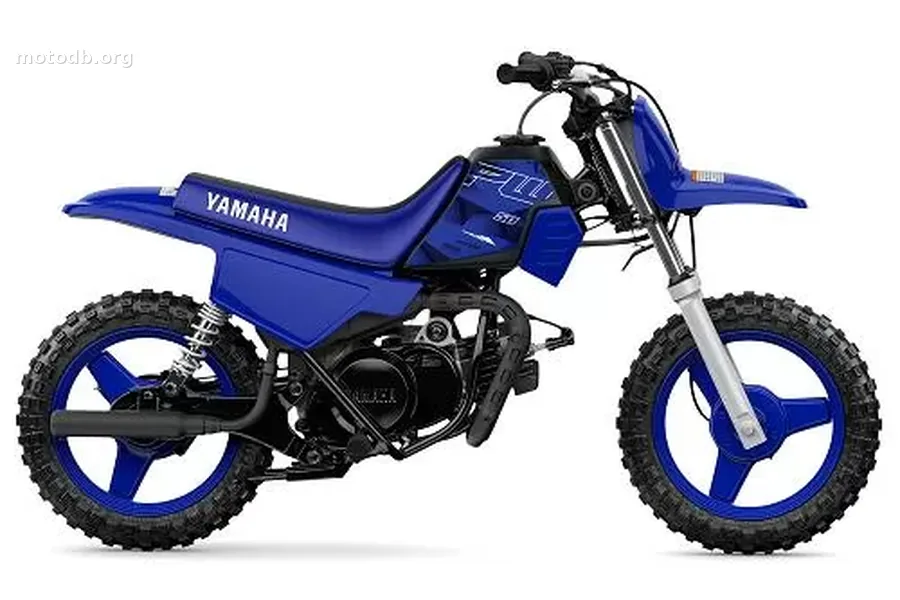
What other motorcycle can boast having put three generations of riders in the saddle without ever changing the recipe? Since 1981 in France, the Yamaha PW50 has remained the mandatory rite of passage for any kid who dreams of handlebars and dirt tracks. This Yamaha PW50 mini bike has crossed the decades with a rare, almost suspicious consistency. The secret lies in two letters: PW, for Pee Wee, the American nickname for the little ones. The name fits the machine perfectly.
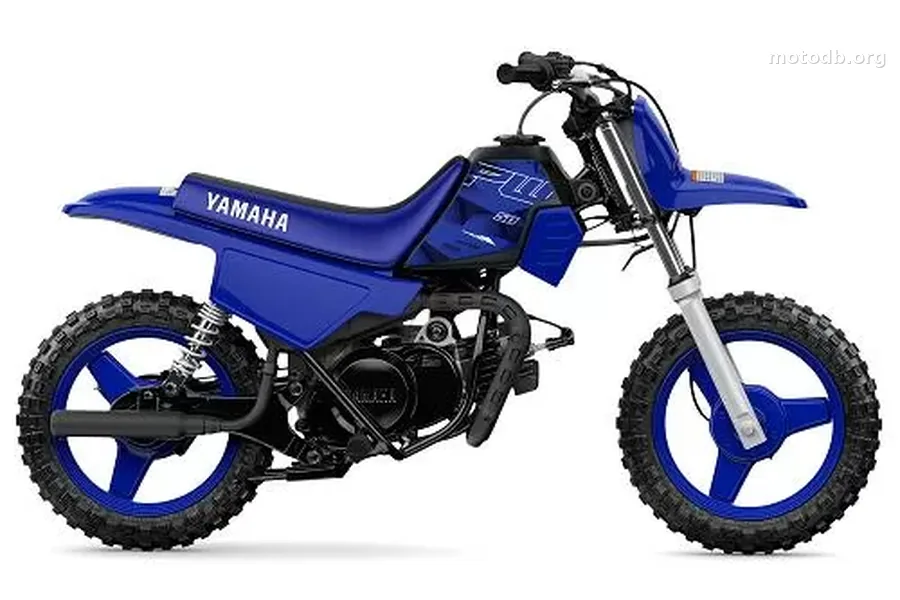
On paper, we're talking about a 49 cc single-cylinder two-stroke, with a 40 mm bore and a 39.2 mm stroke, putting out 3 horsepower at 5,500 rpm and 3.9 Nm of torque at 4,500 rpm. Nothing volcanic. But relative to the machine's 41 kg wet weight, it's enough to deliver genuine thrills to a 3 or 4-year-old. The Yamaha PW50's top speed caps out between 45 and 50 km/h, which may seem modest on paper, but feels perfectly adequate when you watch a five-year-old tearing across a field. Against a Honda CRF50F that tops out at 40–48 km/h on its four-stroke or a KTM 50 SX that climbs toward 65 km/h, the PW lands right in the middle. Neither too tame, nor too twitchy.
The entire philosophy of this Yamaha rests on safety above all else. The 475 mm seat height lets the youngest riders put their feet flat on the ground without contorting themselves. The automatic centrifugal clutch transmission eliminates the headache of shifting gears. The shaft drive as final transmission removes the risk of fingers caught in a chain and simplifies maintenance. The adjustable speed limiter, operated by a simple screw on the throttle grip, lets parents control the maximum speed and progressively unleash the power as the budding rider improves. This feature turns the learning curve into a gentle slope rather than a wall.
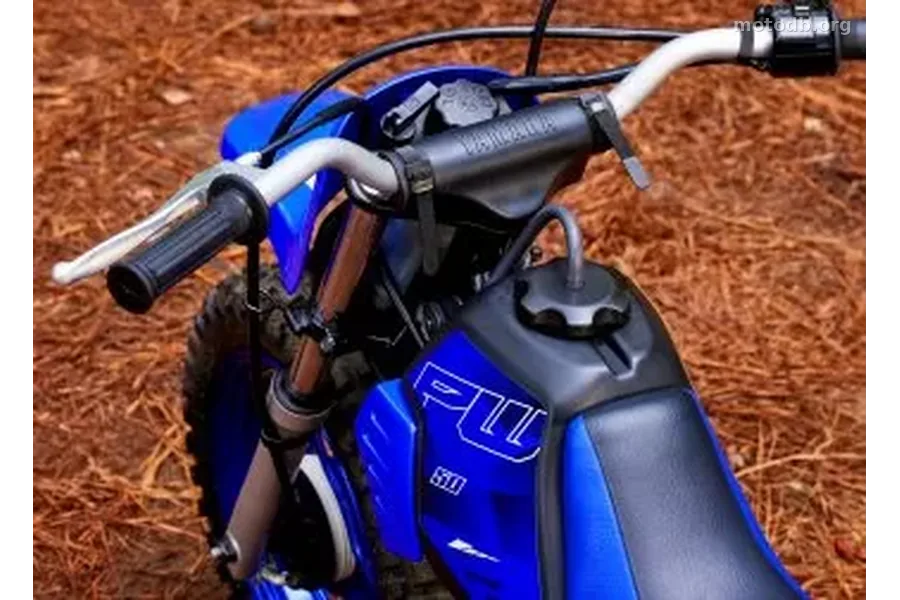
The steel tube frame, 26 mm telescopic fork, single-piece rear swingarm, and drum brakes on both wheels fitted with 2.50-10 tires make up a no-frills package, designed to handle beginner crashes and Sunday mud sessions. The separate oil tank eliminates the chore of pre-mixing, a detail that simplifies life when you're already spending time convincing the youngest to put on their boots. Yamaha PW50 parts and Yamaha PW50 spark plugs can be found everywhere, new or used, making this machine particularly economical to maintain over the long haul. Yamaha PW50 tires are just as easy to track down, and a Yamaha PW50 owner's manual can be found in just a few clicks.
Then there's the question of the new Yamaha PW50 price, which has risen noticeably over the years. For a machine whose design has barely changed since 1980, the bill can sting. But the used market is so well stocked, and the reliability so thoroughly proven, that the math still often works out in its favor. Among the top three best motorcycles for kids, the Yamaha PW50 plays the card of calm initiation, where the KTM 65 SX targets pure competition and the Husqvarna TC85 serves as a springboard to higher categories. The PW doesn't claim to produce world champions. It teaches a child what a real motorcycle is, with a throttle, brakes, an engine that smells like two-stroke, and terrain rolling by under the wheels. Forty years the formula has worked. Hard to argue with that.
Reviews & comments
No reviews yet. Be the first to share your opinion!