Key performance
Technical specifications
Engine
- Displacement
- 890 cc
- Power
- 114.9 ch @ 10000 tr/min (84.5 kW)
- Torque
- 90.2 Nm @ 7000 tr/min
- Cooling
- liquide
- Compression ratio
- 11.5 : 1
- Bore × stroke
- 78 x 62.1 mm
- Valves/cylinder
- 4
- Camshafts
- 2 ACT
- Fuel system
- Injection
- Starter
- électrique
Chassis
- Frame
- type diamant en acier
- Gearbox
- boîte à 6 rapports
- Final drive
- Chaîne
- Front suspension
- Système multi-essieux avec double fourche inversée LMW, déb : 110 mm
- Rear suspension
- Mono-amortisseur, déb : 125 mm
Brakes
- Front brakes
- Freinage 2 disques Nissin Ø 298 mm, fixation radiale, étrier 4 pistons
- Rear brakes
- Freinage 1 disque Ø 282 mm, étrier simple piston
- Front tyre
- 120/70-15
- Rear tyre
- 190/55-17
Dimensions
- Seat height
- 825.00 mm
- Fuel capacity
- 18.00 L
- Weight
- 270.00 kg
- New price
- 17 999 €
Overview
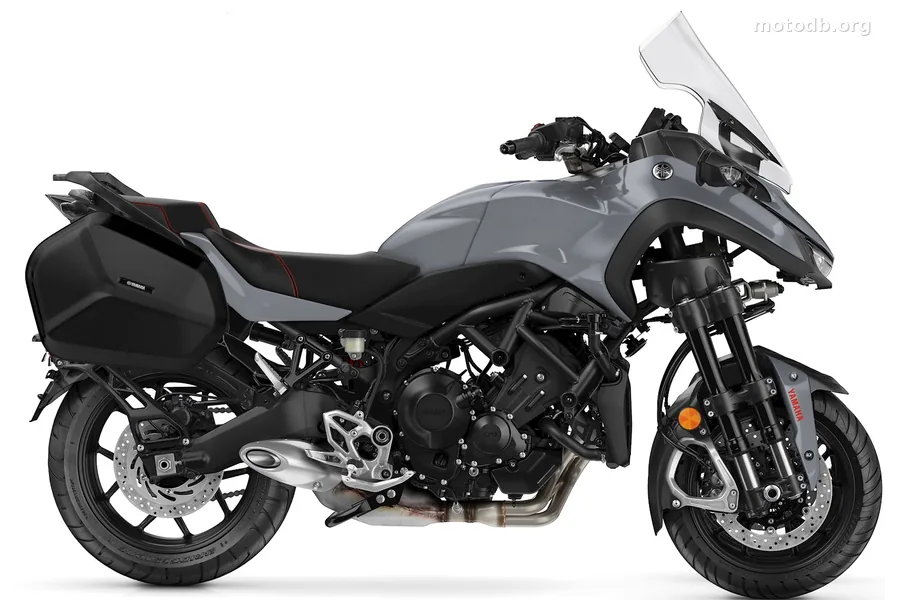
There are still some Niken models in stock. This is an opportunity to discover one of the most surprising machines that Iwata has ever designed. After a fanfare start and some sales to motorcyclists curious about a three-wheeled bike capable of leaning into corners, the Niken continues its discreet career. To boost interest from customers, Yamaha is now targeting a touring rather than sporty audience with a few modifications to this three-wheeled motorcycle.
Do luggage cases change everything?
Yes, I would be tempted to say. With this equipment, the Niken is now targeting a more affluent customer base, less in a hurry and sensitive to safety. Consequently, the original front-end setup has become an argument, as Piaggio used it to reassure scooter users. However, with these 30-liter luggage cases, you’ll need to be mindful of the inter-file. In the same vein of improving travel comfort, Yamaha has enhanced the motorcycle with a redesigned seat for better support. The windscreen has also been modified and is now adjustable in height. Thanks to a handle on the right side of the windscreen, it can be raised by 7 cm.
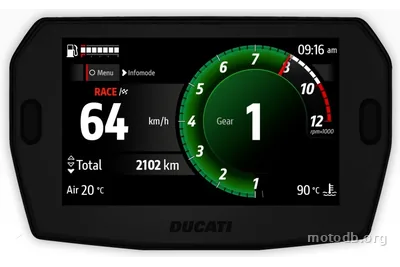
Behind the windscreen, the Niken follows the trend and adopts a TFT screen as a dashboard. Measuring 7 inches diagonally, in addition to basic functions (speed, fuel, etc.), the screen benefits from media functions (call management, messages, or music streaming). With a paid subscription, you can also benefit from Garmin navigation on the screen. You manage all these functions while riding using a joystick 5-axis control panel located on the left side of the handlebar. The screen display and animations are also customizable.
With this control, you can also manage the different driving modes from the screen, of which there are 4. Yamaha has predefined settings: Rain, Road, and Sport. The owner benefits from a Custom mode that allows you to adjust the motorcycle with the desired assistance and levels of intervention of the anti-wheelie, traction control, anti-wheeling, and ABS sensitivity.
The fairing houses a USB port, heated grips, or a cruise control system. Under the seat, there is also a 12 V socket.
A disarmed Niken
Those who have followed the news of this machine all remember journalists wheelieing it despite the imposing and heavy front end. The Niken had a powerplant… that was frightening to its passenger. In its new direction, Yamaha, with the new engine from the Tracer 9 GT+, has chosen to calm the Niken’s turbulent side. The three-cylinder engine gains displacement (890 cm3) for a power of 84.5 kW (114.9 hp) and 90.7 Nm of torque (at 7,000 rpm), obtained 1,500 rpm earlier than on the previous version, thanks to a heavier crankshaft. The goal is to round out the riding experience, making it smoother for use in duo and with luggage.
To assist the engine, the Niken has a quickshifter that serves both for upshifting and downshifting. Considering the additional weight of 40 kg compared to a Tracer GT+, the quickshifter is a plus if you need to frequently use the gearbox for acceleration. The machine weighs a substantial 270 kg (always good to know when maneuvering the motorcycle at a standstill).
In the same quest for comfort, Yamaha has also revised the frame and suspension. The tubular steel chassis receives thinner sections and the shock absorber is mounted on new aluminum linkages (steel on the previous version) for accentuated progressivity, thanks to a new shock absorber spring as well.
The Niken still retains what defines its visual identity with the Ackermann Cantilever front end. This is a double inverted telescopic fork with a 110 mm stroke and allows a maximum lean angle of 45°.
Evolution of Darwin… logical
The defining characteristic of an animal species is to adapt to better evolve and resist. The Niken has chosen the same path. Despite all its originality and undeniable sporting capabilities, its technology struggled to convince traditional roadster enthusiasts. Evolving towards Grand Touring makes sense. The capabilities of its front end take on a certain logic. Remains to be seen whether enthusiasts of German touring bikes will be attracted by its originality. Offered now at almost 18,000 euros, the Niken is attempting its last bet to survive.
Vincent Beaucousin - Media constructeur
Standard equipment
- Assistance au freinage : ABS
- Nombre de mode de conduite : 3
- Volume de rangement : 60 litres
- Taille de l'écran TFT couleur : 17,78 cm / 7 pouces
- Pare brise réglable
- Prise USB
- Contrôle de traction
- Valises
- Régulateur de vitesse
- Jantes aluminium
- Béquille centrale
- Poignées chauffantes
- Embrayage anti-dribble
- Shifter
Practical info
- La moto est accessible aux permis : A
Reviews & comments
No reviews yet. Be the first to share your opinion!