Key performance
Technical specifications
Engine
- Displacement
- 998 cc
- Power
- 165.9 ch @ 11500 tr/min (122.0 kW)
- Torque
- 112.0 Nm @ 9000 tr/min
- Engine type
- In-line four, four-stroke
- Cooling
- Liquid
- Compression ratio
- 12.0:1
- Bore × stroke
- 79.0 x 50.9 mm (3.1 x 2.0 inches)
- Valves/cylinder
- 4
- Camshafts
- 2 ACT
- Fuel system
- Injection. 12-hole fuel injectors
- Valve timing
- Double Overhead Cams/Twin Cam (DOHC)
- Lubrication
- Wet sump
- Ignition
- TCI
- Starter
- Electric
Chassis
- Frame
- Diamond
- Gearbox
- 6-speed
- Final drive
- Chain (final drive)
- Clutch
- Multiplate assist and slipper clutch
- Front suspension
- 43mm KYB® inverted fork, fully adjustable
- Rear suspension
- KYB® piggyback shock, fully adjustable
- Front wheel travel
- 119 mm (4.7 inches)
- Rear wheel travel
- 119 mm (4.7 inches)
Brakes
- Front brakes
- Double disc. ABS. Hydraulic. 4-piston.
- Rear brakes
- Single disc. ABS. Hydraulic.
- Front tyre
- 120/70-ZR17
- Front tyre pressure
- 2.50 bar
- Rear tyre
- 190/55-ZR17
- Rear tyre pressure
- 2.90 bar
Dimensions
- Seat height
- 835.00 mm
- Wheelbase
- 1405.00 mm
- Ground clearance
- 135.00 mm
- Length
- 2100.00 mm
- Width
- 800.00 mm
- Height
- 1165.00 mm
- Fuel capacity
- 17.00 L
- Weight
- 212.00 kg
- New price
- 15 599 €
Overview
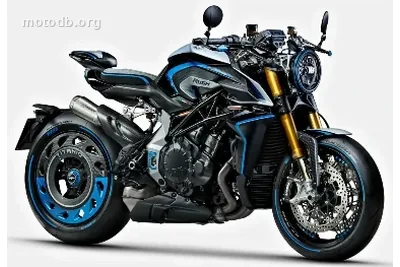
This "Ice Storm" color MT-10 is as frigid as the information associated with this new model year: the powerful roadster will no longer be sold in Europe in 2025. Yamaha is not providing it with Euro5+ compliance. A choice that does not affect other regions, such as the USA or Australia. Deprived of this "stripped-down R1," Yam no longer has a mean big roadster to offer to thrill-seekers. A delicate situation, right when Honda arrives with its 1000 Hornet with very aggressive commercial aspirations. Let's hope the hiatus is short and that a demonic machine resurfaces in 2016 from Iwata.
Yamaha breathed fire onto the R1 to create the MT-10. A mean roadster, fun to ride, with a particular (almost ungrateful) physique and a mesmerizing engine. Half a decade has passed, allowing the competition to strengthen. As the MT range is booming, the largest Hypernaked from the manufacturer is getting a makeover.
As expected, the MT-10 takes its face from the trend of the MT-09 and MT-07. However, with something less robotic, more animal, more bio-mechanical. Shapes forgetting the guttural roughness of the first version without sacrificing a moment of menace. Its large light eyelids overlook the customary R1 headlights, with the unsettling calm of a viper. Once again, the design approach is daring… perhaps less difficult than usual.
The current drawing has hastened to erase some parts, which few will regret. The Lego Technic radiator cowls, the slices of fairing, the appendages of the rear frame have either disappeared or profoundly modified their appearance to be forgotten. The air intake louvers and the tank are also reworked for greater homogeneity. But rest assured, the MT-10 still has Stephen King in its veins, especially in its Cyan Storm color.
Since 2016 and for quite some time, this big roadster is the only one with a 4-cylinder cross-plane crankshaft engine. Hence a characteristic sound and distribution of torque. Thank you R1. The work has been done to give it Euro5 compliance, a little extra torque (0.1 mkg) and a few extra horsepower. From 160, the 998 cm3 block spits out 165.9 hp; still at 11500 rpm. This increase in power, combined with reinforced torque between 4000 and 8000 rpm, will give this machine even more responsiveness. A new intake structure and a new design for the titanium exhaust line take care of the soundtrack, more pronounced to better feel the gruff breath of the engine.
Yam thought that its big streetfighter should show a little more civility. It was therefore provided with a more comfortable seat, an improved riding position and knee-bent handlebars. Its braking should gain in quality with the adoption of a Brembo radial master cylinder, with a separate sport reservoir. Its cycle part changes little, promising some very good riding moments. The wheelbase has increased by 5 mm but remains as compact as 1405 mm. It's barely more than that of an MT-07. The suspensions benefit from new settings, the tire mount evolves in Bridge' S22 and the entire frame retains the attributes of the old MT-10. An aluminum perimeter frame, closely derived from the hypersport, with a 43 mm fully adjustable inverted fork, an amorto of the same origin and just as adjustable, 320 mm front brake discs with four-piston radial calipers, a 220 mm rear disc controlled by a single piston, and a quasi Superbike aluminum swingarm.
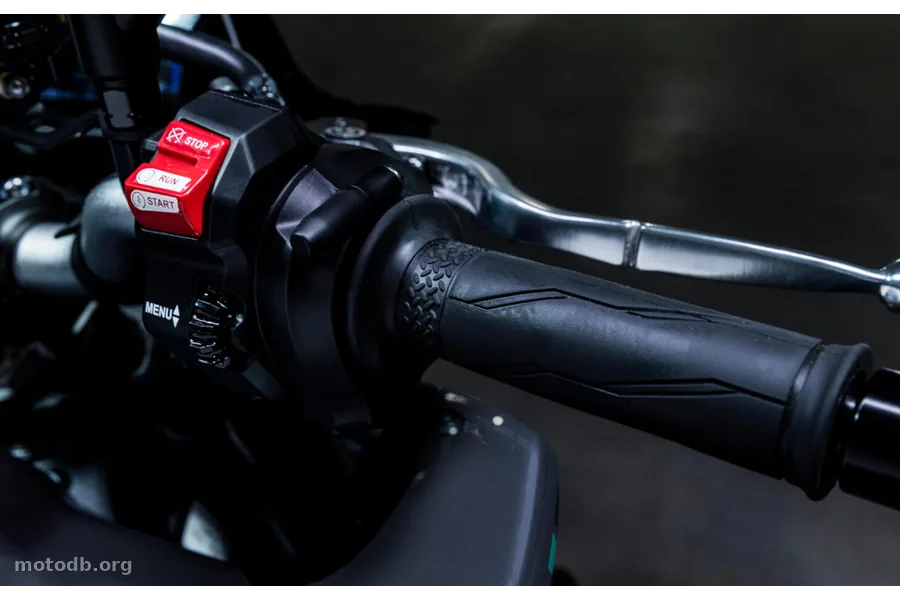
Looking at the dashboard, one can easily guess that Yamaha has forced the dose in electronics. There are many on the R1, so let's borrow as many as possible. The MT-10 was equipped with an LCD screen, three Riding Modes, a cruise control, a quickshifter, traction control at 3 levels and standard ABS. The double-thickness sandwich with even more ingredients. The dashboard switches to color and TFT, like the MT-10 SP – the 4.2-inch (10.6 cm) screen size. A little small considering what is done today (a Z 650 already offers a few mm more), when the competition generally lines up 5 inches. Then comes a speed limiter, a 4-mode throttle (PWR), the installation of a 6-axis IMU to give more precision to the assists, angle-sensitive traction control, slide control SCS, 2-level engine braking management, wheelie control, a 2-level electronic brake distribution (standard / cornering ABS) and a Yamaha Riding Control (YRC) corresponding to 4 Riding Modes.
The Yamaha MT-10 is seriously evolving, with more power, more electronics and styling on the border between menace and alienation. An R1 in roadster form is worth the detour. The most formidable of the Masters of Torque is relaunching in the segment, in pursuit of the Speed Triple 1200 RS, Tuono V4 and S 1000 R.
M.B - Photo manufacturer
* Four-mode throttle APSG (PWR): PWR-1 is adapted to track-muscled riding. PWR-2 and PWR-3 offer a smoother throttle response that allows the rider to enjoy the linear torque of the motorcycle. PWR-4 offers a measured response, particularly useful when the surface is wet or slippery.
**Yamaha Riding Control (YRC):** All riding assistance electronics can be adjusted independently. To supervise them, Yamaha Riding Control (YRC) offers the MT-10 rider the ability to create a system including the settings of the TCS (anti-slip), the SCS (slide control), the QSS (quickshifter), the LIF (wheelie control), the EBM (engine braking management) and the BC (brake control) systems all at once. YRC is available in four different modes, to adapt to every riding condition.
Mode A corresponds to sporty riding, mode B is suitable for versatile use, mode C adapts to urban use, while mode D adapts to unfavorable situations, such as rain. The four YRC modes have predefined values, but the MT-10 rider can choose to reset the parameters according to their preferences.
Standard equipment
- Assistance au freinage : ABS
- Nombre de mode de conduite : 4
- Taille de l'écran TFT couleur : 10,67 cm / 4.2 pouces
- Jantes aluminium
- Shifter
- Indicateur de vitesse engagée
- Régulateur de vitesse
- Contrôle de traction
- Contrôle anti wheeling
- Contrôle de glisse
- Embrayage anti-dribble
- Contrôle du frein moteur
Practical info
- La moto est accessible aux permis : A
Reviews & comments
No reviews yet. Be the first to share your opinion!