Key performance
Technical specifications
Engine
- Displacement
- 124 cc
- Power
- 15.0 ch @ 8000 tr/min (11.0 kW)
- Torque
- 12.7 Nm @ 8000 tr/min
- Engine type
- Monocylindre, 2 temps
- Cooling
- liquide
- Compression ratio
- 6.7 : 1
- Bore × stroke
- 56 x 50.7 mm
Chassis
- Frame
- Double berceau tubulaire en acier
- Gearbox
- boîte à 6 rapports
- Final drive
- Chaîne
- Front suspension
- Fourche téléhydraulique Ø nc, déb : 270 mm
- Rear suspension
- Mono-amortisseur, déb : 260 mm
Brakes
- Front brakes
- Freinage 1 disque Ø 230 mm, étrier 2 pistons
- Rear brakes
- Freinage 1 disque Ø 220 mm, étrier simple piston
- Front tyre
- 80/90-21
- Front tyre pressure
- 1.25 bar
- Rear tyre
- 110/80-18
- Rear tyre pressure
- 1.50 bar
Dimensions
- Seat height
- 900.00 mm
- Fuel capacity
- 10.70 L
- Weight
- 116.00 kg
- Dry weight
- 109.00 kg
- New price
- 3 915 €
Overview
Stéphane Everts is a legend who needs no introduction in the world of motocross. Seven world titles, three different categories, four crowned Japanese manufacturers: the Belgian won everything, everywhere, with everyone. So when Yamaha clinched the 2004 MXGP in 450cc with him at the controls of the YZF, the Iwata manufacturer decided to mark the occasion in a very particular way, by dressing its little DTR 125 in the colors of the factory machine.
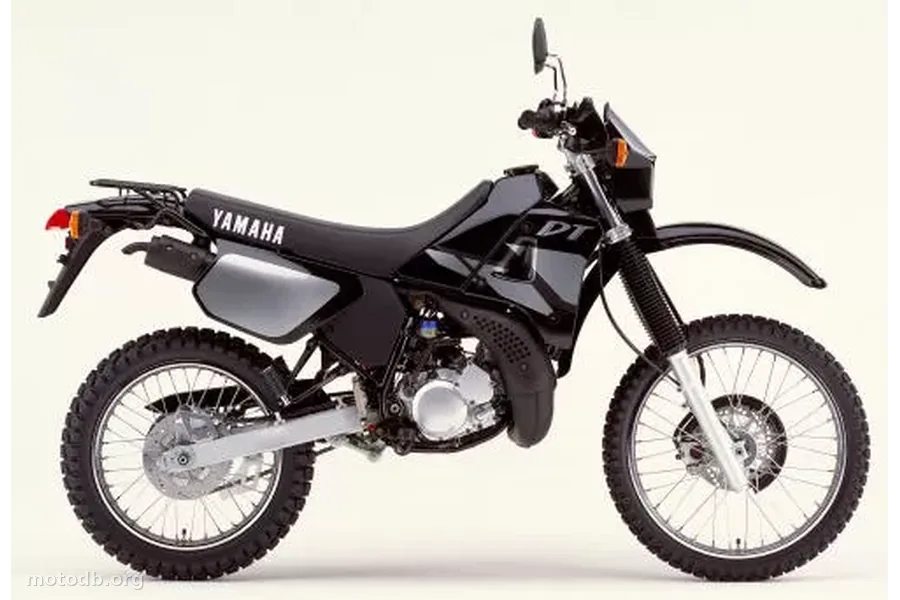
The visual result is striking. Those bold yellow and blue hues, directly mirrored from the 450 competition bike, radically transform the image of this two-stroke 125 that everyone knows. The mechanics, however, don't change one iota: a 124cc two-stroke single-cylinder, 56mm bore by 50.7mm stroke, a compression ratio of 6.7:1, and 15 horsepower delivered at 8,000 rpm. That's modest on paper, but on a machine weighing just 109 kg dry, this little engine with its characteristic smell knows how to be lively and communicative. The 6-speed gearbox does the rest, with a chain transmitting everything to the 110/80-18 rear and 80/90-21 front tires — dimensions that clearly betray the DTR's off-road origins.
The seat perched at 900mm isn't for everyone, and shorter riders will have to make peace with that height, which can catch you off guard at the first stop. The suspension, on the other hand, is serious business for a machine in this class: a telehydraulic fork with 270mm of travel and a rear monoshock that swallows 260mm. Braking is handled by two discs — 230mm up front with a twin-piston caliper, 220mm at the rear with a single piston. The claimed top speed of 135 km/h gives a clear sense of the intended use, firmly oriented toward trails and back roads rather than the highway. The 10.7-liter tank provides decent range for this type of riding.
At €3,915 in 2005, this Everts Replica version costs the same as a standard DTR, with a livery that's well worth the symbolic difference. It's not a competition machine — nobody will be surprised — but that's precisely where its charm lies. It speaks to young A1 license holders who dream of wide open spaces, to two-stroke nostalgists, to weekend adventurers who want a simple-to-maintain motorcycle that's enjoyable to ride across all terrain. Up against a Honda XR 125 or a Suzuki DR 125, the DTR plays the character card and its sporting heritage rather than sensible versatility. With that Everts badge on the bodywork, it carries something greater than its 124cc, and no spec sheet can ever truly quantify that.
Practical info
- La moto est accessible aux permis : A
Reviews & comments
No reviews yet. Be the first to share your opinion!