Key performance
Technical specifications
Engine
- Displacement
- 660 cc
- Power
- 95.0 ch @ 11250 tr/min (69.9 kW)
- Torque
- 68.0 Nm @ 8250 tr/min
- Cooling
- liquide
- Compression ratio
- 12 : 1
- Bore × stroke
- 74 x 51.1 mm
- Valves/cylinder
- 4
- Camshafts
- 2 ACT
- Fuel system
- Injection
- Starter
- électrique
- Euro standard
- Euro 5+
Chassis
- Frame
- Structure en tubes d'acier
- Gearbox
- boîte à 6 rapports
- Final drive
- Chaîne
- Front suspension
- Fourche téléhydraulique inversée Ø 41 mm, déb : 120 mm
- Rear suspension
- Mono-amortisseur, déb : 130 mm
Brakes
- Front brakes
- Freinage 2 disques Nissin Ø 310 mm, étrier 2 pistons
- Rear brakes
- Freinage 1 disque Ø 255 mm, étrier simple piston
- Front tyre
- 120/70-17
- Front tyre pressure
- 2.30 bar
- Rear tyre
- 180/55-17
- Rear tyre pressure
- 2.90 bar
Dimensions
- Seat height
- 810.00 mm
- Seat type
- Selle biplaces
- Fuel capacity
- 14.00 L
- Weight
- 195.00 kg
- New price
- 8 695 €
Overview
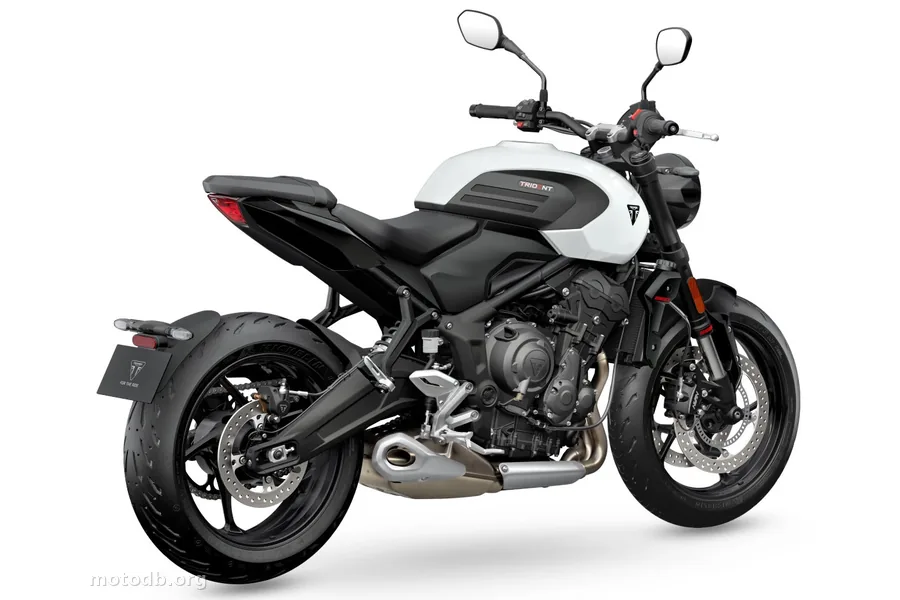
Following last year’s equipment upgrades, Triumph is adding power to its Trident 660. And quite a bit. Enough to allow it to challenge the 750 Hornet and outperform most competitors in the segment. Has the three-cylinder engine been enlivened? Let's say it's excited, like a post-adolescent in search of adrenaline.
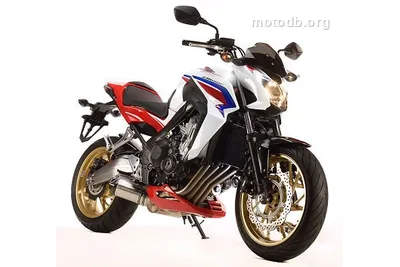
At that age, you want to change your clothes. With moderation for the Trident. Let's say it's a discreet refresh, with a redesigned fuel tank, a padded headlight, reworked leg fairings, and, most visibly, a seat that splits into two tiers with a more taut design. In short, a retouching while preserving much of its identity.
95 horsepower at 11,250 rpm! An impressive power increase: 14 more horsepower in this displacement is furious. Triumph justifies this progression with new engine settings, 3 throttle bodies instead of one, larger exhaust valves, more aggressive camshafts, a larger airbox, improved cooling, and a new calibration for better throttle response. Revitalized, the Trident's engine now develops the same torque as the Daytona; and at the same RPM. It’s therefore not really the Trident’s mechanics that have been boosted; it’s more of a transplant. Torque has also progressed, with 4 Nm more. 80% of the 68 Nm are available from 3,000 to 12,000 rpm, and the peak is reached at 8,250 rpm. But these beautiful figures hide a desire for hysteria: the maximum values of these forces are reached much higher in the rev range than before. The 660 Trident has gained 20% of RPM before reaching the redline. That’s where it will seek its extra horsepower.
Hinckley didn't just focus on exciting the engine. Its engineers also reworked the exhaust manifold and catalytic converter, revised the gearbox, optimized the quickshifter, softened the slipper clutch to further reduce lever effort, and installed a new Showa damper with rebound adjustment as a bonus.
The manufacturer didn't go any further to preserve the balance established by its roadster. The Trident retains its tubular steel frame to which a 41mm Showa upside-down fork with large pistons is attached. The braking system doesn't change either, its 310mm discs being gripped by 2-piston Nissin calipers – let's specify the presence of braided brake hoses; some hypersports still don’t have them…
The bike has gained 5 kg in the process. It remains under 200 units (195 precisely), but it is slowly becoming one of the heaviest in the category. It can dismiss this "appreciation" by pointing out that it is the most powerful and presenting a comfortable electronic equipment:
95 horsepower today! This value seemed to be the privilege of 600 4-cylinder roadsters for dynasties. The 660 Trident seizes it and raises the stakes in this segment. The best part is that all its improvements are a bonus: the price of the machine doesn't change. Although it has much more torque, it is still possible to restrict it to A2. It’s not for nothing that it develops twice 35 kW.
M.B. - Photos manufacturer
Standard equipment
- Assistance au freinage : ABS
- Nombre de mode de conduite : 3
- ABS Cornering
- Jantes aluminium
- Shifter
- Indicateur de vitesse engagée
- Régulateur de vitesse
- Bluetooth
- Contrôle de traction
- Embrayage anti-dribble
Practical info
- Véhicule accessible au permis A2 ou bridable à 47.5ch / 35 Kw
- La moto est accessible aux permis : A, A2
- Pays de fabrication : Thailande
Reviews & comments
No reviews yet. Be the first to share your opinion!