Key performance
Technical specifications
Engine
- Displacement
- 1130 cc
- Power
- 120.0 ch (87.6 kW)
- Torque
- 101.7 Nm
- Engine type
- V2, four-stroke
- Cooling
- Liquid
- Compression ratio
- 11.3:1
- Bore × stroke
- 100.0 x 72.0 mm (3.9 x 2.8 inches)
- Valve timing
- Double Overhead Cams/Twin Cam (DOHC)
- Starter
- Electric
Chassis
- Frame
- Steel/aluminum composite beam frame, 4130 steel/7075 aluminum.
- Gearbox
- 5-speed
- Clutch
- Wet, multi-plate, hydraulic actuation
- Front suspension
- Ohlins 43mm fully adjustable upside-down fork with TiN
- Rear suspension
- Ohlins fully adjustable linkless monoshock
Brakes
- Front brakes
- Double disc. semi-floating discs, radially mounted Brembo monobloc 4 piston Brembo caliper.
- Rear brakes
- Single disc. 2 piston Brembo caliper.
- Front tyre
- 120/70-ZR17
- Rear tyre
- 190/55-ZR17
Dimensions
- Seat height
- 800.00 mm
- Wheelbase
- 1422.00 mm
- Fuel capacity
- 14.38 L
- Dry weight
- 193.00 kg
Overview
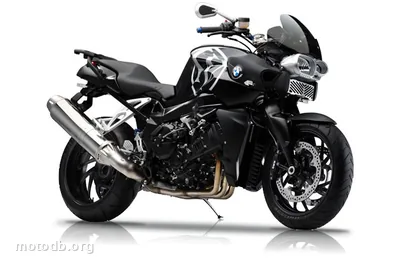
During the period when Japanese and Italian manufacturers were engaged in a relentless war over hypersportives, a small American workshop attempted to play with the big boys with a bold gamble. The 2008 Roehr 1130 Superbike didn't simply incorporate a production engine; it was built around the 1130 cc V2 from the Moto Guzzi 1200 Sport, a rather atypical powerplant in a category dominated by inline four-cylinder engines. The basic idea was clear: to offer a unique character, with monstrous torque and a deep sound, all packaged in a chassis worthy of a race machine.
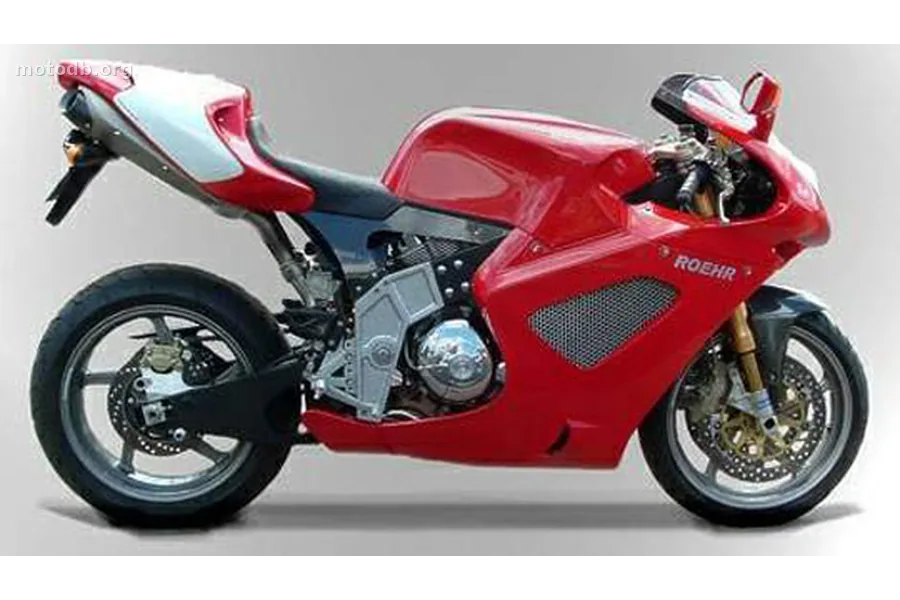
The heart of the beast is this 90° liquid-cooled V2, with its 100 mm bore and a 72 mm stroke for a displacement of 1130 cc. Announced with 120 horsepower and over 101 Nm of torque, this engine promised a surge from low RPM, a philosophy opposite the stratospheric rev ranges of the Honda CBR1000RR or Suzuki GSX-R1000 of the time. The composite frame made of 4130 steel and 7075 aluminum, with a claimed exceptional rigidity, was designed to channel this raw power. A wheelbase of 1422 mm suggested certain stability, perhaps at the expense of agility in tight turns.
Where Roehr clearly put in the effort was in the equipment. A fully adjustable 43 mm Öhlins inverted fork, with TiN treatment on the tubes, and a fully adjustable Öhlins monoshock raised the standard. Braking was entrusted to Brembo, with four-piston monoblock calipers at the front and semi-floating discs. The tires, in 120 at the front and 190 at the rear in ZR17, were cut for pure performance. With a dry weight of 193 kg and a 14.4-liter tank, the Roehr 1130 positioned itself as a heavy but well-equipped sportbike, an exercise in power rather than finesse.
This machine was primarily an object for discerning collectors and riders seeking a radically different experience. Its longitudinal V2 was designed to generate particular gyroscopic effects, and its shaft drive promised certain robustness. Faced with the refinement of Japanese machines, the Roehr embraced a raw, mechanical character, almost archaic in principle but modern in execution. It did not target the track rider seeking the lap time, but the aesthete in search of mechanical singularity. In the motorcycle landscape, it remains a fascinating curiosity, a reminder that performance can sometimes take unconventional paths.
Reviews & comments
No reviews yet. Be the first to share your opinion!