Key performance
Technical specifications
Engine
- Displacement
- 998 cc
- Power
- 201.0 ch @ 13400 tr/min (147.8 kW)
- Torque
- 111.8 Nm @ 9200 tr/min
- Engine type
- 4 cylindres en ligne, 4 temps
- Cooling
- liquide
- Compression ratio
- 13.4 : 1
- Bore × stroke
- 79 x 50.9 mm
- Valves/cylinder
- 4
- Camshafts
- 2 ACT
- Fuel system
- Injection Ø 49 mm
Chassis
- Frame
- Treillis en tubes d'acier au chrome molybdène
- Gearbox
- boîte à 6 rapports
- Final drive
- Chaîne
- Front suspension
- Fourche téléhydraulique inversée Öhlins Ø 43 mm, déb : 120 mm
- Rear suspension
- Mono-amortisseur Öhlins TTX36, déb : 120 mm
Brakes
- Front brakes
- Freinage 2 disques Brembo Ø 320 mm, fixation radiale, étrier 4 pistons
- Rear brakes
- Freinage 1 disque Ø 210 mm, étrier 4 pistons
- Front tyre
- 120/70-17
- Rear tyre
- 190/55-17
Dimensions
- Seat height
- 830.00 mm
- Fuel capacity
- 17.00 L
- Dry weight
- 192.00 kg
Overview
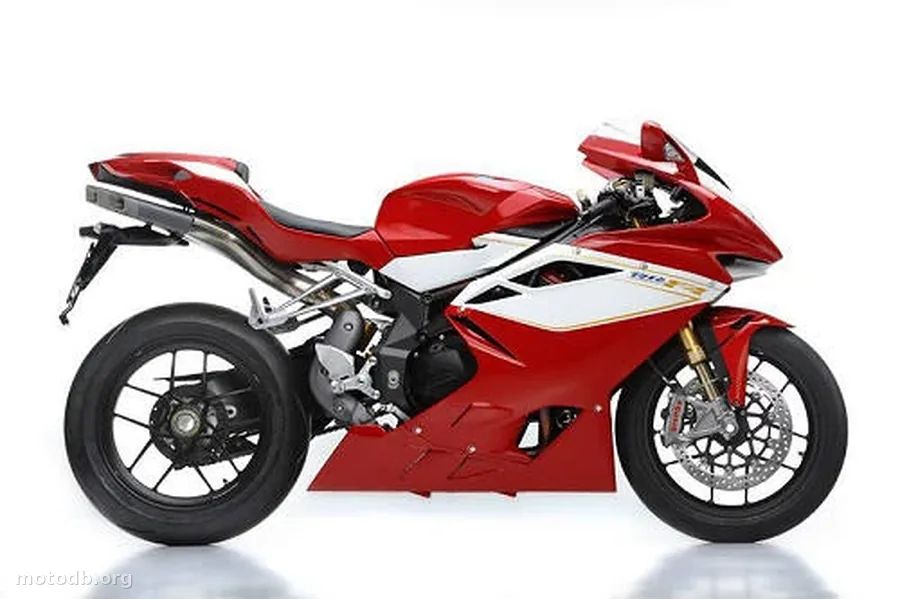
Who still remembers the era when an Italian sportbike could make the straights of Mugello tremble while making the sculptures in Milan's Design Museum jealous? In 2011, MV Agusta answered that question with the F4 1000 RR CorsaCorta, a machine born from an obsession: breaking the 200-horsepower barrier without exceeding one liter of displacement. The name says it all. Corsa Corta, short stroke. Behind those two words lies a thorough redesign of the in-house inline four-cylinder, with bore increased to 79 mm and stroke reduced to 50.9 mm. These ultra-oversquare dimensions allow the engine to climb for its power very high up, at exactly 13,400 rpm, where all 201 hp are unleashed in one burst. The redline? It sits at 13,700 rpm. We're in homologated Superbike territory, pure and simple.
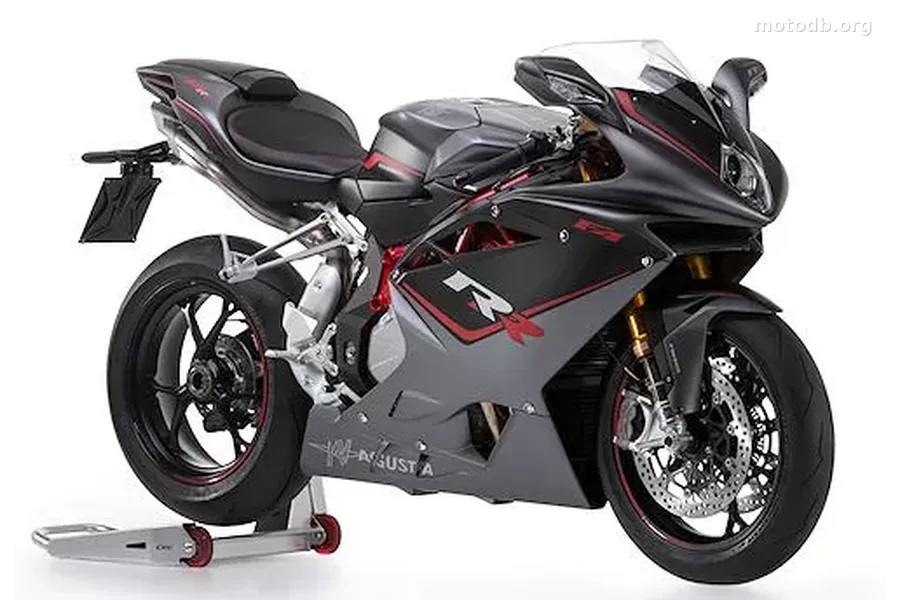
To reach this power level from 998 cc, the engineers in Varese overhauled the entire internal architecture. The valves, now titanium, gain in diameter: 31.6 mm on the intake side, 26 mm on the exhaust. The injection grows to 49 mm, the intake trumpets adopt variable height, and the headers widen to let the engine breathe without restriction. The compression ratio climbs to 13.4:1. The result is 111.8 Nm of torque at 9,200 rpm and a lower mean piston speed compared to the previous F4 1000. In other words, more power and mechanicals that are theoretically under less stress. The electronic management offers two engine maps and an eight-level adjustable traction control, so that every corner exit doesn't turn into a rodeo exercise. The six-speed cassette gearbox, paired with a slipper clutch, confirms the track-oriented vocation of the whole package.
On the chassis side, MV Agusta retains the chrome-molybdenum steel trellis frame from the F4, but dresses it with the finest equipment available. The 43 mm Öhlins NIX inverted fork separates compression and rebound adjustments on each leg, a refinement typically found on race machines. The TTX36 rear shock, from the same Swedish manufacturer, offers compression, rebound, preload, and length adjustments. You can even modify the swingarm geometry and rear axle height using calibrated inserts. Braking is entrusted to Brembo with two 320 mm radially mounted discs and four-piston monoblock calipers. The forged aluminum wheels help keep the dry weight at 192 kg, a respectable figure for such a well-equipped machine. The 17-liter tank does, however, impose frequent stops if you're riding hard.
Against the Kawasaki ZX-10R, the BMW S 1000 RR, or the Aprilia RSV4 of the same era, the MV Agusta F4 1000 RR CorsaCorta plays in a league of its own. Where the Japanese and German bikes accompany you with reassuring electronics and ergonomics designed for the broadest audience, the Italian demands a seasoned rider, ready to deal with an uncompromising character. The riding position, with an 830 mm seat height, is track-oriented. Long-distance comfort is virtually nonexistent. The steering demands authority, the engine needs revs to deliver its full potential. This is not a docile motorcycle — it's a precision instrument that rewards those who take the time to tame it.
The CorsaCorta is aimed at enthusiasts who want to own a piece of Italian sporting history, not Sunday riders looking for a versatile road bike. Its natural habitat is the track, where its 298 km/h top speed and razor-sharp chassis come into their own. On the open road, it remains a rolling collector's piece, a mechanical sculpture capable of fearsome performance but constrained by an environment that is no longer made for it. That is perhaps its greatest quality: reminding us that a motorcycle can be both a work of art and a track weapon, without ever compromising between the two.
Practical info
- La moto est accessible aux permis : A
Reviews & comments
No reviews yet. Be the first to share your opinion!