Key performance
Technical specifications
Engine
- Displacement
- 998 cc
- Power
- 183.0 ch @ 12400 tr/min (134.6 kW)
- Torque
- 112.8 Nm @ 10000 tr/min
- Engine type
- 4 cylindres en ligne, 4 temps
- Cooling
- liquide
- Compression ratio
- 13:1
- Bore × stroke
- 76 x 55 mm
- Valves/cylinder
- 4
- Camshafts
- 2 ACT
- Fuel system
- Injection
Chassis
- Frame
- Treillis en tubes d'acier au chrome molybdène
- Gearbox
- boîte à 6 rapports
- Final drive
- Chaîne
- Front suspension
- Fourche téléhydraulique inversée Ø 50 mm, déb : 129 mm
- Rear suspension
- Suspension AR monoamortisseur, déb : 120 mm
Brakes
- Front brakes
- Freinage 2 disques Ø 320 mm, fixation radiale, étrier 4 pistons
- Rear brakes
- Freinage 1 disque Ø 210 mm, étrier 4 pistons
- Front tyre
- 120/70-17
- Rear tyre
- 190/55-17
Dimensions
- Seat height
- 810.00 mm
- Fuel capacity
- 21.00 L
- Dry weight
- 192.00 kg
- New price
- 21 990 €
Overview
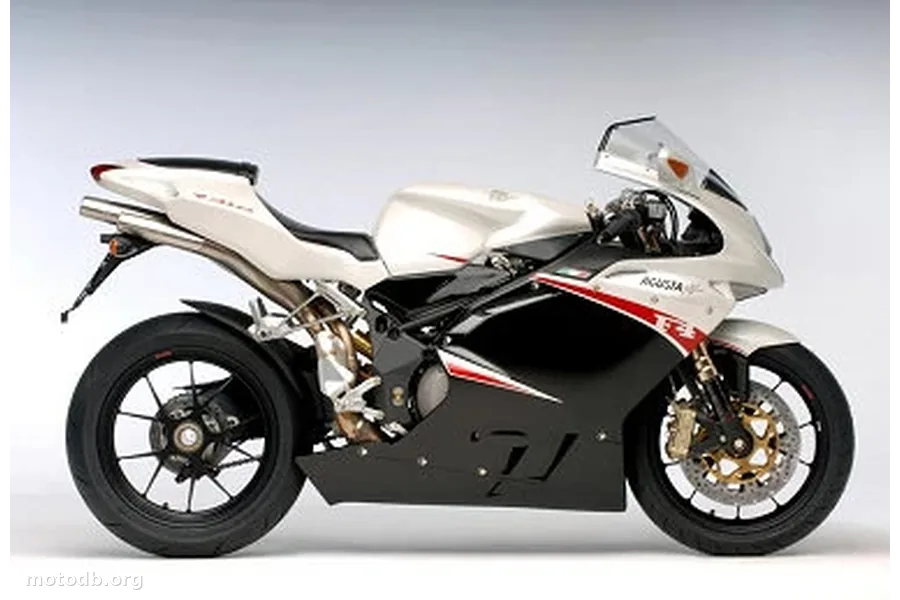
312 km/h. The figure appears on the spec sheet like a slap in the face to any notion of moderation. With the 2008 MV Agusta F4 1000 R 312, the Varese manufacturer isn't content with merely evolving its legendary sportbike. It lays claim, quite simply, to the title of fastest production motorcycle in the world. A direct declaration of war against Suzuki's Hayabusa, which had until then reigned supreme at the top of the speedometer.
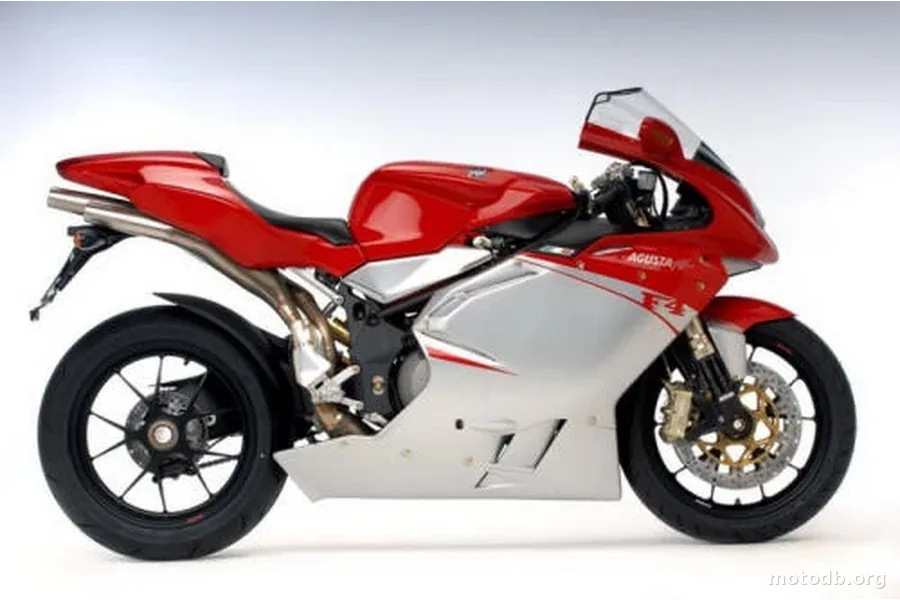
You have to understand the MV Agusta philosophy to grasp the logic behind this machine. Where Japanese manufacturers work on an assembly line, following an unwavering cycle of restylings and overhauls, the Italian firm prefers to cultivate its icon. Since its birth, the F4 1000 has spawned a whole string of versions, from the Senna to the Tamburini, from the Mamba to the CC. Each iteration refines the recipe without ever starting from scratch. The R 312 represents the pinnacle of this strategy: pushing the 998 cc inline four-cylinder to its absolute limits while preserving the DNA that makes lovers of fine Italian engineering weak at the knees.
Under the fairing, the engineers have seriously reworked the blueprint. The engine develops 183 horsepower at 12,400 rpm with 112.8 Nm of torque at 10,000 rpm. The gains come from meticulous work on the intake, with lengthened ports widened from 46 to 48 mm, reprofiled camshafts, and above all the adoption of titanium intake valves. The compression ratio climbs to 13:1, a clear sign this powerplant means business. The whole package is orchestrated by a latest-generation Magneti Marelli fuel injection system, and the machine passes Euro 3 emissions standards without breaking a sweat. For comparison, the CBR1000RR of the era topped out at 178 horsepower, and the ZX-10R hovered around 180. The MV Agusta F4 1000 R 312 therefore plays on the same field as the best Japanese contenders, but with a radically different temperament.
The chassis makes no compromises. The chrome-molybdenum steel trellis frame houses a 50 mm Marzocchi inverted fork with 129 mm of travel, while the rear relies on a Sachs monoshock with dual-rate compression offering 120 mm of travel. The radial braking system calls upon two 320 mm discs gripped by four-piston calipers, backed by a 210 mm rear disc. The Brembo forged aluminum wheels help keep the dry weight down to 192 kg, a remarkable figure for a machine of this power. The 21-liter tank allows decent range between fill-ups, though a rider wringing out all 183 horsepower constantly will need to plan frequent stops.
Then there's the question of price. At 21,990 euros in 2008, the R 312 positions itself well above the Japanese sportbikes of the time. That's the price of exclusivity, Italian prestige, and a level of fit and finish that its Japanese rivals simply cannot offer. The EBS traction control system rounds out an equipment package already very much track-oriented. This machine is clearly not aimed at the weekend rider. It targets the experienced pilot, the enthusiast craving raw sensations and track days, the one who wants to ride a work of art capable of flirting with 312 km/h. The seat at 810 mm won't do any favors for shorter riders, and long-distance comfort is obviously not on the agenda. But nobody buys an F4 to cross France on the motorway. You buy it for its mechanical breath, its timeless lines, and that wild promise engraved in its name: 312.
Practical info
- La moto est accessible aux permis : A
Reviews & comments
No reviews yet. Be the first to share your opinion!