Key performance
Technical specifications
Engine
- Displacement
- 998 cc
- Power
- 212.0 ch @ 13600 tr/min (155.9 kW)
- Torque
- 116.5 Nm @ 11000 tr/min
- Engine type
- 4 cylindres en ligne, 4 temps
- Cooling
- liquide
- Compression ratio
- 13.4 : 1
- Bore × stroke
- 79 x 50.9 mm
- Valves/cylinder
- 4
- Camshafts
- 2 ACT
- Fuel system
- Injection Ø 50 mm
- Starter
- électrique
- Euro standard
- Euro 5
Chassis
- Frame
- Treillis en tubes d'acier au chrome molybdène
- Gearbox
- boîte à 6 rapports
- Final drive
- Chaîne
- Front suspension
- Fourche téléhydraulique inversée Öhlins NIX EC Ø 43 mm, déb : 120 mm
- Rear suspension
- Mono-amortisseur Öhlins EC TTX, déb : 120 mm
Brakes
- Front brakes
- Freinage 2 disques Brembo Ø 320 mm, fixation radiale, étrier 4 pistons (monobloc Stylema)
- Rear brakes
- Freinage 1 disque Brembo Ø 220 mm, étrier 2 pistons
- Front tyre
- 120/70-17
- Rear tyre
- 200/55-17
Dimensions
- Seat height
- 845.00 mm
- Fuel capacity
- 16.00 L
- Dry weight
- 180.00 kg
- New price
- 45 599 €
Overview
Much like Bugatti, MV Agusta has made special series a significant part of its business model. It’s also one of the advantages of being a prestige brand: there’s nothing better than a limited edition to shine a spotlight on its image and excite the public.
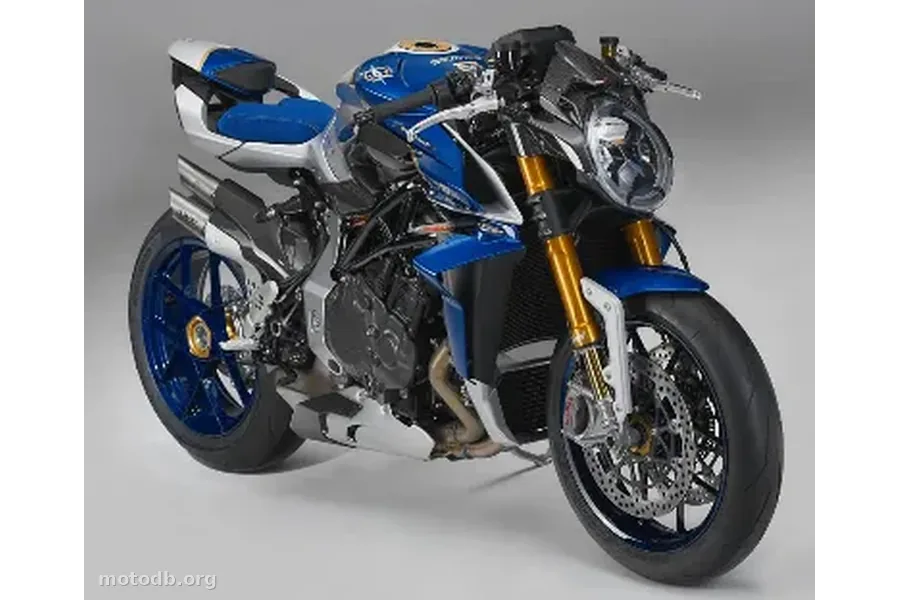
Hence, the Brutale 1000 RR Assen edition. The firm from Varese seems to have developed a passion for composing its models with prestigious circuits. In 2022, it was the Nürburgring variant. This time, it’s in honor of “the cathedral” that the blistering hyperfighter Italian makes its emblems tremble.
MV Agusta won 35 races there. It was during the brand’s golden age, when it won everything. That’s why a beautiful “35” is prominently displayed on the fuel tank. This is a change from the eternal “37” that most MV special series models display (its world champion palmares).
For this latest version, the Italian factory has chosen a patinaed clear coat with colorful accents. The alternation of azure blue and metallic gray expresses good taste, a sense of preciousness, and a sporty delicacy with fine gold stripes on the fuel tank and side fairings. At the bottom of the tank, a representation of the circuit and its nickname – Cathedral of speed – identifies the partnership that MV Agusta has signed with the iconic venue. For once, the serial number is not on the fork stem but on the plate joining the fuel tank and the seat; here in superb yellow-stitched blue Alcantara.
This Brutale is natively an RR. Therefore, the model with semi-active Öhlins suspension. With such ground connections, the roadster knows it can offer handling worthy of its badge. Then, the road can go very, very fast with the engine nestled in the steel trellis frame / aluminum plates. Its 4-cylinder produces 208 horsepower to the rear, accompanied by 11.9 mkg of torque. A sick amount of power, ready to imitate an aircraft carrier catapult.
As with all MVs, the electronics are strong onboard. The large Brutale highlights its 4 Riding Modes, traction control, an inertial measurement unit, a 4th generation shifter, wheelie control, cornering ABS, a 5.5-inch color TFT dashboard with GPS module, cruise control, the Mobisat geolocation system, and Launch Control. Let this not obscure essential components such as the beautiful and very effective Brembo Stylema calipers commanded by a PS13 master cylinder, this magnificent NIX 30 fork, Pirelli Diablo Supercorsa SP V3 tires (track tire adapted for the road), or refined elements such as the swingarm pivot adjustment, the adjustable footrest plates, the monobras, or the stunning rear of this fiery machine.
The Nurburgring Brutale featured color-matched BST carbon wheels. For the Assen version, MV Agusta preferred Rotobox rims, still in carbon but with very fine spokes and entirely blue. Other parts are also made from this high-end material: the airbox cover, the headlight “cap,” the engine covers, the exhaust heat shields and the silencing chamber, the side panels and those of the fuel tank, and a few other elements.
The Brutale Assen is sold with a “Special Parts Kit.” A large box in which the 300 future owners will find what to make their machine more sporty: CNC-machined levers and a fuel cap, a carbon seat cover, and Titanium Arrow exhausts with the racing ECU. Enough to bring it to 212 horsepower at 13,600 rpm and make it lose 3 kilos.
The Assen circuit has hosted the Dutch Grand Prix since 1949. That’s to say it has seen many champions. The first in 500 was Nello Pagani, on Gilera, and the most recent was Francesco Bagnaia on Ducati. Among the most notable drivers, one can cite Mike Hailwood, winner of the 250, 350 and 500 categories on the same day in 1967. Jim Redman did the same in 1964 in 125, 250 and 350. The majority of races were won by English, Italian and Spanish drivers but a few other nations managed to hoist their flag: Brazil once with Alex Barros, Austria with Gerd Kafka, Canada with Michael Duff, Hungary with Gábor Talmácsi, Finland with Mika Kallio. France has only managed to win three times: Jean-François Baldé in 1982 (350 cm3) -Johann Zarco in 2015 (Moto2) andFabio Quartararo in 2021 (MotoGP). Giacomo Agostini remains the record holder for victories, with 14 Assen GPs to his credit.
M.B - Photos constructeur
Standard equipment
- Assistance au freinage : ABS MK100
- Nombre de mode de conduite : 4
- Taille de l'écran TFT couleur : 13,97 cm / 5.5 pouces
- ABS Cornering
- Jantes Carbone
- Shifter
- Amortisseur de direction
- Indicateur de vitesse engagée
- Régulateur de vitesse
- Bluetooth
- GPS
- Aide au démarrage
- Contrôle de traction
- Suspensions réglables électroniquement
- Contrôle anti wheeling
- Centrale inertielle
Practical info
- La moto est accessible aux permis : A
Indicators & positioning
Similar bikes
CB 1000 R Stardust Swiss Limited Edition
CB 1000 R+ Limited Edition
Reviews & comments
No reviews yet. Be the first to share your opinion!