Key performance
Technical specifications
Engine
- Displacement
- 625 cc
- Power
- 55.0 ch @ 7000 tr/min (40.5 kW)
- Torque
- 56.9 Nm @ 5500 tr/min
- Engine type
- Monocylindre, 4 temps
- Cooling
- liquide
- Compression ratio
- 11.5 : 1
- Bore × stroke
- 101 x 78 mm
- Valves/cylinder
- 4
- Camshafts
- 1 ACT
Chassis
- Frame
- simple berceau dédoublé en acier
- Gearbox
- boîte à 5 rapports
- Final drive
- Chaîne
- Front suspension
- Fourche téléhydraulique inversée WP Ø 48 mm, déb : 275 mm
- Rear suspension
- Mono-amortisseur WP, déb : 300 mm
Brakes
- Front brakes
- Freinage 1 disque Ø 300 mm, étrier 4 pistons
- Rear brakes
- Freinage 1 disque Ø 220 mm, étrier simple piston
- Front tyre
- 90/90-21
- Rear tyre
- 140/80-18
Dimensions
- Seat height
- 945.00 mm
- Fuel capacity
- 28.00 L
- Dry weight
- 154.00 kg
- New price
- 8 719 €
Overview
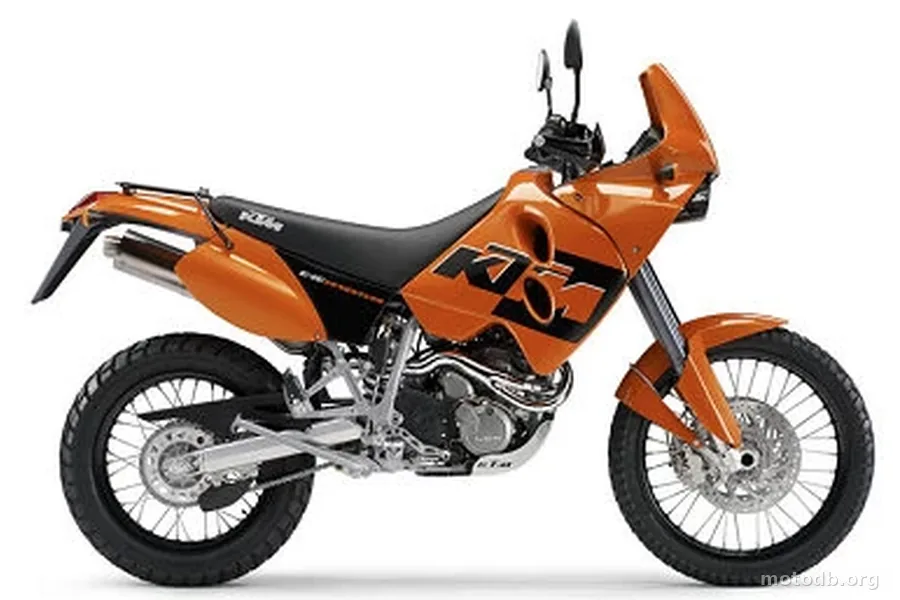
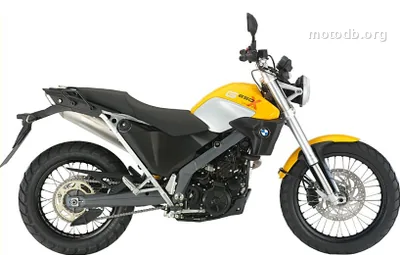
Who, in 2006, could boast of offering a dual-sport capable of linking Paris to Dakar without flinching, at a dry weight of just 154 kg? KTM, obviously. With the LC4-E 640 Adventure, the Austrian manufacturer translated its expertise forged in the Mauritanian sand into an accessible machine, built to swallow the most unforgiving trails. The concept is crystal clear: a big 625 cc single, a generous 28-liter tank, WP suspension with travel worthy of a rally-raid machine, and the bare minimum to keep the whole package light. On paper, it's a simple recipe. On the trail, it's devastatingly effective.
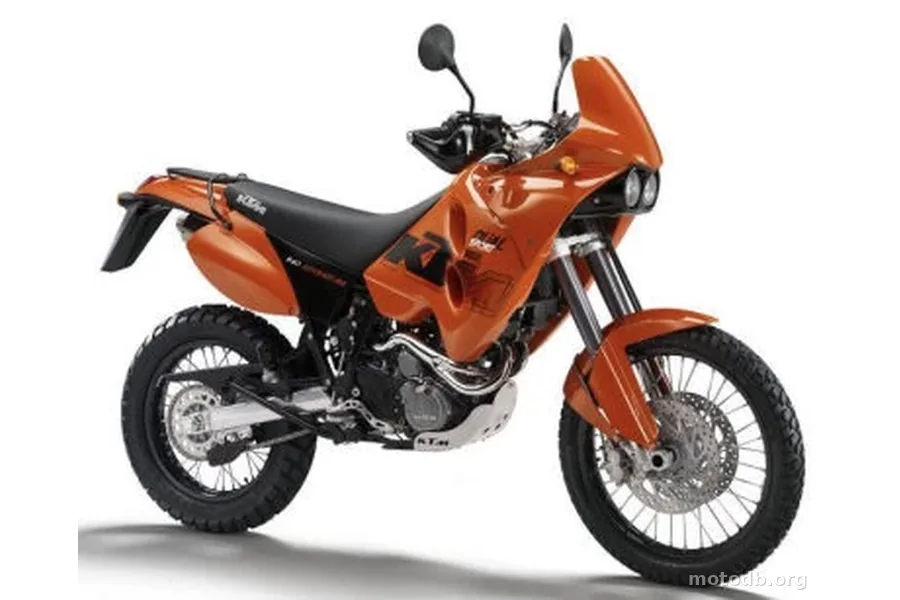
The four-stroke single-cylinder develops 55 horsepower at 7,000 rpm and 56.9 Nm of torque from just 5,500 rpm. On a spec sheet, that's hardly a dream matchup against the twins in the category. But some perspective is needed: this engine, with its generous 101 mm bore and short 78 mm stroke, delivers its power with a directness that more sophisticated motors sometimes struggle to replicate. The power-to-weight ratio is excellent, and the well-spaced five-speed gearbox is more than sufficient for a machine whose primary calling isn't the motorway. The top speed of 165 km/h confirms that the 640 Adventure never claimed to play in GT territory.
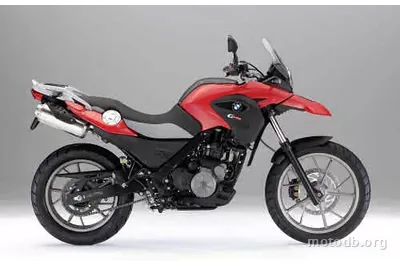
On the chassis side, KTM spared no expense. The 48 mm WP inverted fork offers 275 mm of travel up front, while the rear monoshock, also WP-sourced, climbs to 300 mm. These figures place the machine in a league of its own, well above what a BMW F 650 GS Dakar of the same era offered. The steel frame, a split single cradle design, absorbs off-road stresses without complaint. The 21-inch front and 18-inch rear rims, fitted with 90/90 and 140/80 tires respectively, allow knobby tires to be mounted without compromise. Braking, handled by a 300 mm disc clamped by a four-piston caliper up front, proves adequate given the machine's contained weight.
The riding position immediately betrays the beast's intentions. With a seat perched at 945 mm, shorter riders will need to step aside or invest in a lowering kit. Standing on the footpegs, however, the ergonomics are a genuine delight. The fairing provides effective protection from wind and debris, the seat remains comfortable over long stages, and the 28-liter tank allows a range that many touring bikes would envy. Add a pair of side panniers and you have a setup capable of crossing the Sahel without bankrupting yourself at fuel stops.
The entry price, set at 8,719 euros in 2006, might have seemed steep for a single-cylinder. But the quality of the components, particularly the adjustable WP suspension and the meticulous Austrian build quality, justified the investment. Up against a Yamaha XT 660 Z Ténéré that was cheaper but also less accomplished in pure off-road conditions, the KTM was clearly aimed at demanding adventurers, ready to leave the tarmac behind for good. This is not a motorcycle for everyone. It's a motorcycle for those who look at a map of Africa and think that the road ends where the adventure begins.
Practical info
- La moto est accessible aux permis : A
Reviews & comments
No reviews yet. Be the first to share your opinion!