Key performance
Technical specifications
Engine
- Cooling
- Liquid
- Compression ratio
- 14.5:1
- Bore × stroke
- 81.0 x 48.5 mm (3.2 x 1.9 inches)
- Fuel system
- Carburettor
- Valve timing
- Double Overhead Cams/Twin Cam (DOHC)
- Ignition
- Keihin EMS
- Starter
- Electric
Chassis
- Frame
- Central double-cradle-type 25CrMo4 steel
- Gearbox
- 5-speed
- Final drive
- Chain (final drive)
- Clutch
- Wet multi-disc DS clutch, Brembo hydraulics
- Front suspension
- WP XACT-USD, Ø 48 mm
- Rear suspension
- WP XACT Monoshock with linkage
- Front wheel travel
- 305 mm (12.0 inches)
- Rear wheel travel
- 293 mm (11.5 inches)
Brakes
- Front brakes
- Single disc. GSK Wave disk.
- Rear brakes
- Single disc. GSK Wave disk.
- Front tyre
- 90/90-21
- Rear tyre
- 140/90-19
Dimensions
- Seat height
- 950.00 mm
- Wheelbase
- 1482.00 mm
- Ground clearance
- 360.00 mm
- Length
- 2260.00 mm
- Fuel capacity
- 7.20 L
- Dry weight
- 101.20 kg
Overview
Impossible to find a terrain for the Husqvarna FE 250? This machine, especially in its 2016 version, is not meant to stay still. It is the antithesis of compromise, a pure proposition that speaks directly to riders seeking a serious enduro platform, without the hassles of a two-stroke. With a 250 cc single-cylinder engine and a dry weight announced at 105 kg, it poses a simple question: is this the modern definition of four-stroke agility?
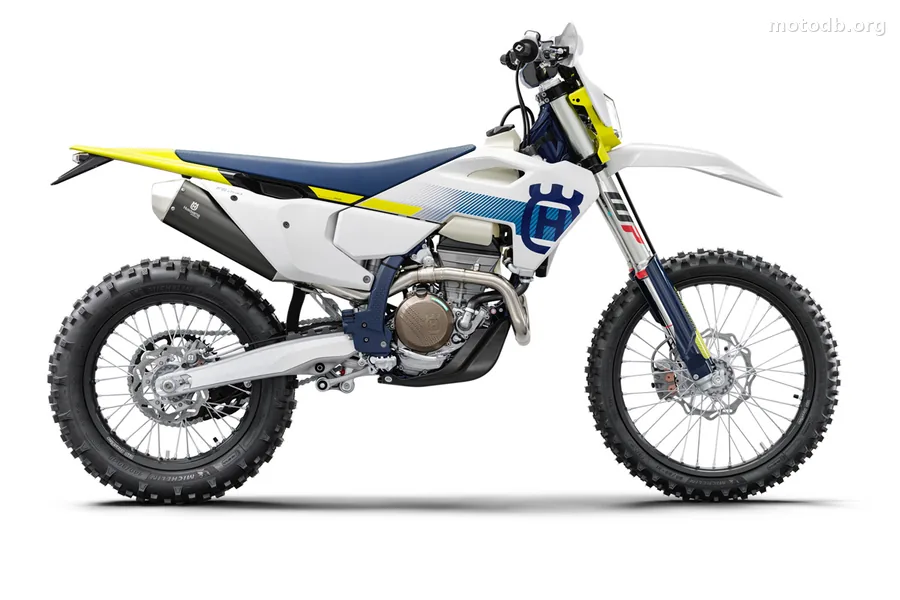
Its heart, a four-valve four-stroke engine, delivers 37 horsepower. It’s not brute power, but usable power, linear, tailored for precision rather than explosion. This is where the 2016 FE 250 distinguishes itself. It doesn’t try to compete with the violence of a 300 two-stroke, it offers another philosophy: mastery. The 25CrMo4 steel frame and geometry with a wheelbase of 1482 mm provide a neutral and confident base. The WP suspensions, the 4CS fork of 48 mm at the front and the mono shock with linkage at the rear, are standard components that speak directly to the serious enduro rider. They are versatile, capable of digesting the sudden shocks of a rugged trial and the minor imperfections of a faster trail.
What is captivating, beyond the technical specifications, is the equipment. An electric starter as standard on a machine of this category, in 2016, was almost a provocation. Add the handlebar-mounted mapping switch, allowing modulation of the engine’s response, and you have a motorcycle that thinks with you. The 9.5-liter fuel tank and 345 mm ground clearance confirm this vocation: it is made to cover distances, not just to explode on a circuit. Compared to some contemporary Japanese competitors, often more rudimentary, the Husqvarna FE 250 positions itself as a premium tool, ready to use.
But this tool has a price, and it requires a certain physique. With a seat height of 970 mm, it is not accessible to everyone. It targets the regular rider, the one who understands that enduro is a discipline of endurance and technique. The beginner rider might be intimidated by this stature and by the initial price of 9590 euros. That is why the second-hand market, as one can find on Le Bon Coin for a used Husqvarna FE 250, is often the entry point for many. For those who persist, it offers a remarkable progression platform, a forgiving chassis and an engine that encourages consistency rather than aggression.
The Husqvarna FE 250, from 2016 to today, has built a true heritage in the world of four-stroke enduro. It is not the most powerful, nor the most radical, but it could be the most consistent. It answers a very specific question: how to combine the reliability and ease of a four-stroke with the agility necessary for varied terrain? Its answer, with a lightweight chassis, complete equipment and a reliable engine, remains relevant, even in the face of more recent models like the Husqvarna FE 250 2024. It is less a combat motorcycle than a companion motorcycle, a technical partner for those who see the trail as a puzzle to solve, rather than a barrier to pulverize.
Reviews & comments
No reviews yet. Be the first to share your opinion!