Key performance
Technical specifications
Engine
- Displacement
- 1130 cc
- Power
- 115.0 ch @ 8500 tr/min (84.6 kW)
- Torque
- 98.1 Nm @ 7000 tr/min
- Engine type
- Bicylindre en V à 60°, 4 temps
- Cooling
- liquide
- Compression ratio
- 11.3 : 1
- Bore × stroke
- 100 x 72 mm
- Valves/cylinder
- 4
- Camshafts
- 2 ACT
- Fuel system
- Injection Ø 53 mm
Chassis
- Frame
- double berceau tubulaire en acier
- Gearbox
- boîte à 5 rapports
- Final drive
- Courroie
- Front suspension
- Fourche téléhydraulique Ø 49 mm, déb : 100 mm
- Rear suspension
- 2 amortisseurs latéraux, déb : 60 mm
Brakes
- Front brakes
- Freinage 2 disques Ø 292 mm, étrier 4 pistons
- Rear brakes
- Freinage 1 disque Ø 292 mm, étrier 4 pistons
- Front tyre
- 120/70-19
- Front tyre pressure
- 2.48 bar
- Rear tyre
- 180/55-18
- Rear tyre pressure
- 2.62 bar
Dimensions
- Seat height
- 660.00 mm
- Fuel capacity
- 14.00 L
- Weight
- 284.00 kg
- Dry weight
- 270.00 kg
- New price
- 17 995 €
Overview
When Milwaukee decides to betray its own dogmas, the result is noticeable. The V-Rod is already, in itself, an anomaly in the Harley-Davidson catalog. The 2005 VRSCB Black pushes the exercise a step further, not by reinventing the formula, but by blackening the picture to the bone. Black lacquered frame, two-tone black and silver engine, dark controls, instrumentation moved to an adjustable handlebar that brings the riding position closer to that of a roadster: surgical refinements, but consistent. The result evokes more an engine from a cinematic dystopia than the sunny custom Harley had accustomed us to.
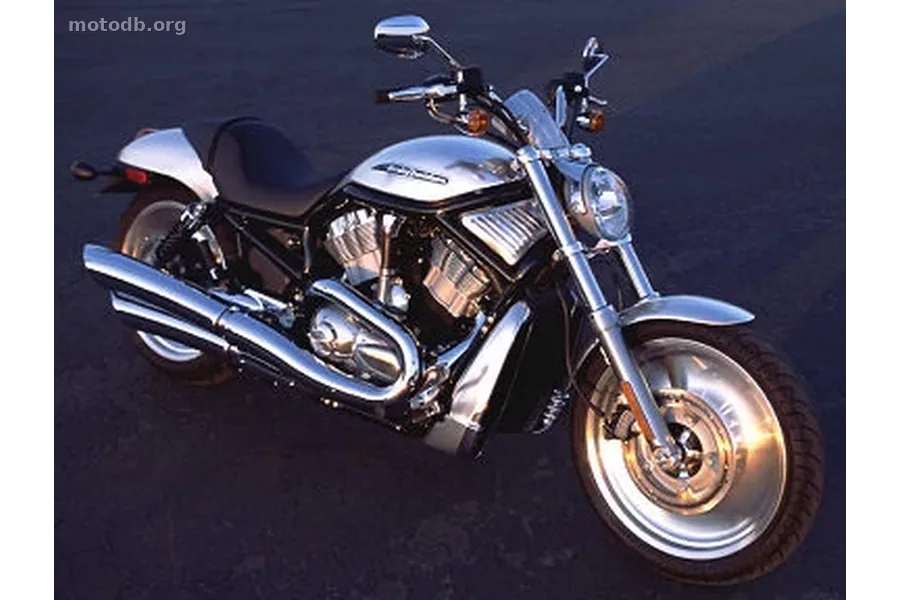
What fundamentally differentiates the V-Rod from everything the brand has ever produced is its engine. The Revolution, 1,130 cm3, 60-degree V-twin, liquid-cooled, double overhead camshafts and four valves per cylinder, is a creature apart. Porsche Engineering was tasked with transforming a competition base into a viable production motorization. The result is an engine that has nothing to do with the Shovelhead, Evo or Twin Cam that built the Milwaukee legend. It develops 115 horsepower at 8,500 rpm and 98.1 Nm of torque at 7,000 rpm. To put the difference in perspective: the Twin Cam 1,450, which equips the Fat Boy or Electra Glide, peaks around 65 horsepower. The VRSCB therefore represents a considerable increase in power within the range, which the figures alone do not completely convey as the character of the two engines diverges.
On the road, this Harley doesn't handle like a Harley. The low seat at 660 mm, the weight of 284 kg fully fueled and the asymmetrical tire mount, 120/70-19 at the front and 180/55-18 at the rear, are more reminiscent of the codes of Japanese dragsters than those of traditional American customs. The five-speed gearbox associated with a belt transmission ensures smooth operation, and the dual 292 mm disc braking with four-piston calipers at the front is serious. The announced top speed of 210 km/h seems credible in view of the available power. Facing a Ducati Diavel that didn't exist yet, or a more contemporary Honda VTX 1800, the VRSCB plays a radically different card: it is spectacular visually and surprising mechanically, but it does not claim the same versatility.
At 17,995 euros in 2005, it was clearly aimed at a passionate, affluent audience who wanted to ride a Harley without suffering the vibrations and dynamic modesty of traditional models. Neither truly roadworthy, nor truly sporty, the VRSCB Black remains a fascinating industrial curiosity: the moment when one of the world's most conservative brands decided, for the duration of a model, to play by rules that were not its own.
Practical info
- La moto est accessible aux permis : A
Indicators & positioning
Similar bikes
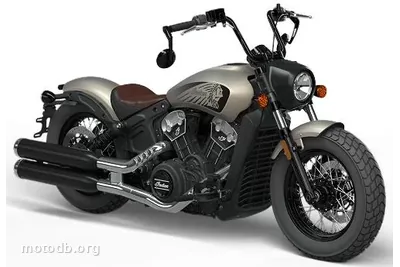
Scout Bobber Twenty
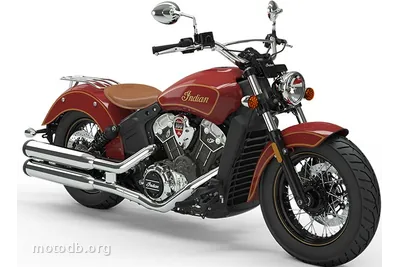
Scout 100th Anniversary Edition
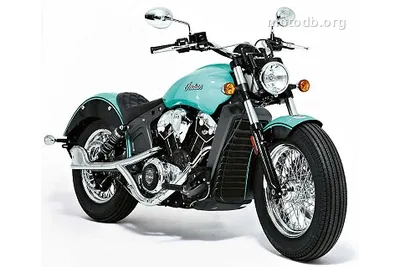
1133 Scout Tiffany Blue
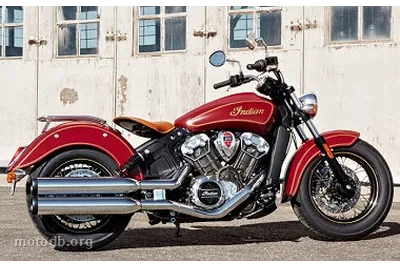
1133 Scout 100ème anniversaire
Reviews & comments
No reviews yet. Be the first to share your opinion!