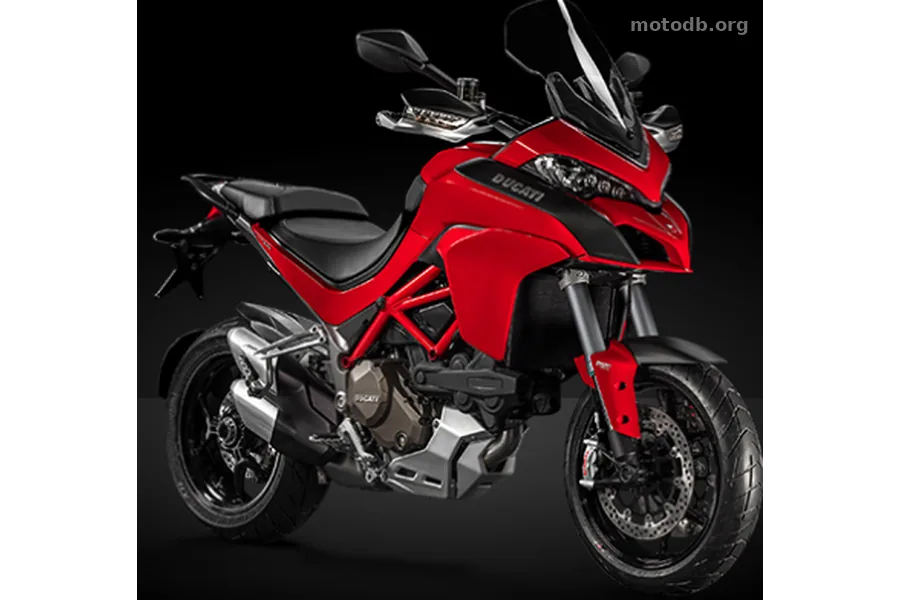
Key performance
Technical specifications
Engine
- Displacement
- 1198 cc
- Power
- 160.0 ch @ 9500 tr/min (116.8 kW)
- Torque
- 136.0 Nm @ 7500 tr/min
- Engine type
- V2, four-stroke
- Cooling
- Liquid
- Compression ratio
- 12.5:1
- Bore × stroke
- 106.0 x 67.9 mm (4.2 x 2.7 inches)
- Valves/cylinder
- 4
- Camshafts
- 2 ACT
- Fuel system
- Injection. Bosch electronic fuel injection system, elliptical throttle bodies with Ride-by-Wire, equivalent diameter 56 mm
- Valve timing
- Desmodromic valve control
- Ignition
- Dual Spark
- Starter
- Electric
Chassis
- Frame
- Tubular steel Trellis frame
- Gearbox
- 6-speed
- Final drive
- Chain (final drive)
- Clutch
- Light action, wet, multiplate clutch with hydraulic control. Self-servo action on drive, slipper action on over-run
- Front suspension
- 48mm fully adjustable usd forks. Electronic compression and rebound damping adjustment with Ducati Skyhook Suspension (DSS)
- Rear suspension
- Fully adjustable unit. Electronic compression and rebound damping adjustment. Electronic spring pre-load adjustment with Ducati Skyhook Suspension (DSS). Aluminium single-sided swingarm
- Front wheel travel
- 170 mm (6.7 inches)
- Rear wheel travel
- 170 mm (6.7 inches)
Brakes
- Front brakes
- Double disc. ABS. Floating discs. Four-piston calipers. Radially mounted.
- Rear brakes
- Single disc. ABS. Two-piston calipers.
- Front tyre
- 120/70-17
- Front tyre pressure
- 2.50 bar
- Rear tyre
- 190/55-17
- Rear tyre pressure
- 2.50 bar
Dimensions
- Seat height
- 825.00 mm
- Wheelbase
- 1529.00 mm
- Length
- 2200.00 mm
- Fuel capacity
- 20.00 L
- Weight
- 235.00 kg
- Dry weight
- 212.00 kg
- New price
- 17 990 €
Overview
The 2017 version of the 1200 MTS features a few minor changes. An optimized air intake via a revised airbox and new engine parameters should further improve response in the mid-range. The technical documentation still lists the substantial power of 160 horsepower, but the official website figures drop to 152 horsepower. Go figure. With one or the other, we remain in the saddle of a serious powerhouse. And not just that.
The original Multistrada was a true oddity in the Ducati lineup. And in the motorcycle world as well. Its concept played a significant role, as did its particular design for many. The 1200, in 2013, allowed this “hybrid” machine to truly find its vocation, its expression, its ferocity. The hypersport trail was born. Today, the 1200 Multistrada of the 3rd generation is packed with technologies, introduces variable distribution into its engine, and improves its efficiency.
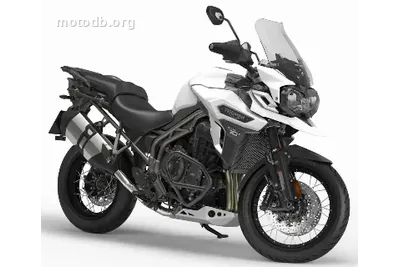
The design of the Multistrada is a bit like that of a BMW GS or a Suzuki GSX-R. Regardless of the generation, you immediately recognize the identity. The MTS follows its genetic lineage, but with an even more menacing face. The snout has changed direction: trails have a duck beak, while this one has that of a vulture. The eyes have been stretched, the skid plate is revised, the side panels have evolved while retaining the stylistic line, the fairing has gained cheekbones. Ultimately, you can feel that this Multistrada is not here to put on a show.
But rather to take a lot of pleasure in the saddle. With watts, and a lot of them. And even more. The Bologna brand has looked into a new area to offer more comfort to its twin. This involves a variable distribution system. Quite common in automotive, it is rarely found in motorcycles. Few machines are capable of modifying what happens in the cylinder head. There was the Kawasaki GTR 1400; the VFR 800 has defended it since 2002, and... and that's it. Let's forget Honda's, which only acts on the number of acting valves. The GTR’s acted only on the intake. With its DVT (Desmodromic Variable Timing), Ducati goes further and allows its trail to be the first series motorcycle to be able to offset its intake and exhaust camshafts. This is to reconcile a lot of torque at low revs and a lot of power at high revs. With a classic distribution, you have to prioritize one or the other, or compromise. Here, we are winning on both fronts.
To explain DVT, you need a beautiful diagram, a dose of patience, and a brain that knits. So, we're going to keep it simple. The end of each camshaft timing actuator (ACT) is not connected to a traditional pinion but to a phase shifter controlled by oil pressure. The engine control unit can modify a flow of oil entering this complex part to adjust the ACTs according to engine speed. For more, much more details, a large paragraph is found at the end of the article, with a video to better visualize. In fact, this DVT allows the big twin to offer more engine performance, more availability, increased flexibility, and reduced consumption. Ducati announces 8% on average. As for performance and acceleration, you will need to keep your cool. The Multistrada has gained 10 horsepower in the process. The stable now overflows with 160 horses. And in terms of torque, things will heat up in the tires. At 3500 rpm, we already have 80 Nm (8.2 mkg) at hand. Between 5750 rpm and 9000 rpm, there is always at least 100 Nm (10.2 mkg) available. The peak is at 7500 rpm where the Testastretta 1200 delivers 136 Nm, almost 14 mkg. Previously, the curve peaked at 12.7 mkg. Enough to atomize many machines when accelerating. This major top-end work is more than sufficient; the rest of the engine block has not changed. Nor was it necessary, it was already one of the most advanced in production. And for maintenance. The manufacturer is confident: routine maintenance extended to 15,000 km and the adjustment of the distribution timing at 30,000 km.
Ducati likes to make engines that tear your neurons apart. And when it comes to the chassis, we won't reproach them much either. In terms of sportbikes, you need skill. In terms of trails, the desire is less elitist but just as rigorous. The type of structure remains the same, but the evolution is visible. The tubular steel trellis is redesigned, stiffened, now painted red, and the development team took the opportunity to raise the ground clearance by 20 mm. With 180 mm, it allows action of the multi-road motorcycle function... in a reasonable area. Everyone their own route? You will need to adjust the suspensions. Here we find a Sachs 48 mm inverted fork and a single shock absorber from the same manufacturer.
M.B - Media constructor
DVT - Desmodromic Variable Timing
Desmodromic Variable Timing (DVT) uses camshaft phase shifters operating hydraulically (two for each cylinder head) to modify the position of the camshaft relative to the pinion connected to the timing belt, which allows to vary the distribution. These phase shifters are located on both the intake and exhaust camshafts.
The camshaft phase shifter is a mechanism consisting of two parts: an external pinion (2) connected to the timing belt and an internal rotor (3) connected to the camshaft that modifies the distribution of the valves by adjusting the angle of rotation of the camshaft.
The two parts of the mechanism can pivot by approximately 45° relative to the camshaft independently of each other in 0.45 sec. The internal rotor consists of several lobes and regulates the flow of oil entering the phase shifter or exiting the space located between (the chambers) the external housing and the lobes. Oil seals are inserted into the machined grooves of the rotor to ensure sealing between the chambers, grouped on both sides.
Only, the external pinion will simply rotate at the same rate as the internal rotor. As soon as a group of chambers receives pressurized oil (the system adds oil on one side of the lobe) and the others are evacuated, the external pinion provides the force necessary to rotate or hold the rotor relative to the body of the phase shifter.
The camshaft phase shifters of each cylinder head are connected to the oil system via two solenoid valves (4) attached to the cylinder heads.
These valves control the oil pressure on the two camshaft phase shifters according to the signal sent by the engine control unit.
The oil pressure in the camshaft phase shifters is continuously adjusted by the oil control valves to determine the correct position of each camshaft.
The position of the camshaft is dynamically controlled by a specific sensor mounted on the cylinder head cover.
The engine control unit activates the solenoid valves according to the data from the engine (speed, engine load, temperature and positions of the crankcase and camshafts). The valves open the conduits for the oil in the control housing. Engine oil flows into the control housing to the camshaft phase shifters. The camshaft phase shifters rotate and regulate the distribution of the camshafts according to the specifications sent by the engine control unit.
Standard equipment
- Assistance au freinage : ABS in curves
Practical info
- La moto est accessible aux permis : A
Indicators & positioning
Similar bikes
Dorsoduro 1200
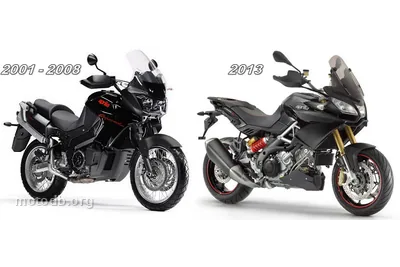
Caponord 1200 Travel Pack
Reviews & comments
No reviews yet. Be the first to share your opinion!