Key performance
Technical specifications
- Rear tyre pressure
- 2.50 bar → 2.70 bar
- New price
- 12 790 € → 13 050 €
Engine
- Displacement
- 821 cc
- Power
- 110.0 ch @ 9250 tr/min (80.9 kW)
- Torque
- 89.2 Nm @ 7750 tr/min
- Engine type
- Bicylindre en L à 90°, 4 temps
- Cooling
- liquide
- Compression ratio
- 12.8 : 1
- Bore × stroke
- 88 x 67.5 mm
- Valves/cylinder
- 4
- Camshafts
- 2 ACT
- Fuel system
- Injection Ø 52 mm
Chassis
- Frame
- treillis tubulaire en tubes d'acier
- Gearbox
- boîte à 6 rapports
- Final drive
- Chaîne
- Front suspension
- Fourche téléhydraulique inversée Kayaba Ø 43 mm, déb : 150 mm
- Rear suspension
- Mono-amortisseur Sachs, déb : 150 mm
Brakes
- Front brakes
- Freinage 2 disques Brembo Ø 320 mm, fixation radiale, étrier 4 pistons
- Rear brakes
- Freinage 1 disque Ø 245 mm, étrier 2 pistons
- Front tyre
- 120/70-17
- Front tyre pressure
- 2.50 bar
- Rear tyre
- 180/55-17
- Rear tyre pressure
- 2.70 bar
Dimensions
- Seat height
- 850.00 mm
- Fuel capacity
- 16.00 L
- Weight
- 204.00 kg
- Dry weight
- 181.00 kg
- New price
- 13 050 €
Overview
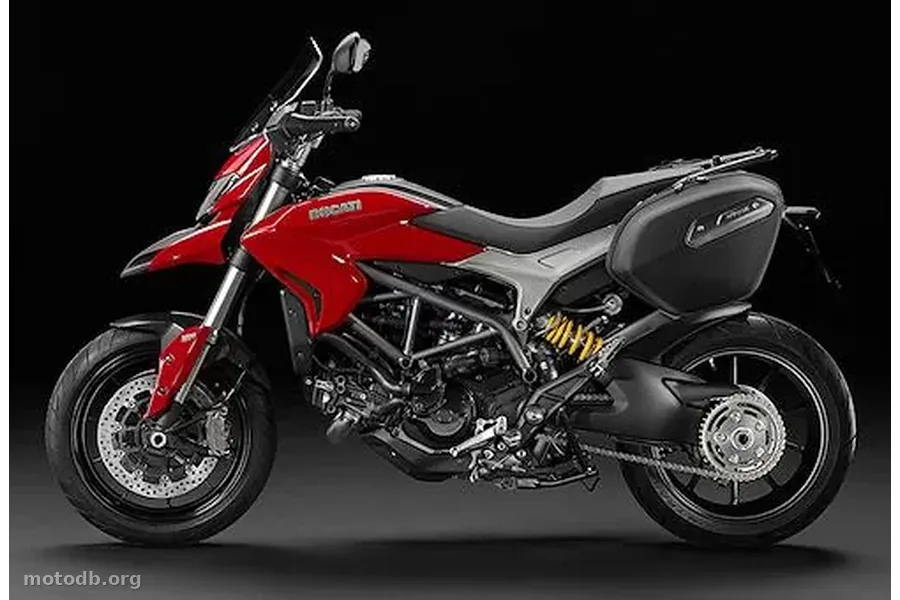
Since its launch, the Hypermotard has earned appreciation for its playful nature, its remarkable agility between switchbacks, and its sporty character, which suits Italian productions so well. The 1100 and 796 have moved on: the 821 takes over with more horsepower and technology, and loses a bit of generosity in terms of torque. It takes the opportunity to look towards a wider range of uses. Why have fun mainly on weekends when you could be letting off steam almost every day, with the added possibility of doing medium-range trips!? Let's brainstorm, let's lock an Hypermotard and a touring bike in the workshop, let them heat up, and when we open the pressure cooker, that's how the Hyperstrada is born.
Does it look like an Hypermot' with panniers!? Only that? Not really, and even a bit more. By becoming Strada, the bike allows for a few welcome modifications. It's about being nice to ride every day, or covering a few three-digit miles. There's this small windscreen, which expands the front and protects the torso. We won't ask for GT protection, but it will relieve the torso and a little bit the cervicals. Seat-side, the changes are more than noticeable. A supermotard is high! And the Ducati doesn't deviate from the rule. The Hyperstrada does better: the suspension travel is reduced by 20 mm, and the seat height by the same amount. Which means the saddle culminates at 850 mm. Too high? There's a low seat available as an accessory, which further reduces this value by 20 mm. Or alternatively, you can order an Hyperstrada "low version" at 830 mm, equipped with shorter suspension and footpegs, with the low seat fitted, bringing the seat to 810 mm.
We can play with the height, OK. But there's more to it than that. The seat is wider, thicker, more comfortable, but will allow less freedom of movement than on the Hypermotard. This won't prevent retaining a specific riding position, less radical but still frankly inviting onto the front, as if strolling with the forks. Great for attacking and sensations; more confusing for touring. It's not just the seat that changes. The handlebars are 20 mm higher, the mudguards are more enveloping, and passenger grips are provided. Plus, 25-liter panniers can accommodate a full-face helmet. Cool. But they are made of fabric... and they fasten with a zip... So, they risk taking on water, you need a padlock, and they noticeably weigh down the bike's sylph-like silhouette. In terms of practicality, the Bologna factory has included a center stand and two 12V sockets.
Touring for the Hyperstrada? Certainly, but more sport-touring than GT. A Ducati bubbles. And the combination of a trellis frame, a lively twin, a dry weight of 184 kilograms and an Italian character, immediately announces a right hand itching and a tongue hanging out. The engine is identical to the Hypermotard and the Hypermotard SP. An 821 cm3 Testastretta, liquid-cooled, 8 valves with a 11° overlap (for more flexibility and availability), a wet clutch, 110 horsepower at 9,250 rpm and a maximum torque of 9.1 mkg at 7,750 rpm. However, Ducati doesn't let it behave like a wild man. Electronics monitor via the Safety Pack. In the box (packed with silicon and software), there are 3 riding modes, traction control at 8 levels, and a Bosch 9MP ABS at 3 levels.
Technically, the Hyperstrada is based on the Hypermotard. Trellis tubular steel frame followed by an aluminum cradle, 43 mm inverted Kayaba fork with 150 mm of travel (170 on the HM), Sachs mono-shock with 150 mm of stroke as well, aluminum monobrach, two 320 mm front brake discs with four-piston Brembo M4-32 calipers, 1 rear 245 mm disc with a double-piston caliper. In addition to the touring equipment, the Hyperstrada is distinguished by a slightly shorter wheelbase of 10 mm (1490), 6 kilos more to reach 204 units fully painted and Pirelli Skorpion Trail tires. The essentials of a sporty toy are there; the desire for touring will allow you to extend it to everyday life. With the Ducati philosophy of course, closer to sneakers than moccasins.
Riding Modes:
- Sport: delivers 110 hp, with a RbW "High" for maximum sensitivity at the throttle and reduced traction control.
- Touring: 110 hp, with a RbW "Medium", a traction control that intervenes more intrusively and an ABS at level 2 for as stable braking as possible which also prevents rear wheel lift.
- Urban: 75 hp, with a RbW "Low", a DTC that intervenes more strongly and an ABS at level 2 for as stable braking as possible and also parameterized to avoid rear wheel lift.
M.B - Manufacturer photos
Standard equipment
- Assistance au freinage : ABS de série
Practical info
- La moto est accessible aux permis : A
Reviews & comments
No reviews yet. Be the first to share your opinion!