Key performance
Technical specifications
No spec differences between these two model years.
Engine
- Displacement
- 124 cc
- Power
- 13.0 ch @ 9000 tr/min (9.6 kW)
- Torque
- 11.8 Nm @ 7000 tr/min
- Engine type
- Monocylindre, 4 temps
- Cooling
- par air
- Bore × stroke
- 56.5 x 49.5 mm
- Valves/cylinder
- 4
Chassis
- Frame
- Double berceau en tubes d'acier
- Gearbox
- boîte à 5 rapports
- Final drive
- Chaîne
- Front suspension
- Fourche téléhydraulique Ø nc, déb : 100 mm
- Rear suspension
- 2 amortisseurs latéraux, déb : 90 mm
Brakes
- Front brakes
- Freinage
- Rear brakes
- Freinage tambour
- Front tyre
- 90/90-18
- Front tyre pressure
- 2.00 bar
- Rear tyre
- 130/90-15
- Rear tyre pressure
- 2.00 bar
Dimensions
- Fuel capacity
- 12.20 L
- Dry weight
- 153.00 kg
- New price
- 3 178 €
Overview
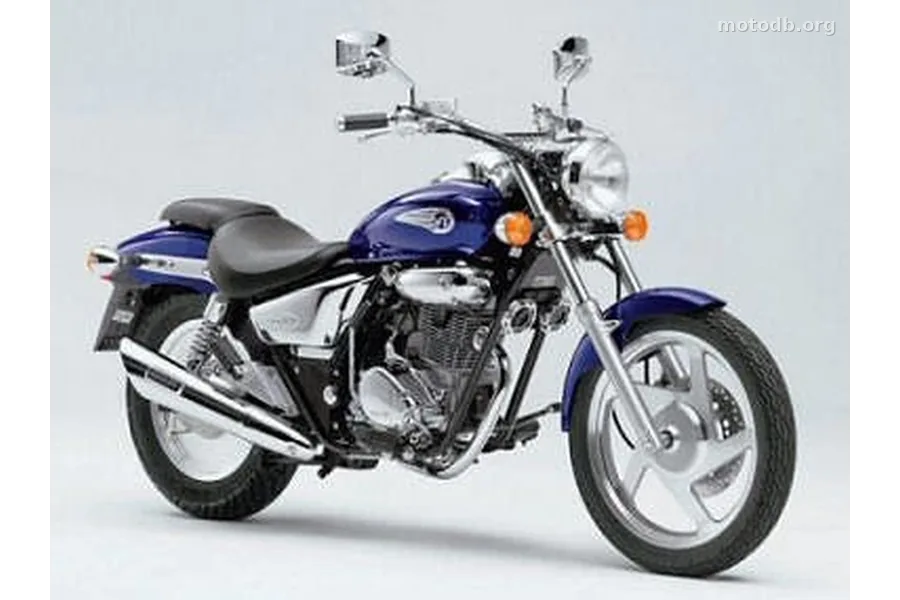
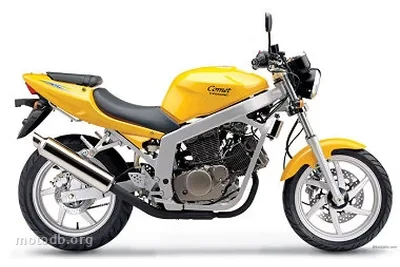
When Daelim arrives on the European 125 market, few people bet on the Korean brand. We know Honda, Yamaha, the usual suspects. We don't yet know this VT Evolution, which will nevertheless quietly establish itself as a reference in the accessible custom category for an A1 license. The dimensions are largely responsible: 153 kg dry weight, a low seat line, a curved tank, and proportions that evoke a medium-displacement American more than a hurried high schooler’s 125. The confusion is deliberate, and it is successful.
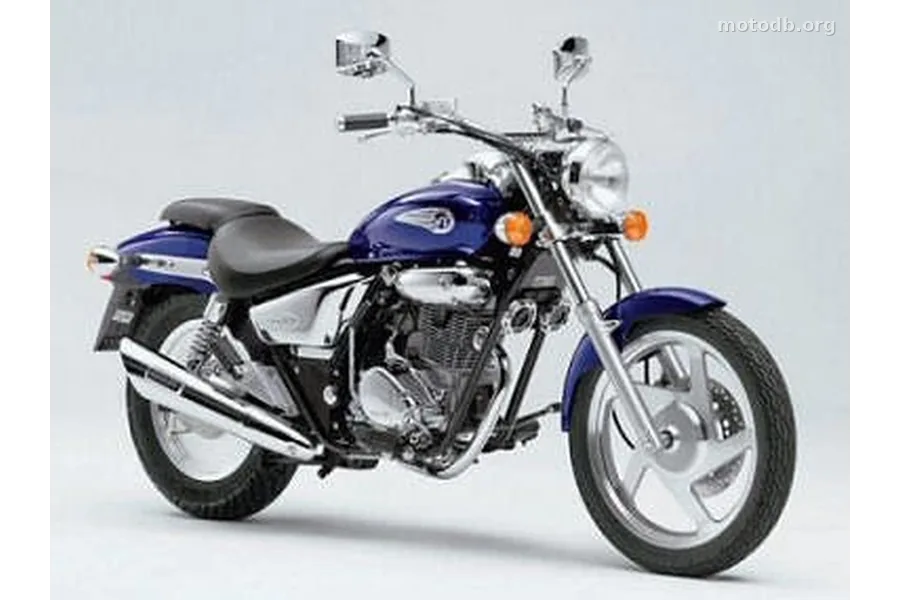
Under the twin-cylinder engine designed to impress, it's a Honda engine doing the work. A 124 cc four-stroke single-cylinder engine, four valves, short stroke with 56.5 mm bore and 49.5 mm stroke. On paper, 13 horsepower at 9000 rpm and 11.8 Nm at 7000 rpm, it’s nothing to frighten a Kawasaki Z900. But relative to the category, this engine performs frankly well. It accepts high revs without complaint, recovers correctly from low revs, and pushes the machine to a top speed of 110 km/h. For a 125 custom in 2002, it’s in the leading pack, ahead of some direct competitors who struggle to exceed 100 km/h without excessive vibrations.
The five-speed gearbox is well-spaced, the chain drive understated and unsurprising. On the other hand, the drum brakes on both wheels are part of the economic compromises that recall that the VT Evolution remains an entry-level product. You get used to it in urban and suburban use, which constitutes the majority of the kilometers covered by this type of machine. The telescopic fork with 100 mm of travel and the two rear shock absorbers with 90 mm do their job without pretension, correctly filtering irregularities without giving the illusion of a steel double cradle chassis of a sports bike. The target audience here is the young license holder who wants to appear bigger than their driving license, or the urban dweller who prefers a custom silhouette to a small, ordinary touring bike.
What really distinguishes the Daelim from its rivals is the level of standard equipment. Fuel gauge, center stand, rims ready for tubeless tires, kick starter, and a profusion of chrome on the protections, the low rider handlebar, and the trim. At 3178 euros in 2002, the equipment/price ratio is difficult to beat. A Yamaha XV125 Virago or a Honda VT125 Shadow cost significantly more for comparable equipment, or even inferior in some areas. Daelim is playing a pragmatic card here, and playing it well.
The shadow on the picture comes from within the range itself. The arrival of the Daystar, a smaller, more modern and slightly re-centered sister, creates a fraternal competition that forces the VT Evolution to justify its existence. It achieves this through the argument of dimensions and a more assertive style, but the situation illustrates a classic problem for brands that expand their catalogs without always segmenting sufficiently. For the buyer, this is good news: internal competition drives prices and pushes equipment upwards. For Daelim, it is a question of positioning to clarify.
Practical info
- La moto est accessible aux permis : A
Reviews & comments
No reviews yet. Be the first to share your opinion!