Key performance
Technical specifications
- Power
- 98.0 ch @ 7500 tr/min (71.5 kW) → 98.0 ch @ 7500 tr/min (70.5 kW)
- Bore × stroke
- 101.0 x 70.0 mm (4.0 x 2.8 inches) → 99.0 x 70.5 mm (3.9 x 2.8 inches)
- Fuel system
- Injection → Injection. Electronic intake pipe injection/digital engine management: Bosch Motronic MA 2.4 with overrun fuel cut-off, twin spark ignition
- Valve timing
- — → Single Overhead Cams (SOHC)
- Frame
- bâti avant en alu coulé, bâti arrière en acier → Three-section composite frame consisting of front and rear section, load bearing engine.
- Gearbox
- boîte à 6 rapports → 6-speed
- Clutch
- — → Single-disc dry clutch, hydraulically operated
- Front suspension
- Telelever → BMW Motorrad Telelever
- Rear suspension
- Central suspension strut → Die-cast aluminium single-sided swinging arm with BMW Motorrad Paralever
- Front wheel travel
- 110 mm (4.3 inches) → 35 mm (1.4 inches)
- Rear wheel travel
- 130 mm (5.1 inches) → 135 mm (5.3 inches)
- Rear brakes
- Single disc → Double disc
- Wheelbase
- — → 1478.00 mm
- Length
- — → 2180.00 mm
- Width
- — → 880.00 mm
- Height
- — → 1160.00 mm
- Weight
- 245.00 kg → 229.00 kg
- Dry weight
- 229.00 kg → 208.00 kg
Engine
- Displacement
- 1085 cc
- Power
- 98.0 ch @ 7500 tr/min (70.5 kW)
- Torque
- 97.0 Nm @ 5750 tr/min
- Engine type
- Two cylinder boxer, four-stroke
- Cooling
- Oil & air
- Compression ratio
- 11.3:1
- Bore × stroke
- 99.0 x 70.5 mm (3.9 x 2.8 inches)
- Valves/cylinder
- 4
- Camshafts
- 1 ACT
- Fuel system
- Injection. Electronic intake pipe injection/digital engine management: Bosch Motronic MA 2.4 with overrun fuel cut-off, twin spark ignition
- Valve timing
- Single Overhead Cams (SOHC)
- Starter
- Electric
Chassis
- Frame
- Three-section composite frame consisting of front and rear section, load bearing engine.
- Gearbox
- 6-speed
- Final drive
- Shaft drive (cardan) (final drive)
- Clutch
- Single-disc dry clutch, hydraulically operated
- Front suspension
- BMW Motorrad Telelever
- Rear suspension
- Die-cast aluminium single-sided swinging arm with BMW Motorrad Paralever
- Front wheel travel
- 35 mm (1.4 inches)
- Rear wheel travel
- 135 mm (5.3 inches)
Brakes
- Front brakes
- Double disc
- Rear brakes
- Double disc
- Front tyre
- 120/70-ZR17
- Front tyre pressure
- 2.20 bar
- Rear tyre
- 170/60-ZR17
- Rear tyre pressure
- 2.50 bar
Dimensions
- Seat height
- 800.00 mm
- Wheelbase
- 1478.00 mm
- Length
- 2180.00 mm
- Width
- 880.00 mm
- Height
- 1160.00 mm
- Fuel capacity
- 18.00 L
- Weight
- 229.00 kg
- Dry weight
- 208.00 kg
- New price
- 12 600 €
Overview
What drove BMW, in the late 1990s, to play the sportbike game with a flat engine? The answer lies in three letters and four numbers: the BMW R 1100 S. Produced from 1998 to 2005, this BMW R 1100 S remains one of the most distinctive offerings in the sport touring segment. Where a Honda VFR 800 or a Ducati ST relied on tried-and-tested recipes, Munich chose to mount its 1085 cc boxer twin in a three-piece composite frame, using the engine as a stressed member. An engineering gamble few competitors would have dared to take.
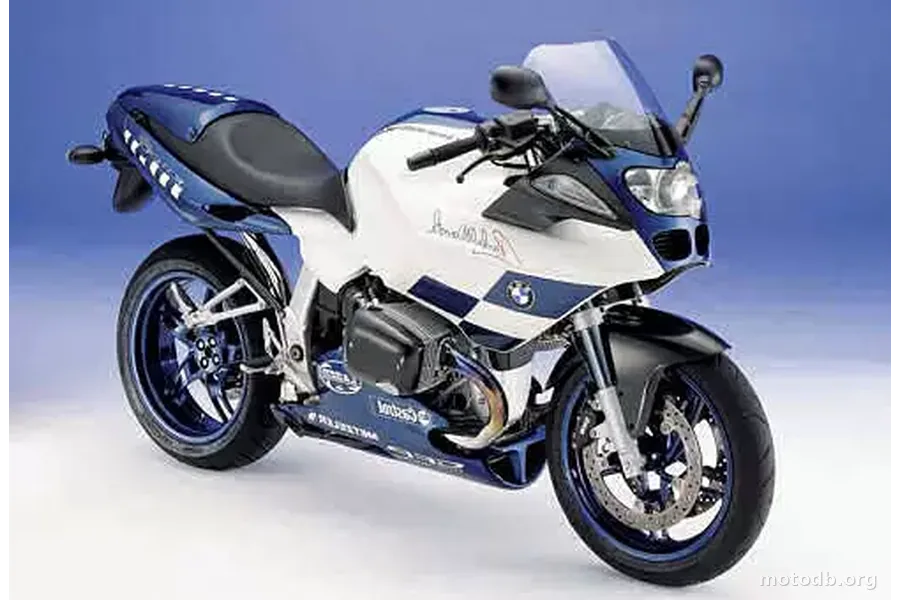
The flat-twin produces 98 hp at 7500 rpm and, more importantly, 97 Nm of torque from just 5750 rpm. On paper, these figures don't intimidate anyone. On the road, it's a different story. The boxer pulls hard between 3000 and 5000 rpm, with a smoothness that Japanese four-cylinders simply can't match. Beyond that, the power tapers off, and the twin reveals its limits against a ZX-9R or a CBR 900. But the R 1100 S never claimed to fight on that battlefield. Its top speed of 230 km/h is enough to remind you it's not just a touring bike in disguise. All this while returning a modest 4.3 liters per hundred kilometers, which provides decent range from the 18-liter tank.
On the chassis side, the Telelever front end and the Paralever single-sided swingarm form a combination of remarkable stability. The bike weighs 229 kg wet, which makes itself felt in tight corners: low-speed maneuverability is not its strong suit. On the other hand, through sweeping curves and fast transitions, confidence is absolute. The fork is adjustable via a knob accessible from the saddle, even while riding. The Brembo braking system, with dual discs front and rear, delivers powerful and progressive stopping. The 800 mm seat height comfortably accommodates most rider sizes, and the wind protection lives up to its promises up to 180 km/h. The only truly recurring flaw reported on BMW R 1100 S forums and confirmed by numerous BMW R 1100 S reviews: the vibrations. The boxer shakes, especially on the highway, and it's a BMW R 1100 S issue that successive model years, from 1999 to 2005, never fully resolved.
The BMW R 1100 S Boxer Cup, a lighter and more radical version created for the single-make racing series, helped forge this machine's legend. The Randy Mamola edition, produced in limited numbers, remains a collector's item. Today, a used BMW R 1100 S can be found at reasonable prices, well below the 12,600 euros asked at the time for a new model. This is precisely what makes it a popular platform for custom builds: the BMW R 1100 S cafe racer has become a staple among custom builders, as the boxer lends itself well to the exercise with its exposed cylinders and naturally racy lines.
At the end of the day, this motorcycle is aimed at the rider who refuses to choose between sporty thrills and daily usability. Not a pure track weapon, not a resigned grand tourer. A BMW R 1100 S test in 2026 reveals a machine that has aged with dignity, carried by an endearing powertrain and a confidence-inspiring chassis. For anyone seeking a sport tourer with character, with shaft drive as a bonus and a solid BMW R 1100 S spec sheet, it remains a compelling choice against more sanitized Japanese alternatives.
Standard equipment
- Assistance au freinage : Integral ABS en option
Practical info
- La moto est accessible aux permis : A
Reviews & comments
No reviews yet. Be the first to share your opinion!