Key performance
Technical specifications
- Power
- — → 215.0 ch @ 13900 tr/min (156.9 kW)
- Torque
- — → 120.0 Nm @ 10000 tr/min
- Compression ratio
- — → 13.7:1
- Bore × stroke
- — → 80.0 x 49.7 mm (3.1 x 2.0 inches)
- Valves/cylinder
- — → 4
- Fuel system
- Injection → Injection. Electronic racing injection, variable intake pipe length, four selectable modes
- Frame
- Carbon fibre → Carbon monocoque RTM frame with steering head angle and swinging-arm pivot adjustment, load- bearing engine.
- Front suspension
- Upside-down telescopic fork 46 mm, compression and rebound stage adjustable, → O and #776;hlins FGR 300 WSBK fork, adjustable rebound and compression-stage damping, adjustable spring preload
- Rear suspension
- Aluminium 2-sided swing arm, compression and rebound damping adjustable, adjustable → Aluminium WSBK swinging arm, O and #776;hlins TTX 36 GP central spring strut, adjustable rebound and compression-stage damping, adjustable spring preload, top spring strut pivot point adjustable (0/3 mm), adjustable spring strut deflection (tension strut
- Front wheel travel
- 120 mm (4.7 inches) → 130 mm (5.1 inches)
- Front brakes
- Double disc → Double disc. Brembo
- Rear brakes
- Single disc → Single disc. Brembo
- Front tyre
- 120/70-17 → 120/70-ZR17
- Rear tyre
- 190/55-17 → 200/60-ZR17
- Seat height
- 815.00 mm → 831.00 mm
- Wheelbase
- 1438.00 mm → 1400.00 mm
- Length
- — → 2070.00 mm
- Width
- — → 777.00 mm
- Height
- — → 1193.00 mm
- Weight
- — → 171.40 kg
- Dry weight
- — → 146.00 kg
Engine
- Displacement
- 999 cc
- Power
- 215.0 ch @ 13900 tr/min (156.9 kW)
- Torque
- 120.0 Nm @ 10000 tr/min
- Engine type
- In-line four, four-stroke
- Cooling
- Oil & air
- Compression ratio
- 13.7:1
- Bore × stroke
- 80.0 x 49.7 mm (3.1 x 2.0 inches)
- Valves/cylinder
- 4
- Fuel system
- Injection. Electronic racing injection, variable intake pipe length, four selectable modes
- Valve timing
- Double Overhead Cams/Twin Cam (DOHC)
- Lubrication
- Wet sump
- Starter
- Electric
Chassis
- Frame
- Carbon monocoque RTM frame with steering head angle and swinging-arm pivot adjustment, load- bearing engine.
- Gearbox
- 6-speed
- Final drive
- Chain (final drive)
- Front suspension
- O and #776;hlins FGR 300 WSBK fork, adjustable rebound and compression-stage damping, adjustable spring preload
- Rear suspension
- Aluminium WSBK swinging arm, O and #776;hlins TTX 36 GP central spring strut, adjustable rebound and compression-stage damping, adjustable spring preload, top spring strut pivot point adjustable (0/3 mm), adjustable spring strut deflection (tension strut
- Front wheel travel
- 130 mm (5.1 inches)
- Rear wheel travel
- 120 mm (4.7 inches)
Brakes
- Front brakes
- Double disc. Brembo
- Rear brakes
- Single disc. Brembo
- Front tyre
- 120/70-ZR17
- Rear tyre
- 200/60-ZR17
Dimensions
- Seat height
- 831.00 mm
- Wheelbase
- 1400.00 mm
- Length
- 2070.00 mm
- Width
- 777.00 mm
- Height
- 1193.00 mm
- Fuel capacity
- 17.50 L
- Weight
- 171.40 kg
- Dry weight
- 146.00 kg
Overview
When an S 1000 RR is no longer enough, when the track time lacks a few tenths of a second, and the rider wants to move up a level without changing brands, BMW responds with the BMW HP4. Not a simple cosmetic evolution, but a targeted, surgical overhaul, designed for those who already know what 193 horsepower at 13,000 rpm means in their hands. This 2015 version further refines the recipe with the arrival of ABS Pro, a system that recovers data from lean angle, roll, and transverse acceleration to dose braking pressure in corners. The greater the angle, the more the system releases pressure. This logic is borrowed from the KTM 1190 Adventure and transplanted here into a pure sporting context, with a clear objective: safety on wet roads or in emergency situations. This system does not operate in "Race" or "Slick" mode, only in "Rain" and "Sport," which is consistent with its role.
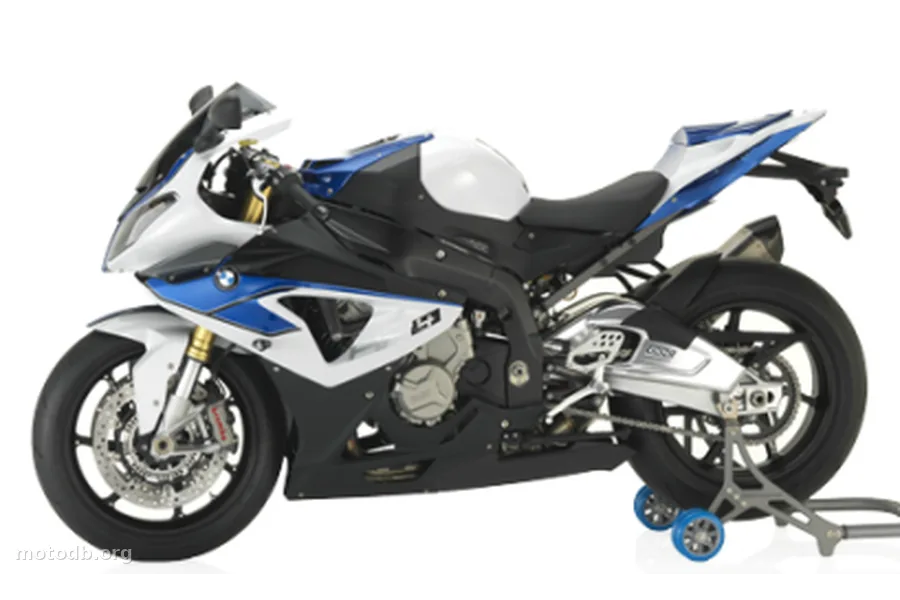
The BMW HP4 S1000RR is first and foremost about lost kilos. The standard S points to 206.5 kg when fully fueled; the HP4 drops to 199 kg thanks to forged aluminum wheels, which save 2.4 kg, and the Akrapovic titanium exhaust system, which saves an additional 4.5 kg. A total of nearly 8 kg stripped from the rotating parts and the top of the engine, where every gram counts. Brembo radial monoblock calipers, with specific pads and refined by data from the German IDM championship, ensure top-notch bite. Facing an Aprilia RSV4 Factory or a Kawasaki ZX-10R SE, the HP4 makes no complexes in this area.
The 999 cc four-cylinder engine receives no major modifications—with 193 real horsepower and 112 Nm at 9,750 rpm, the engine does not need major surgery. The Akrapovic exhaust system and a slightly retouched mapping are enough to unleash the potential. What changes is the torque in the middle of the range, reinforced between 6,000 and 9,750 rpm to better relaunch the bike out of slow corners. The quickshifter is standard equipment: you shift gears without lifting the throttle, without load changes, without losing any traction on the large 200/55-17 rear tire. Those looking for a used BMW HP4 know that this kind of detail makes the difference on a crowded track.
What truly distinguishes the HP4 from the competition is its electronic brain. Dynamic Damping Control (DDC) continuously receives data from speed, inclination, and fork travel sensors to adjust damping in milliseconds. In "Rain" and "Sport" modes, the suspensions soften to absorb degraded pavement; in "Race" and "Slick," they stiffen to glue the front end to the trajectory. This is adjusted with a press of the left handlebar control, without stopping, without a screwdriver. For a sportbike born for the circuit, this versatility is a real strength.
Launch Control complements the starting arsenal: limited to 8,000 rpm in first gear up to 60 km/h, then torque management in second gear according to the engaged ratio. The system automatically disengages in third gear, at 30 degrees of lean angle or when changing DTC mode. Without this device, the HP4 tolerates wheelies up to 25 degrees in "Race" and 30 degrees in "Slick," with a tunable DTC from -7 to +7 during riding. This level of real-time adjustment, at the time of the 2015 BMW HP4, had few direct equivalents in the liter-class category.
At €21,400 in base configuration, the BMW HP4 price was clearly positioned in the upper segment. Each copy bears its serial number laser-engraved on the upper fork leg, a sign of limited-series production. A Competition pack adds carbon parts, blue wheels, and HP controls for riders who want to push the racing aspect even further. This bike is not for the beginner looking for an accessible first sportbike, nor for the tourist who loops 1,000 km on the weekend. It speaks directly to the serious track rider, to those who practice regular track days and know how to exploit each parameter that the machine makes available to them. For others, a standard S 1000 RR will do just fine—and will cost considerably less.
Reviews & comments
No reviews yet. Be the first to share your opinion!