Key performance
Technical specifications
- Power
- 193.0 ch @ 13000 tr/min (139.0 kW) → 193.0 ch @ 13000 tr/min (140.9 kW)
- Fuel system
- Injection. Electroinc injection, digital engine electronics with integrated knock control (BMS-KP) → Injection. Electronic injection, digital engine electronics with integrated knock control (BMS-KP)
- Valve timing
- Double Overhead Cams/Twin Cam (DOHC) → —
- Front suspension
- Upside down telescopic fork 46 mm, dynamic damping control DDC, adjustable spring preload, electronically adjustable damping → Upside down telescopic fork 46 mm, dynamic damping control DDC, adjustable spring preload, electronically adjustable damping (Slick mode)
- Rear suspension
- Aluminium dual swing arm, dynamic damping control DDC (central spring strut), hydraulically adjustable spring preload, adjustable compression and rebound damping → Aluminium dual swing arm, dynamic damping control DDC (central spring strut), hydraulically adjustable spring preload, adjustable compression and rebound damping (Slick mode)
- Front tyre
- 120/70-17 → 120/70-ZR17
- Rear tyre
- 200/55-17 → 200/55-ZR17
Engine
- Displacement
- 999 cc
- Power
- 193.0 ch @ 13000 tr/min (140.9 kW)
- Torque
- 112.0 Nm @ 9750 tr/min
- Engine type
- In-line four, four-stroke
- Cooling
- Oil & air
- Compression ratio
- 13.0:1
- Bore × stroke
- 80.0 x 49.7 mm (3.1 x 2.0 inches)
- Valves/cylinder
- 4
- Camshafts
- 2 ACT
- Fuel system
- Injection. Electronic injection, digital engine electronics with integrated knock control (BMS-KP)
- Starter
- Electric
Chassis
- Frame
- Aluminium composite bridge frame, partially self-supporting
- Gearbox
- 6-speed
- Final drive
- Chain (final drive)
- Clutch
- Multiple clutch in oil bath, anti hopping clutch, mechanically controlled
- Front suspension
- Upside down telescopic fork 46 mm, dynamic damping control DDC, adjustable spring preload, electronically adjustable damping (Slick mode)
- Rear suspension
- Aluminium dual swing arm, dynamic damping control DDC (central spring strut), hydraulically adjustable spring preload, adjustable compression and rebound damping (Slick mode)
- Front wheel travel
- 120 mm (4.7 inches)
- Rear wheel travel
- 130 mm (5.1 inches)
Brakes
- Front brakes
- Double disc. Floating discs. Four-piston calipers.
- Rear brakes
- Single disc. Floating disc. Single-piston caliper.
- Front tyre
- 120/70-ZR17
- Front tyre pressure
- 2.50 bar
- Rear tyre
- 200/55-ZR17
- Rear tyre pressure
- 2.90 bar
Dimensions
- Seat height
- 820.00 mm
- Wheelbase
- 1422.00 mm
- Length
- 2056.00 mm
- Width
- 826.00 mm
- Height
- 1138.00 mm
- Fuel capacity
- 17.50 L
- Weight
- 199.00 kg
- Dry weight
- 169.00 kg
- New price
- 21 400 €
Overview
When BMW Motorrad decides to push the S 1000 RR to its absolute limits, the result is the BMW HP4. HP for High Performance, the same mindset as the M divisions in four-wheeled vehicles, the same philosophy of taking an already formidable base and refining it until nothing superfluous remains. The 2014 BMW HP4 represents the culmination of this approach, a track bike in series production that rivals factory machines without the prohibitive price tag, even though the €21,400 asked at the time was not insignificant.
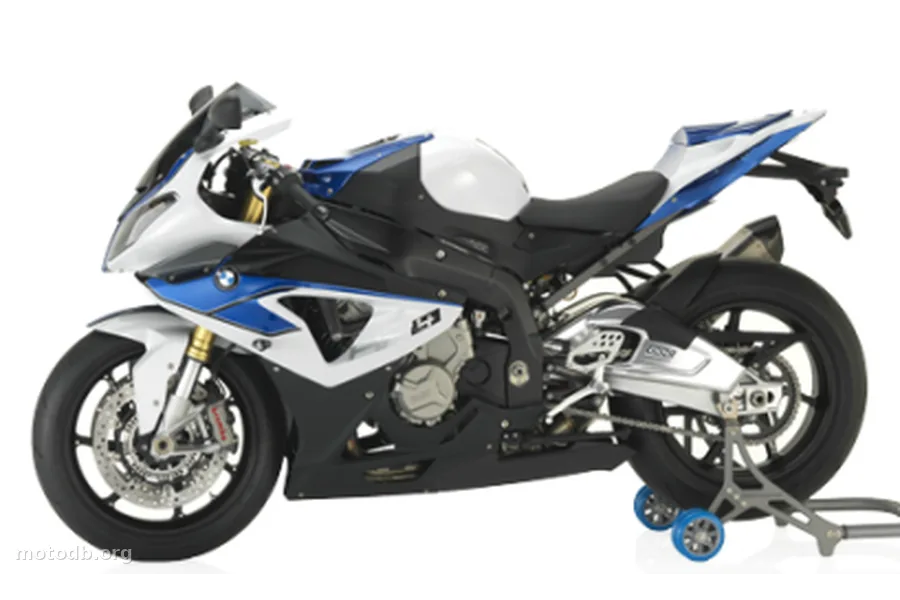
The inline four-cylinder engine of 999 cm³ remains architecturally identical to that of the S 1000 RR, but the HP4 S1000RR does not play in the same league as its base model. The Akrapovic titanium exhaust line sheds 4.5 kilograms instantly, the forged alloy wheels gain an additional 2.4 kilograms, and the lightweight battery trims off a few more grams. Result: 199 kg all fueled up versus 206.5 kg for the standard S 1000 RR. The difference may seem modest on paper, but on a circuit, every kilogram saved in unsprung mass translates to increased responsiveness with each change of direction. The 193 horsepower developed at 13,000 rpm remain unchanged—with this level of power, any attempt at further improvement would be overkill—but torque has been strengthened in the midrange range, between 6,000 and 9,750 rpm, where you really exit corners. The fitted quickshifter completes the picture, gear changes chaining together without the slightest interruption in ignition timing on the straights.
What fundamentally distinguishes the 2014 HP4 from direct competitors, including Aprilia RSV4 and Ducati Panigale, is the integration of Dynamic Damping Control. This DDC system does not merely offer selectable damping presets from the handlebar: it recalculates in real time, in milliseconds, the ideal firmness of each damper by cross-referencing speed, lean angle, suspension travel, and selected riding mode. In Rain or Sport mode, the damping favors comfort and absorption of road imperfections. In Race or Slick mode, everything stiffens, the bike flattens on its rolling chassis, and responds with surgical precision. Switching from the track to the return trip to the van in a few button presses—that’s what most 2014 sportbikes generally couldn’t do as well. The 46 mm inverted forks and the rear monoshock with adjustable hydraulic preload thus become instruments of unexpected versatility for a machine so openly marketed as a track bike.
The Launch Control deserves special mention. The system regulates engine torque in first gear up to 60 km/h, limits the rpm to 8,000, then gradually transfers power in second gear, taking into account mass transfer to the front. Unintentional wheelies disappear at the start, the rear wheel pushes without slipping, the rider can focus all their attention on the apex of the first corner. This device is deactivated in third gear or as soon as the lean angle exceeds 30 degrees, then leaving the traction control DTC to manage the urges of a large 200/55 ZR17 rear tire on hot asphalt. The RaceABS, refined thanks to data from the German IDM championship, and the radial Brembo monoblock calipers with specific pads form a braking system worthy of the machine's ambitions.
On the used market, the used HP4 is still negotiated at a gold price, a sign that the value holds up well, which is not surprising for a numbered series where each copy bears its serial number laser-engraved on the upper fork tube. This is not a motorcycle for novices; the 820 mm seat height, the very sporty riding position, and the 193 horsepower available without a filter demand an experienced rider who knows what they are doing on the track. The optional Competition pack, with its carbon parts, racing blue wheels, and adjustable HP controls, further drives home the sense of exclusivity. The HP4 Race that would follow years later would go even further in radicality, but this 2014 version remains the first to have democratized adaptive electronic suspension on a production hypersportive.
Standard equipment
- Assistance au freinage : Sport ABS
Practical info
- La moto est accessible aux permis : A
Reviews & comments
No reviews yet. Be the first to share your opinion!