Key performance
Technical specifications
No spec differences between these two model years.
Engine
- Displacement
- 1078 cc
- Power
- 98.0 ch @ 7500 tr/min (72.1 kW)
- Torque
- 103.0 Nm @ 5500 tr/min
- Engine type
- Bicylindre en L à 90°, 4 temps
- Cooling
- par air
- Compression ratio
- 10.7 : 1
- Bore × stroke
- 98 x 71.5 mm
- Valves/cylinder
- 2
- Camshafts
- 1 ACT
- Fuel system
- Injection
Chassis
- Frame
- Treillis tubulaire en acier
- Gearbox
- boîte à 6 rapports
- Final drive
- Chaîne
- Front suspension
- Fourche téléhydraulique inversée Ø 50 mm, déb : 165 mm
- Rear suspension
- Mono-amortisseur Extreme Tech, déb : 140 mm
Brakes
- Front brakes
- Freinage
- Rear brakes
- Freinage 1 disque
- Front tyre
- 120/70-17
- Rear tyre
- 180/55-17
Dimensions
- Fuel capacity
- 13.50 L
- Weight
- 182.00 kg
- Dry weight
- 168.00 kg
- New price
- 20 790 €
Overview
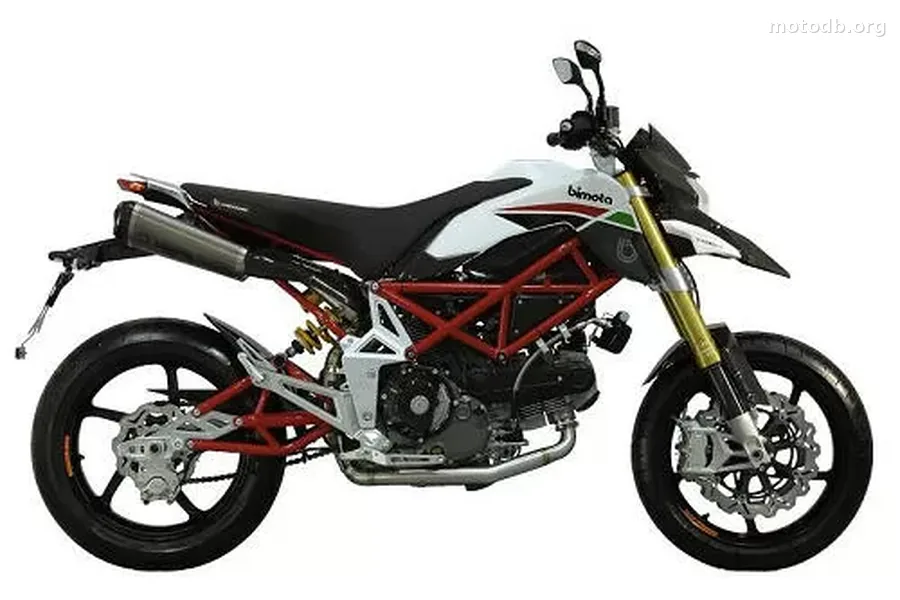
Rimini, 2012. A manufacturer that fits in a hangar, a handful of obsessive engineers, and a reputation built on three-digit machines in the catalog and five-digit invoices. Bimota has never sought to sell volume; it sells obsession. When the small Italian brand decides to venture into the high-end supermotard segment with the DB10 Bimotard, one expects something striking. The result is more nuanced.
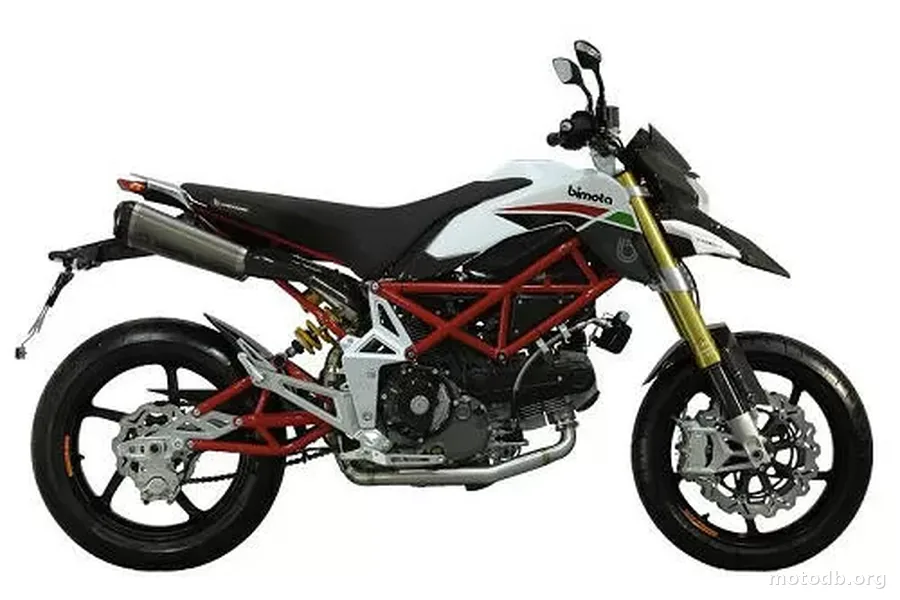
Let's start with what is unsettling. The DB10 is based on the 90° L-twin of 1078 cc from the Ducati universe, the one found in the Monster and the HM. This choice is consistent, but it creates an immediate perception problem: the overall silhouette too strongly recalls Bologna's Hypermotard. For a brand whose positioning relies on visual exclusivity, this is a difficult concession to swallow. At €20,790, one expects a stylistic scalpel, not such a pronounced family resemblance. Bimota enthusiasts deserved a sharper aesthetic.
That said, the mechanical architecture and the selection of components tell another story. The tubular steel trellis frame, supported by machined solid aluminum plates, constitutes a structure that is both lightweight and precise. The swingarm attracts all eyes, rightfully so, with a quality of execution that would make many production runs blush. The 50 mm diameter Marzocchi inverted fork works on 165 mm of travel, the Extreme Tech mono-shock manages the 140 mm at the rear. Four-piston radial Brembo calipers bite on 320 mm wave discs. This is a list of equipment that partly justifies the price, even if direct competition, a Husqvarna Nuda 900R or a KTM 990 SMR, offers equally refined chassis for a significantly lower budget.
The 98 horsepower delivered at 7500 rpm on a machine that weighs 168 kg dry is a frankly seductive equation. The 103 Nm of torque available from 5500 rpm ensures a frank and immediate response, characteristic of the L-twin with a large bore, here 98 mm for a stroke of 71.5 mm. The titanium exhaust line and the Bimota-refined engine mapping truly change the character of the twin compared to its original Ducati version. The 13.5-liter tank limits range, but on this type of machine, no one talks about grand touring. OZ Racing rims, carbon covers, the license plate holder, the side fairings: every detail contributes to a coherent and displayed weight reduction. The announced top speed of 220 km/h on a supermotard clearly signals the tone.
The target audience is narrow: the experienced rider who wants a muscular, traceable road machine with a very rare manufacturer's label. Not a beginner, not a touring rider, rather someone who already owns a sportbike and is looking for a different second tool, more urban and more playful. The DB10 Bimotard fulfills this contract halfway. The components are excellent, the mechanics efficient, the rarity guaranteed. But for a sum that far exceeds that of a competing KTM or an Aprilia Dorsoduro 1200, the lack of strong visual identity leaves a taste of a missed opportunity. Bimota knows how to build desirable objects; here, desire comes through the hands rather than the eyes.
Practical info
- La moto est accessible aux permis : A
Indicators & positioning
Similar bikes
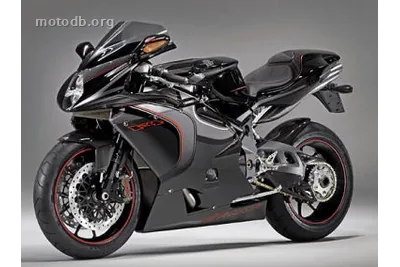
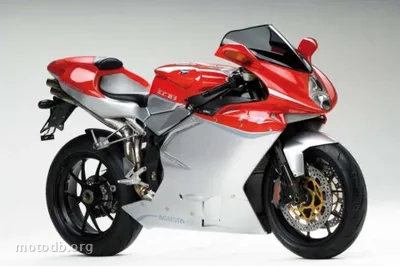
F4 1080 CR PLATINO
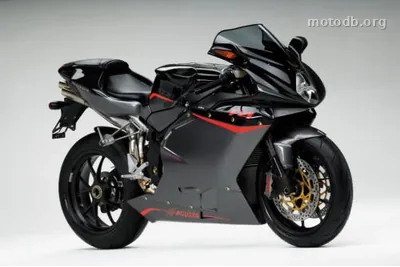
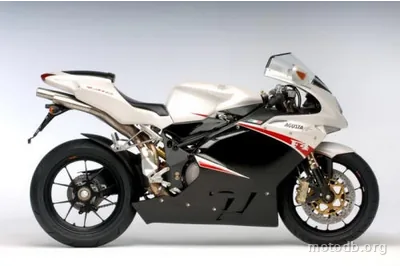
F4 1078 RR 312 Edizione Finale
Reviews & comments
No reviews yet. Be the first to share your opinion!