Key performance
Technical specifications
Engine
- Displacement
- 249 cc
- Power
- 25.0 ch @ 9500 tr/min (18.4 kW)
- Torque
- 21.0 Nm @ 7500 tr/min
- Engine type
- Monocylindre, 4 temps
- Cooling
- liquide
- Compression ratio
- 11.2 : 1
- Bore × stroke
- 72 x 61.2 mm
- Valves/cylinder
- 4
- Camshafts
- 2 ACT
- Fuel system
- injection Ø 37 mm
Chassis
- Frame
- Treillis en tubes d'acier
- Gearbox
- boîte à 6 rapports
- Final drive
- Chaîne
- Front suspension
- Fourche téléhydraulique inversée Ø 41 mm, déb : 120 mm
- Rear suspension
- Mono-amortisseur, déb : 51 mm
Brakes
- Front brakes
- Freinage 1 disque Ø 280 mm, étrier 4 pistons
- Rear brakes
- Freinage 1 disque Ø 240 mm, étrier simple piston
- Front tyre
- 110/70-17
- Rear tyre
- 150/60-17
Dimensions
- Seat height
- 835.00 mm
- Fuel capacity
- 17.00 L
- Dry weight
- 153.00 kg
- New price
- 3 800 €
Overview
While manufacturers keep piling technology onto their adventure bikes, inflating displacements and pushing prices toward Himalayan heights, Benelli takes the opposite approach and releases a 250 cc adventure-styled machine. Provocateur or visionary? Probably a bit of both.
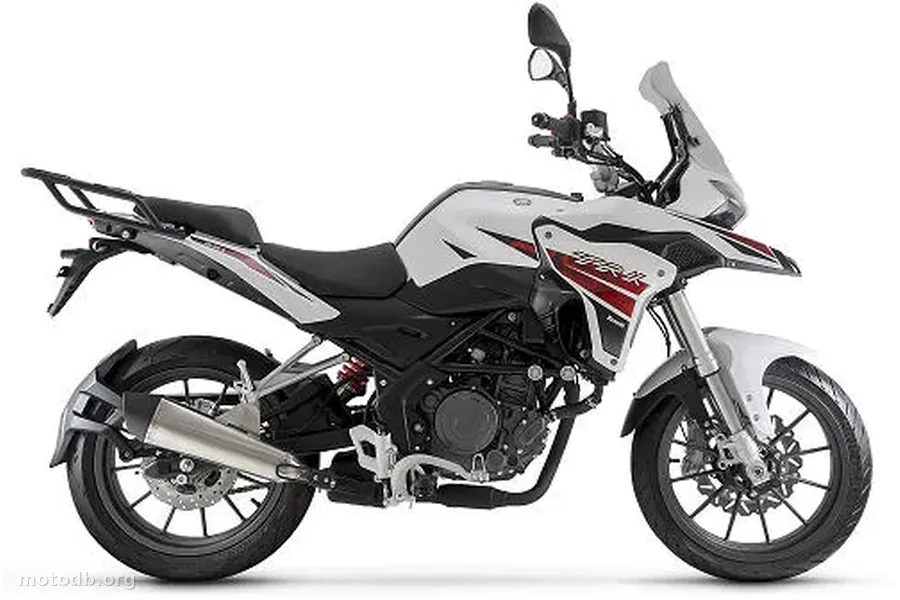
The TRK 251 makes no attempt to hide its origins. The design is a clear nod to the TRK 502, which itself borrows from the Ducati Multistrada. The family resemblance is obvious at first glance, and stylistic originality is clearly not the Pesaro brand's strong suit. But no matter: beneath that familiar bodywork lies a machine built around an in-house steel trellis frame, slimmer and lighter than its bigger sibling. The 249 cc single-cylinder four-stroke, with its 25 horsepower delivered at 9,500 rpm and 21 Nm of torque at 7,500 rpm, makes no claim to transcontinental adventure. It accepts its role as a commuter engine — nimble in the city, adequate on secondary roads, and sensible on the motorway beyond 130 km/h. The claimed top speed of 150 km/h leaves little margin for playing the hero on fast roads.
What the TRK 251 is really selling is physical and financial accessibility. At 153 kg dry and a seat height of 835 mm, it targets riders new to the adventure segment or those looking for a lightweight second bike for daily commuting. It is A2 licence compliant, and its catalogue price of €3,800 positions it against serious competition: the Suzuki V-Strom 250, the BMW G 310 GS, and the Kawasaki Versys-X 300. In this segment, every argument counts. The Benelli plays the equipment card visibly: a 41 mm inverted fork with 120 mm of travel, a 280 mm front disc clamped by a four-piston caliper, ABS, and Delphi fuel injection. The 17-litre tank is generous for the category. On the other hand, the centre stand and handguards are absent, which is surprising on a bike sold as an adventure tourer. The rear monoshock with only 51 mm of travel will not invite exploration of forest tracks either. The 17-inch wheels shod with road tyres confirm the vocation: this trail bike prefers tarmac to mud.
Benelli also announced a 125 cc version, sharing the same frame, the same weight and the same silhouette, but equipped with a smaller single-cylinder producing 12.8 horsepower. In this specific segment, the disappearance of the Honda Varadero 125 a few years ago left a gap that nobody had truly filled. If the TRK 125 does reach the European market, it will occupy this A1-licence adventure-tourer niche almost alone — a commercially interesting position, even if technically the competition from maxi-trail scooters is beginning to make itself felt.
The real gamble of the TRK 251 is not to rival an Africa Twin or a Tiger 900. It is to convince the first-time buyer or the savvy urban rider that an adventure bike is not necessarily an intimidating and ruinous machine. On that front, the Benelli has its arguments — provided you accept its limitations and do not ask more of it than it can deliver. A nimble weekday runabout, not a grand-horizons explorer.
Standard equipment
- Assistance au freinage : ABS
Practical info
- La moto est accessible aux permis : A
Reviews & comments
No reviews yet. Be the first to share your opinion!