Key performance
Technical specifications
Engine
- Displacement
- 998 cc
- Power
- 152.0 ch @ 10500 tr/min (111.8 kW)
- Torque
- 104.9 Nm @ 8500 tr/min
- Engine type
- 4 cylindres en ligne, 4 temps
- Cooling
- liquide
- Compression ratio
- 11.8 : 1
- Bore × stroke
- 74 x 58 mm
- Valves/cylinder
- 5
- Camshafts
- 2 ACT
- Fuel system
- Injection
Chassis
- Frame
- deltabox III, double poutre en alliage alu
- Gearbox
- boîte à 6 rapports
- Final drive
- Chaîne
- Front suspension
- Fourche téléhydraulique inversée Ø 43 mm, déb : 120 mm
- Rear suspension
- Mono-amortisseur, déb : 130 mm
Brakes
- Front brakes
- Freinage 2 disques Ø 298 mm, étrier 4 pistons
- Rear brakes
- Freinage 1 disque Ø 220 mm, étrier 2 pistons
- Front tyre
- 120/70-17
- Rear tyre
- 190/50-17
Dimensions
- Seat height
- 820.00 mm
- Fuel capacity
- 17.00 L
- Weight
- 200.00 kg
- Dry weight
- 172.00 kg
- New price
- 11 350 €
Overview
Who would have bet, at the beginning of the 2000s, that Yamaha would transform its circuit supercar, the R1, into a machine intended for open roads? Yet, that is exactly what they did with the Steel Fighter in 2003, a boldness that still generates discussion today. Rather than letting independent customizers take hold of the model, the Japanese firm took the initiative and entrusted the mission to Boxer Design, already known for its radical creations. The result is a motorcycle that does not hide its origins: beneath this reworked skin beats the heart of a 998 cm3 sportbike, capable of delivering 152 horsepower at 10500 rpm and a torque of nearly 105 Nm. We remain on a formidable technical base, with the Deltabox III frame, the 43 mm inverted fork, and the dual 298 mm disc braking system.
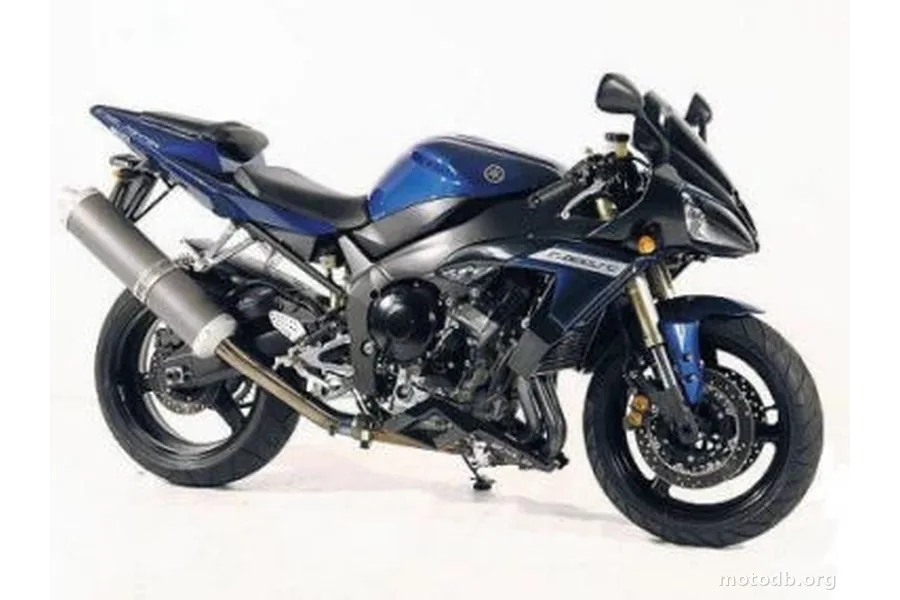
Compared to a standard R1 of the same generation, the Steel Fighter undergoes a profound change in character, especially if you opt for the flat handlebar offered as an option. This modification, almost essential for daily use, radically transforms the rider's posture. One abandons the combat position, broken on the front, for a more relaxed seat, without sacrificing the feeling of control and the direct connection with the machine. The rigidity of the frame and the responsiveness of the engine remain intact, but you gain tolerance for long journeys or urban rides. It is an intelligent evolution that shows that brute power can be civilized without being diluted.
The aesthetic work carried out by Thierry Henriette also deserves attention. Far from flashy transformations, it focuses on details that enhance the natural aggressiveness of the R1. The minimalist engine guard, the sculpted radiator fairings, and the specific fork head give the motorcycle the gaze of a predator, without superfluous additions. This restrained and effective approach makes the Steel Fighter a distinctive and coherent machine, which never falls into the trap of stylistic excess. One feels that each modification was thought to serve the function, not only to please the eye.
Ultimately, this Yamaha YZF-R1 Steel Fighter positions itself as a brilliant option for those seeking the performance of a pure sportbike, but refuse extreme compromises on comfort. With a wet weight of 200 kg and a 17-liter fuel tank, it is neither the lightest nor the most economical, but it offers a rare compromise between explosiveness and versatility. Its price, around 11350 euros at the time, placed it in the same range as its purely sporty competitors, but with a unique proposition. It is particularly suitable for the sporty touring rider or the track rider who also wants to be able to use his machine outside the circuit, without physical suffering. Yamaha has proven here that one can reinvent the identity of an icon without betraying its essence.
Practical info
- La moto est accessible aux permis : A
Reviews & comments
No reviews yet. Be the first to share your opinion!