Key performance
Technical specifications
Engine
- Displacement
- 998 cc
- Power
- 205.0 ch (150.8 kW)
- Engine type
- 4 cylindres en ligne, 4 temps
- Cooling
- liquide
- Bore × stroke
- 78 x 52.2 mm
- Valves/cylinder
- 4
- Camshafts
- 2 ACT
- Fuel system
- Injection Ø 45 mm
Chassis
- Frame
- Deltabox en aluminium
- Gearbox
- boîte à 6 rapports
- Final drive
- Chaîne
- Front suspension
- Fourche téléhydraulique inversée Öhlins Ø 43 mm
- Rear suspension
- Mono-amortisseur Öhlins
Brakes
- Front brakes
- Freinage 2 disques Ø 310 mm, fixation radiale, étrier 4 pistons
- Rear brakes
- Freinage 1 disque Ø 220 mm, étrier simple piston
Dimensions
- Fuel capacity
- 24.00 L
- Dry weight
- 175.00 kg
- New price
- 100 000 €
Overview
Motorcycle: Yamaha YZF-R1 1000 EWC GMT 94 (2011)
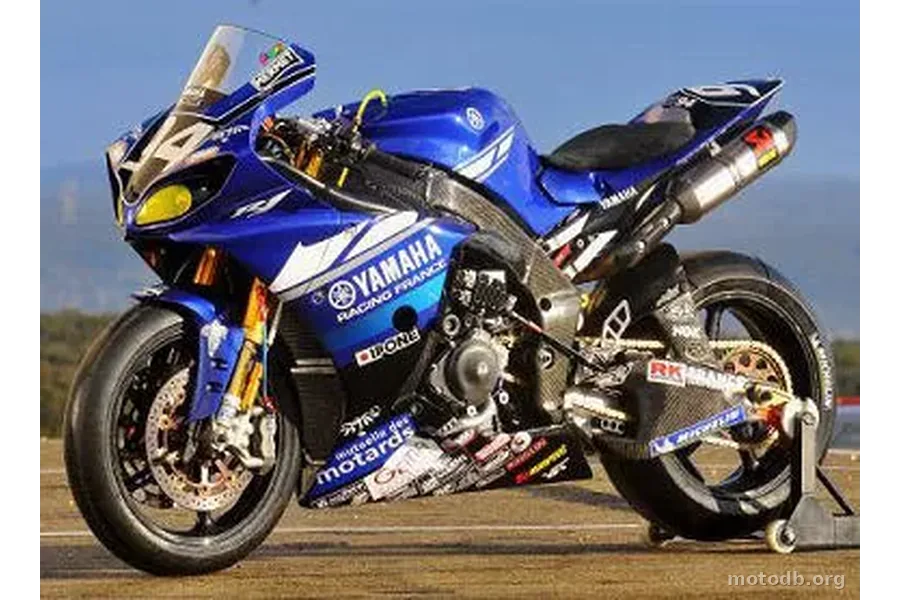
How to distinguish an endurance machine from a track superbike? The Yamaha YZF-R1 from GMT 94 offers a tangible answer. Beneath its carbon fiber fairing and electric blue paint, this 2011 version is not simply a disguised R1; it is a radical reinterpretation of the hypersport, forged for the 24 Hours of the Endurance World Championship.
Its sound signature is the first divergence. While the classic four-cylinder engines of other Japanese bikes sing a linear VROAARR, the Yamaha crossplane engine exhales a gritty and pulsed BROAAMBLRRR. This architecture, with its offset cranks, transforms the power and torque delivery. In standard form, 180 horsepower may seem modest compared to the 200 of the ZX-10R or the S 1000 RR. But here, after a Danielson Engineering preparation and the addition of YEC parts, the engine officially delivers 205 horsepower, a raw power adapted for long races. Overheating, an initial weakness, is now contained, even if the mechanics prefer to avoid prolonged stays in the redline.
The chassis, a 175 kg dry-weight aluminum Deltabox, appears conventional. But the endurance adaptations are crucial. The swingarm is reinforced and modified to withstand specific stresses. The trick lies in details that gain precise seconds during tire changes: the rear wheel ejects without needing to manipulate the chain, as the sprocket remains fixed. At the front, quick-release fittings on the hoses allow for instantaneous hydraulic interventions. These optimizations, coupled with a pressurized Öhlins FGR 900 fork and a TTX shock absorber, make this R1 a machine where every component aims for efficiency and rapid replacement.
Its 24-liter tank features a unique Stäubli valve for rapid filling, an expensive system but one that limits fuel emulsification. The Akrapovic exhaust replaces the old Laser, releasing that distinctive sound and improving flow. Despite this array of racing parts, the bike differs from superbikes by a notable absence: no electronic traction control. Christophe Guyot and GMT 94 rely on the experience and feel of the riders to manage these 205 horsepower, a philosophy that places the human at the center of the machine.
This YZF-R1 EWC, with a price approaching 100,000 euros, is not intended for beginners or even Sunday track riders. It is the tool of a professional team, designed for regularity and resistance over time, rather than explosive performance on a single lap. It proves that a motorcycle can be superb in detail, teeming with carbon fiber and ingenious solutions, while also being a formidable weapon on the track. It does not seek to beat the lap times of a qualifying session, but to survive and dominate in the relentless arena of a 24-hour race.
Practical info
- La moto est accessible aux permis : A
Reviews & comments
No reviews yet. Be the first to share your opinion!