Technical specifications
Chassis
- Frame
- monocoque CFRP
- Final drive
- Chaîne
- Front suspension
- Fourche téléhydraulique Ø nc
- Rear suspension
- Mono-amortisseur
Brakes
- Front brakes
- Freinage 1 disque
- Rear brakes
- Freinage 1 disque
Dimensions
- Dry weight
- 70.00 kg
Overview
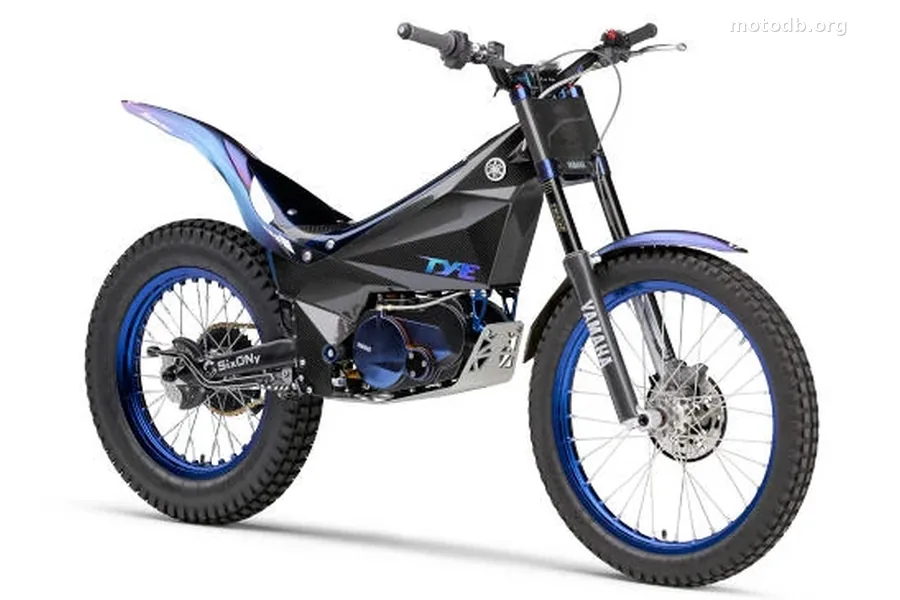
The trial segment has also begun its electric transformation. Yamaha is moving to a new stage of its TY-E with this 2.0 version, with the goal of achieving carbon neutrality for leisure motorcycles. The company plans to enter this prototype in certain rounds of the 2022 FIM (Fédération Internationale de Motocyclisme) Trial World Championship.
In 2021, the company revised the 2050 Environmental Plan of the Yamaha Motor Group, initially formulated in 2018, and set a new goal of achieving carbon neutrality across all of its business activities – including the lifecycle of its products – by 2050.
The ongoing development project of the TY-E 2.0 represents a unique approach by Yamaha to achieve carbon neutrality. Within the framework of its FUN x EV development concept, the TY-E 2.0 aims to offer more enjoyment than internal combustion engines by leveraging the characteristics inherent in electric vehicles, such as immediate torque at low RPM and strong acceleration.
The development of the TY-E 2.0 has progressed from the TY-E presented in 2018. The model consists of a new monocoque frame made of composite laminates integrating a higher-performance electric power unit, combining mechanical parts and electronic control. It also benefits from a new lightweight battery with a capacity approximately 2.5 times greater than the previous one.
The new TY-E 2.0 will be entered in the FIM Trial World Championship starting in June 2022. Kenichi Kuroyama of the Yamaha Factory Racing Team, also in charge of its development, will be the rider. The TY-E 2.0 will be displayed on the Yamaha Motor stand at the 49th Tokyo Motorcycle Show, held from March 25 to 27.
Monocoque composite laminate frame
The TY-E 2.0 uses a monocoque frame made of composite laminates to contribute to a lighter weight and optimal rigidity. The layout of the power unit and battery has been reviewed and corrected to achieve a significantly lower center of gravity than on the previous model.
New lightweight battery with approximately 2.5 times increased capacity
Yamaha has developed a new high-capacity battery (2.5 times greater than that of the previous model) while containing the weight increase to around 20%.
Improved power unit via optimized mechanical parts and electronic control
Based on the previous model, traction has been improved by combining mechanical parts such as the clutch and flywheel, with carefully tuned electronic control for the engine, capable of measuring subtle changes in grip.
Credits info and images: Yamaha
Reviews & comments
No reviews yet. Be the first to share your opinion!