Key performance
Technical specifications
Engine
- Displacement
- 689 cc
- Power
- 73.4 ch @ 8750 tr/min (54.0 kW)
- Torque
- 68.0 Nm @ 7750 tr/min
- Engine type
- Bicylindre en ligne, 4 temps, calé à 270°
- Cooling
- liquide
- Compression ratio
- 11.5 : 1
- Bore × stroke
- 80 x 68.6 mm
- Valves/cylinder
- 4
- Camshafts
- 2 ACT
- Fuel system
- Injection
- Starter
- électrique
- Euro standard
- Euro 5+
Chassis
- Frame
- type Diamant en tubes d'acier
- Gearbox
- boîte à 6 rapports
- Final drive
- Chaîne
- Front suspension
- Fourche téléscopique Ø 41 mm, déb : 130 mm
- Rear suspension
- Mono-amortisseur, déb : 139 mm
Brakes
- Front brakes
- Freinage 2 disques Advics Ø 298 mm, étrier 4 pistons
- Rear brakes
- Freinage 1 disque Nissin Ø 245 mm, étrier simple piston
- Front tyre
- 120/70-17
- Front tyre pressure
- 2.25 bar
- Rear tyre
- 180/55-17
- Rear tyre pressure
- 2.50 bar
Dimensions
- Seat height
- 830.00 mm
- Seat type
- Selle biplaces
- Fuel capacity
- 18.00 L
- Weight
- 203.00 kg
- New price
- 9 950 €
Overview
The Y-AMT arrives on the Tracer 7 of the 3rd generation. Available since late 2024 on the MT-07, it was somewhat surprising that the trail-tourer (based on the same roadster) didn’t immediately offer this robotic clutch. Time for the Tracer to find its footing?
Regardless, the Y-AMT finds its place on the 700 Tracer. Want to ride far and long? Let the system manage the gearbox with AT mode and its two gear shift laws, one soft and the other dynamic. The rider can take over at any time by switching to MT and shifting gears with a palette on the left handlebar control.
No more clutch lever, no more matching, no more over or under-revving. The Tracer gains all the convenience of an automatic gearbox. The €500 price increase isn’t staggering considering the technology, but the final price starts to make people cough for a 700 – at the level of a V-Strom 800SE.
With this Phase III, we are witnessing an evolution of the Tracer 7 from Yamaha rather than a revolution… Revised frame, adjustable fork, lengthened swingarm, subtle aesthetic and ergonomic modifications, improved electronics, Yamaha didn’t want to revolutionize a machine that is a hit, unlike the recipe applied for the (bold?) renewal of the Tracer 9.
Still powered by the famous CP2 engine from the brand with the tuning forks, this Tracer 7 is likely to surf the asphalt for a while longer.
At first glance, you might think it’s the same, yet, while retaining the DNA of the Tracer 7, Yamaha has nevertheless redesigned every element that makes up the motorcycle’s design. Broadly speaking, the motorcycle is less smooth. Take the lower fairing, it gains openings, more marked edges, and even scoops as if they wanted to play an aerodynamic role. With these modifications, the motorcycle gains character, relief if I may say so.
The visual signature of the lighting system has become an exacerbated point of the identity of a contemporary motorcycle and the marketing surrounding the model. For this version, Yamaha has emphasized this point with a unique animation of the position lights when the engine starts. It’s a shame, therefore, that the rider won’t see it, but it will impress friends, as the brand promises a unique three-dimensional effect and a premium look. For some, it’s enough to buy a motorcycle, apparently. Incidentally, on this point, the most tech-savvy will be delighted to learn that there is a choice of three turn signals for the indicators. The emergency braking light (ESS) activates the hazard lights in the event of sudden braking, and an automatic shut-off function turns off the turn signals after 15 seconds or 150 meters.
The aesthetic modifications have also made the motorcycle more practical. Thus, the design of the tank does not detract from the seductive side of the motorcycle but allows for an autonomy increased to 18 liters (+1 L). Since 2025, the model also receives more enveloping handguards, a good point for comfort on board with better protected hands from the wind or rain in winter.
The dashboard has a 5-inch color TFT screen and smartphone connectivity including turn-by-turn navigation via the free Garmin StreetCross app. To improve control of all these functions, the motorcycle is equipped with new handlebar controls that, according to the press release, will respond better to the first nudge. Next to the screen, there is now a USB-C socket to charge or connect the phone to the TFT screen system.
Yamaha has also chosen to include a revised riding position for the Tracer 7. You might be a little surprised if you jump from a 2024 (or earlier) model to the 2025 if you try it. Thus, the handlebar grips are now 30 mm higher and 25 mm wider on each side, the position is upright. Furthermore, the handlebar stem has been redesigned and incorporates a riser. The new two-piece seat should offer increased comfort for the rider and passenger. The rider's seat is adjustable over a range of 20 mm without tools. The new Tracer 7 will give the impression of a more touring and slightly less sporty machine at the handlebars. In this idea, the space dedicated to the passenger has also been improved with 40 mm of extra seat. The passenger grips have been redesigned.
The model since 2025 retains the already well-known structure of the Tracer 7. The steel frame is still there but has undergone some modifications to increase lateral, longitudinal and torsional rigidity. In the same vein, the swingarm has been lengthened by 40 mm and optimized for greater rigidity. Even good on the suspension side: the 41 mm inverted fork offers 18 adjustment levels in rebound only. At the rear, a shock absorber mounted on rockers has preload adjustments. Thus, the qualities of the Tracer 7 should be sublimated. By gaining rigidity, the motorcycle becomes more sporty in its mechanical qualities.
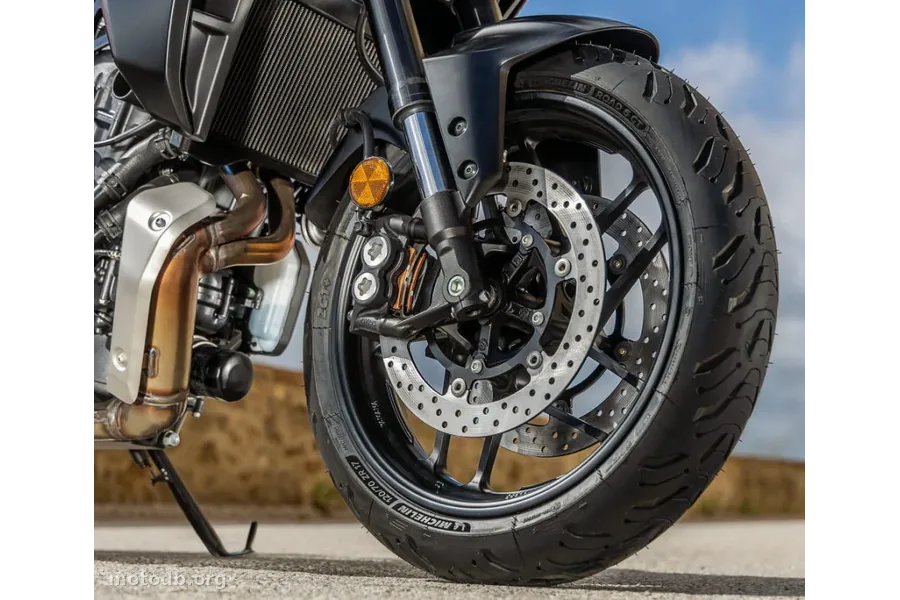
The braking evolves slightly with calipers whose purpose, divulged by Yamaha, is to better resist heavy braking even with a loaded motorcycle. The tires are Michelin Pilot Road 6 GT.
At the heart of this chassis, we still find the 690 cm3 CP2 engine and its famous 270° firing order that gives it spirit and character. It is now Euro5+ compliant, which takes away a bit of its famous pep. The values do not change with a maximum power of 54.0 kW (73.4 hp) at 8,750 rpm and a maximum torque of 68.0 Nm at 6,500 rpm. An assisted slipper clutch (A&S) perfects the engine / transmission relationship. This equipment reduces clutch lever pressure by 22% when shifting gears. This part also manages residual torque on the rear wheel, avoiding excessive engine braking during downshifts.
The TRACER 7 is also equipped with the Y-CCT (Yamaha Chip Controlled Throttle) and YRC (Yamaha Ride Control) systems. The first system allows for finer control of the throttle (electronic accelerator) while the second offers 3 riding modes to adopt according to your mood.
Two modes are predefined in the factory with the Sport and Street modes, to which a third Custom mode is added that can be defined by the rider via the TFT dashboard or the free MyRide app. The owner can customize this mode with three power maps and two levels of traction control. The latter can be completely deactivated. The Tracer 7 also receives a speed limiter from this year as standard. It can be activated from the third gear and beyond 40 km/h. To deactivate the speed limiter, simply press the button on the left handlebar control, brake, clutch or accelerate.
If solitary pleasure will still take all its meaning at the handlebars of the Tracer 7, we see that Yamaha has also chosen to improve its qualities in long-distance travel and in duo. A machine even more formidable therefore in terms of efficiency for a price close to €10,000. As before, the GTest version is reintroduced, with enough to consider touring more than daily use.
Vincent Beaucousin - Credits images: manufacturer
Standard equipment
- Assistance au freinage : ABS
- Nombre de mode de conduite : 3
- Taille de l'écran TFT couleur : 12,70 cm / 5 pouces
- Jantes aluminium
- Bluetooth
- Pare brise réglable
- Prise USB
- Régulateur de vitesse
- Indicateur de vitesse engagée
- Selle réglable
- Embrayage anti-dribble
Practical info
- Véhicule accessible au permis A2 ou bridable à 47.5ch / 35 Kw
- La moto est accessible aux permis : A, A2
- Pays de fabrication : France
Indicators & positioning
Similar bikes
NT700V Deauville
Nouvelle Tiger Sport 660
VERSYS 650 Mobility
Reviews & comments
No reviews yet. Be the first to share your opinion!