Key performance
Technical specifications
- Power
- 200.0 ch @ 13500 tr/min (146.0 kW) → 200.0 ch @ 13500 tr/min (147.1 kW)
- Torque
- 112.0 Nm @ 11500 tr/min → 113.8 Nm @ 11500 tr/min
- Engine type
- In-line four, four-stroke → 4 cylindres en ligne, 4 temps
- Cooling
- Liquid → liquide
- Compression ratio
- 13.0:1 → 13 : 1
- Bore × stroke
- 79.0 x 50.9 mm (3.1 x 2.0 inches) → 79 x 50.9 mm
- Camshafts
- — → 2 ACT
- Fuel system
- Injection. Fuel Injection with YCC-T and YCC-I → Injection
- Valve timing
- Double Overhead Cams/Twin Cam (DOHC) → —
- Ignition
- TCI: Transistor Controlled Ignition → —
- Starter
- Electric → —
- Frame
- Aluminum Deltabox → périmétrique Diamond en aluminium
- Gearbox
- 6-speed → boîte à 6 rapports
- Final drive
- Chain (final drive) → Chaîne
- Clutch
- Multiplate slipper clutch → —
- Front suspension
- 43mm Öhlins electronic suspension w/ inverted fork; fully adjustable → Fourche téléhydraulique inversée Öhlins Ø 43 mm, déb : 120 mm
- Rear suspension
- Öhlins electronic suspension w/ single shock w/piggyback reservoir, 4-way adjustable → Mono-amortisseur Öhlins, déb : 120 mm
- Front wheel travel
- 119 mm (4.7 inches) → —
- Rear wheel travel
- 119 mm (4.7 inches) → —
- Front brakes
- Double disc. ABS. Hydraulic. Four-piston calipers. → Freinage 2 disques Ø 320 mm, fixation radiale, étrier 4 pistons
- Rear brakes
- Single disc. ABS. Hydraulic. → Freinage 1 disque Ø 220 mm, étrier simple piston
- Front tyre
- 120/70-ZR17 → 120/70-17
- Front tyre pressure
- — → 2.50 bar
- Rear tyre
- 200/55-ZR17 → 200/55-17
- Rear tyre pressure
- — → 2.90 bar
- Seat height
- 861.00 mm → 860.00 mm
- Wheelbase
- 1405.00 mm → —
- Length
- 2055.00 mm → —
- Width
- 691.00 mm → —
- Height
- 1151.00 mm → —
- Fuel capacity
- 17.03 L → 17.00 L
- Weight
- 200.90 kg → 202.00 kg
- New price
- — → 27 999 €
Engine
- Displacement
- 998 cc
- Power
- 200.0 ch @ 13500 tr/min (147.1 kW)
- Torque
- 113.8 Nm @ 11500 tr/min
- Engine type
- 4 cylindres en ligne, 4 temps
- Cooling
- liquide
- Compression ratio
- 13 : 1
- Bore × stroke
- 79 x 50.9 mm
- Valves/cylinder
- 4
- Camshafts
- 2 ACT
- Fuel system
- Injection
Chassis
- Frame
- périmétrique Diamond en aluminium
- Gearbox
- boîte à 6 rapports
- Final drive
- Chaîne
- Front suspension
- Fourche téléhydraulique inversée Öhlins Ø 43 mm, déb : 120 mm
- Rear suspension
- Mono-amortisseur Öhlins, déb : 120 mm
Brakes
- Front brakes
- Freinage 2 disques Ø 320 mm, fixation radiale, étrier 4 pistons
- Rear brakes
- Freinage 1 disque Ø 220 mm, étrier simple piston
- Front tyre
- 120/70-17
- Front tyre pressure
- 2.50 bar
- Rear tyre
- 200/55-17
- Rear tyre pressure
- 2.90 bar
Dimensions
- Seat height
- 860.00 mm
- Fuel capacity
- 17.00 L
- Weight
- 202.00 kg
- New price
- 27 999 €
Overview
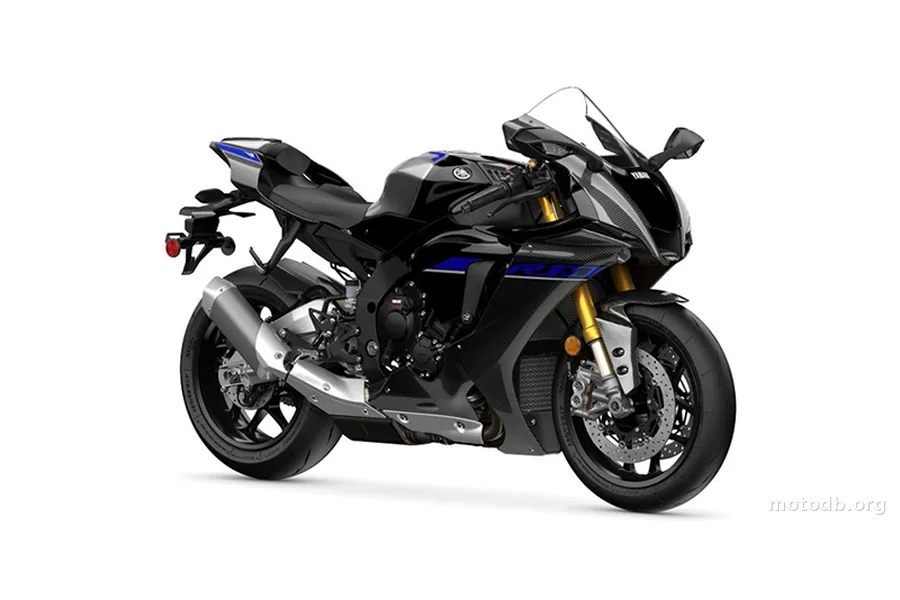
For several years, the R1-M has been Yamaha’s ultimate track bike. An almost accessible fantasy, unlike very exclusive sportbikes like the GYTR. In the crucible of lap times and trajectories, the R1M doesn’t wait for the years to leave their mark on its black carbon fiber skin. Like its R1 (without the M), the 2020 model brought its share of modifications to remain at its best and of its connecting rods. Efficiency for both, accomplishment for the M, and indulgence for the riders.
Let's briefly review the evolutions of the Yamaha R1: engine optimizations to meet Euro5 while retaining its 200 horsepower, slightly revised fairing with improved aerodynamic efficiency of 5%, 2-level ABS adjustable according to the angle, engine braking management, modified launch control assistant, redesigned exhaust with four catalytic converters, Bridgestone Battlax RS11 tire fit - all details are developed in the R1 datasheet. But what interests us is how the R1 M exploits its personal assets. First and foremost, its semi-active Öhlins suspension.
The Swedish manufacturer's "Electronic Racing Suspension" system is more effective with a 43 mm diameter pressurized Öhlins ERS NPX inverted fork. Inside the fork leg, a cylinder containing gas exerts an internal pressure of 0.6 MPa. This gas reduces fork oil cavitation caused by the negative pressure that occurs during rebound. Damping is more constant and agility is enhanced. Consequently, the rear damper is modified accordingly in terms of preload. Automatic or Manual, the system allows you either to trust it and let it take care of adjusting the settings permanently, or to fine-tune the suspension yourself and perfect the chassis without taking out the slightest tool. The only drawback is the weight. With this equipment, the R1M is slightly heavier than the standard model (+1 kg).
The other particularity of the M is its carbon fiber trim. Since the first R1M, the noble material has been used for the essential part of the fairing; until now it is also used for the rear shell. We actually wonder why Yam didn't do it sooner. A way to save weight and affirm its high-end character. A reinforced categorization marked by a numbered badge finding its place on the airbox cap. Its production number will be engraved on it.
All the electronics of the R1 are obviously present on the M, except that the latter wants to offer something extra to justify its involvement with riders. Rather, two things extra. 1/ The YRC Setting application, which allows users to create their own customized riding modes by adjusting the seven electronic control systems. The rider can choose the setting for each mode and, in some cases, deactivate certain electronic controls. 2/ The Y-TRAC. It is a telemetry recording and analysis system. It allows users to access the machine's communication control unit (CCU) and download a wide range of data to a mobile device. Thanks to Y-TRAC, it is possible to display and reread files in real time on Google Maps of a race circuit, to analyze and compare a host of information, from engine speed to lean angle to accelerations, and to discover when the various electronic assists were activated.
As at its beginnings, you don't buy an R1M like you're going to order a cake from the pastry chef; even if in both cases, you want to indulge yourself right away. You have to reserve it at the Yamaha dealer. Then, you have to face a sum that is almost violent. Welcome to this club where reason is common: an intense pleasure of riding.
M.B - Manufacturer photos
Standard equipment
- Assistance au freinage : ABS en curvas
- Nombre de mode de conduite : 4
- Taille de l'écran TFT couleur : 10,92 cm / 4.3 pouces
- Jantes aluminium
- Shifter
- Indicateur de vitesse engagée
- Aide au départ arrêté (Launch Control)
- Contrôle de traction
- Suspensions réglables électroniquement
- Contrôle anti wheeling
- Carénage carbone
- Jantes magnésium
- Contrôle de glisse
- Contrôle du frein moteur
Practical info
- La moto est accessible aux permis : A
Reviews & comments
No reviews yet. Be the first to share your opinion!