Key performance
Technical specifications
Engine
- Displacement
- 998 cc
- Power
- 200.0 ch @ 13500 tr/min (147.1 kW)
- Torque
- 113.8 Nm @ 11500 tr/min
- Engine type
- 4 cylindres en ligne, 4 temps
- Cooling
- liquide
- Compression ratio
- 13 : 1
- Bore × stroke
- 79 x 50.9 mm
- Valves/cylinder
- 4
- Camshafts
- 2 ACT
- Fuel system
- Injection
Chassis
- Frame
- périmétrique Diamond en aluminium
- Gearbox
- boîte à 6 rapports
- Final drive
- Chaîne
- Front suspension
- Fourche téléhydraulique inversée Ø 43 mm, déb : 120 mm
- Rear suspension
- Mono-amortisseur, déb : 120 mm
Brakes
- Front brakes
- Freinage 2 disques Ø 320 mm, fixation radiale, étrier 4 pistons
- Rear brakes
- Freinage 1 disque Ø 220 mm, étrier simple piston
- Front tyre
- 120/70-17
- Rear tyre
- 190/55-17
Dimensions
- Seat height
- 855.00 mm
- Fuel capacity
- 17.00 L
- Weight
- 201.00 kg
- New price
- 20 499 €
Overview
Sixty years of Grand Prix racing, half a thousand victories, and a lineage of champions that defies belief. This is the fertile ground on which Yamaha plants, in 2022, the R1 1000 World GP 60th Anniversary. A special edition that doesn't merely slip on a ball gown: it carries on its flanks the weight of a history that few manufacturers can claim with such legitimacy.
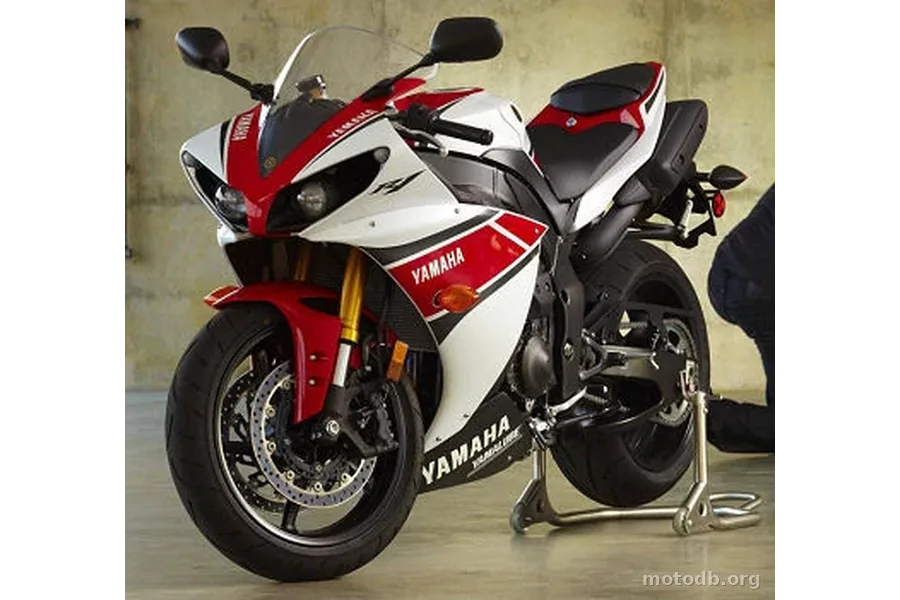
The red and white "Speed Block" livery harks directly back to the 60s and 70s, when these colors served as Iwata's visual signature on circuits around the world. Phil Read, Giacomo Agostini, Kenny Roberts, Wayne Rainey, Valentino Rossi, Fabio Quartararo: the list of riders associated with this aesthetic reads like a two-wheeled hall of fame. Yamaha doesn't do things by halves when it comes to finishing touches. Matte gold magnesium wheels, a front face recalling the yellow number plates of the era, a commemorative badge on the tank. Every detail has been designed so the machine tells a story before you even turn the key.
But beneath the paint, it's the mechanical package that really speaks volumes. The 998 cc inline four-cylinder develops 200 horsepower at 13,500 rpm, backed by 113.8 Nm of torque at 11,500 rpm. To put those figures in perspective, the anniversary R1 from ten years ago was nearly 20 horsepower down. The technological gap between the two generations is staggering. The perimeter aluminum frame contains 201 kg wet weight, a power-to-weight ratio that places this Yamaha on par with the best supersports on the market. Against the Kawasaki ZX-10R or the Ducati Panigale V4, the R1 plays in the same league with a slightly different philosophy—finer, more surgical in its responses.
The electronic arsenal has taken a considerable leap forward compared to previous generations. Six-axis inertial measurement unit, lean-angle-sensitive ABS, advanced traction control, wheelie control, engine brake management, bi-directional quickshifter, launch control, and multiple riding modes. The small color TFT display centralizes the lot, even if you'd wish for a slightly more generous format at this price point. Because the bill is steep: 20,499 euros for a machine that makes no secret of its track-focused calling. The seat perched at 855 mm, the 17-liter tank, and ergonomics designed for attack will not make this R1 a comfortable tourer. It clearly targets the experienced rider, the one who knows their racing lines and is looking for a precision instrument for track days or competition.
The real question with this anniversary edition is the matter of added value over the standard R1. The engine remains identical, the chassis too. You're paying for refined cosmetics and undeniable emotional capital. For a collector or an enthusiast of Yamaha's Grand Prix history, the premium is easily justified. For someone who simply wants the most effective supersport in the catalog, the standard version does exactly the same job on track. That said, this R1 60th Anniversary possesses a charm that numbers alone cannot convey: that of a machine bearing six decades of racing on its bodywork, with the mechanical nobility to back it up.
Standard equipment
- Assistance au freinage : ABS de série
Practical info
- La moto est accessible aux permis : A
Reviews & comments
No reviews yet. Be the first to share your opinion!