Key performance
Technical specifications
Engine
- Displacement
- 998 cc
- Power
- 200.0 ch @ 13500 tr/min (147.1 kW)
- Torque
- 113.8 Nm @ 11500 tr/min
- Engine type
- 4 cylindres en ligne, 4 temps, calage de type Crossplane - 270° - 180° - 90° - 180°
- Cooling
- liquide
- Compression ratio
- 13 : 1
- Bore × stroke
- 79 x 50.9 mm
- Valves/cylinder
- 4
- Camshafts
- 2 ACT
- Fuel system
- Injection
Chassis
- Frame
- périmétrique Diamond en aluminium
- Gearbox
- boîte à 6 rapports
- Final drive
- Chaîne
- Front suspension
- Fourche téléhydraulique inversée Ø 43 mm préparée Öhlins, déb : 120 mm
- Rear suspension
- Mono-amortisseur Öhlins, déb : 120 mm
Brakes
- Front brakes
- Freinage 2 disques Ø 320 mm, fixation radiale, étrier 4 pistons
- Rear brakes
- Freinage 1 disque Ø 220 mm, étrier simple piston
- Front tyre
- 120/70-17
- Rear tyre
- 190/55-17
Dimensions
- Seat height
- 855.00 mm
- Fuel capacity
- 17.00 L
- Weight
- 201.00 kg
- New price
- 35 100 €
Overview
Picture the scene. Jonathan Rea, six-time World Superbike champion, lands at Crescent Yamaha for the 2024 season after an entire career spent in Kawasaki colours. Naturally, it calls for a celebration. And rather than rolling out a simple commemorative sticker, the British outfit decided to cook up an R1 done to a turn, stamped with the number 65, built in 65 units, and with each chassis certified by hand by the Northern Irish rider and his team manager Paul Denning. That sets the stage.
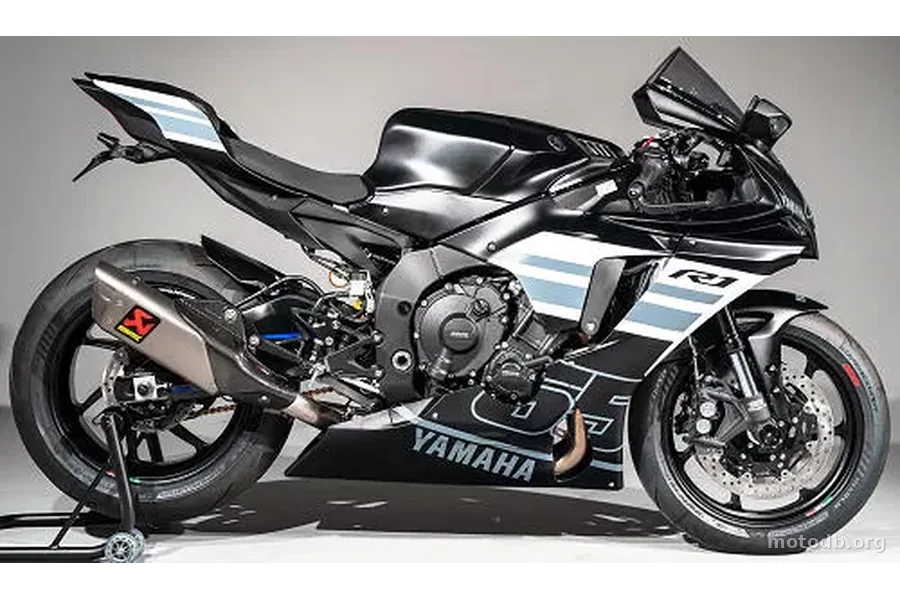
Beneath the skin, future owners are offered two choices: the official race livery campaigned this season, or the dark "Winter Test" scheme used during winter testing. I prefer the latter, more understated, almost clandestine, a world away from the usual flashiness of special editions. But you don't pay thirty-five thousand euros for paint alone. The base remains that of a 2024 R1, so the 998 cc Crossplane inline-four, with its unusual 270-180-90-180 firing order, 13:1 compression ratio and 200 horsepower delivered at 13,500 rpm. Torque peaks at 113.8 Nm for 201 kg fully fueled on the scales. Nothing new under the hood, but a platform that remains a benchmark against a Panigale V4 or an RSV4, even if Bologna and Noale have since pulled ahead on the electronics front.
Crescent fortunately dug into its pockets to justify the price tag. An Akrapovic titanium exhaust releases the Crossplane's signature growl, forged Marchesini wheels reduce unsprung mass, Pirelli SuperCorsa SPs stick to the tarmac, a Brembo 19 RCS master cylinder and HEL lines sharpen the lever bite, and final drive runs through a DID 520 chain with 16/41 Gandini sprockets. On the suspension side, Öhlins comes aboard, but without a full fork: only a NIX cartridge kit, springs and oil inside the stock 43 mm inverted fork, complemented by a TTX rear shock and a steering damper. A pity, at this price, one would have liked a full NIX 30.
Attention to detail goes further with GB Racing and GYTR protections, a JR-branded race seat, a "shark fin" chain guard, Pro-Bolt titanium fasteners, a carbon seat cowl and tank extension. For fans of surgical braking, a Brembo GP4-RX kit with T-Drive discs is priced at 2,000 pounds as an option, and an in-house garage pack adds 700 pounds. Seat height stays set at 855 mm and the 17-litre tank allows for decent track sessions before hunting for the pump, knowing that top speed still flirts with 300 km/h.
That leaves the awkward question. At 29,995 pounds, roughly 35,100 euros, this JR Replica costs nearly fifteen thousand euros more than a standard R1. For whom? Clearly not for the pragmatic trackday rider, who will prefer to invest the difference in tyres, fuel and a couple of well-chosen track sessions. This series targets the collector, the die-hard Rea fan, the one who wants a numbered piece before the R1 definitively disappears from European dealerships to survive only as a circuit-only version. Given that the previous Crescent edition vanished within thirty-six hours in late 2021, the 65 lucky chosen ones are probably already identified. The rest will watch the train go by, a 500-pound deposit in hand, wondering whether they really should have clicked faster.
Standard equipment
- Assistance au freinage : ABS de série
- Nombre de mode de conduite : 4
- Taille de l'écran TFT couleur : 10,92 cm / 4.3 pouces
- Jantes aluminium
- Shifter
- Amortisseur de direction
- Indicateur de vitesse engagée
- Aide au départ arrêté (Launch Control)
- Contrôle de traction
- Contrôle anti wheeling
- Jantes forgées
- Contrôle de glisse
- Contrôle du frein moteur
Practical info
- La moto est accessible aux permis : A
Reviews & comments
No reviews yet. Be the first to share your opinion!