Key performance
Technical specifications
Engine
- Displacement
- 998 cc
- Power
- 230.0 ch (169.2 kW)
- Engine type
- 4 cylindres en ligne, 4 temps
- Cooling
- liquide
- Bore × stroke
- 79 x 50.9 mm
- Valves/cylinder
- 4
- Camshafts
- 2 ACT
- Fuel system
- Injection
- Starter
- électrique
Chassis
- Frame
- périmétrique Deltabox en aluminium
- Gearbox
- boîte à 6 rapports
- Final drive
- Chaîne
- Front suspension
- Fourche téléhydraulique inversée Öhlins FGR 400 Ø 46 mm
- Rear suspension
- Mono-amortisseur Öhlins TTX36
Brakes
- Front brakes
- Freinage 2 disques Brembo Ø 320 mm, fixation radiale, étrier 4 pistons
- Rear brakes
- Freinage 1 disque Ø 220 mm, étrier 2 pistons
- Front tyre
- 125/70-17
- Rear tyre
- 200/60-17
Dimensions
- Seat height
- 855.00 mm
- Weight
- 175.00 kg
- New price
- 159 000 €
Overview
Twenty-five candles, and Yamaha isn't settling for a mere commemorative sticker. To celebrate a quarter-century of the R1, the Iwata manufacturer is rolling out the heavy artillery with a limited series that transforms its legendary sportbike into a near turnkey competition tool. The GYTR department, the brand's racing arm, has thrown open the floodgates of the Superbike catalogue to deliver a machine that barely knows what road codes are anymore.
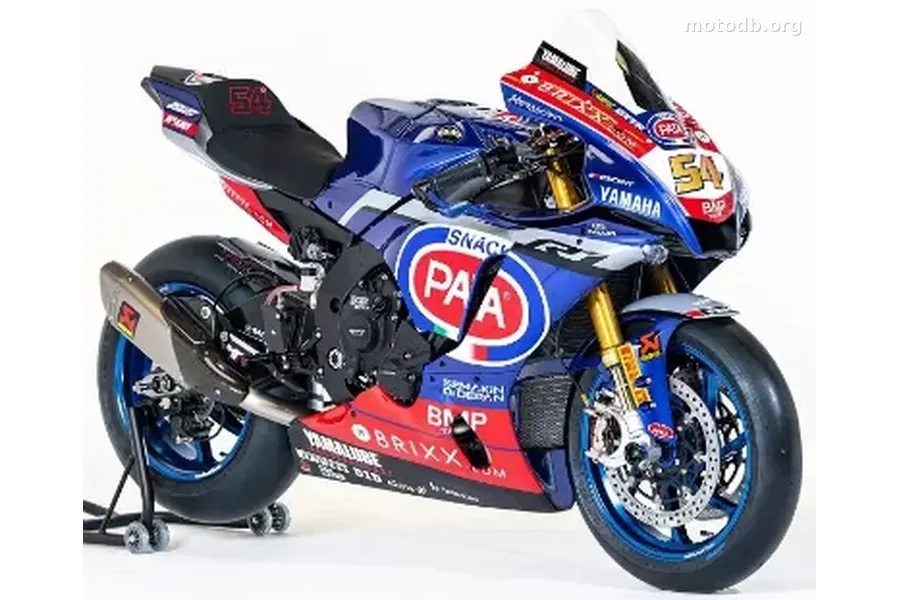
The specification brief fits in a single sentence. Take a production R1, and push it to the threshold of the WSBK paddock. The result, dubbed the GYTR Pro 25th Anniversary Limited Edition, lines up a kit that would make many private machines running in the championship turn pale. A swingarm lifted directly from the World Superbike bikes, forged aluminium Marchesini wheels shod with Pirelli Diablo SC2 slick compounds, pure racing dimensions with a 125/70 at the front and a 200/60 at the rear. The braking follows the same logic, with CNC-machined Brembo P4 EVO calipers, titanium pistons and a remote-adjust master cylinder, exactly the kit that equips world title contenders. To strike any harder, you'd have to go digging in the back rooms of MotoGP.
On the suspension side, the 46 mm Öhlins FGR 400 fork and the TTX36 mono-shock with pneumatic preload deliver performance you never come across at a regular dealership. Those gold legs alone cost the price of a brand-new MT-09 SP, which gives you a sense of the playing field. The aluminium Deltabox chassis retains its philosophy, but the tank has been redesigned to lower the centre of gravity and tip the bike over more aggressively. The 998 cc inline four-cylinder, still crossplane to the core, puts out 230 horsepower at the end of a serious build. Sharp camshafts, reinforced valve springs, racing spark plugs and head gasket, removal of the anti-pollution system via AIS plates, Suter clutch, full Akrapovic exhaust line, enlarged radiator and a dedicated Magneti-Marelli ECU. All of it managed by the GPES module, a data acquisition and control electronics package that plays in the big leagues of genuine factory machines, well beyond the simple anti-wheelie or launch control found on a V4 S or a Panigale V4 R.
Featherweight at 175 kg fully fueled, 855 mm seat height, top speed quoted at 320 km/h. The spec sheet could almost look ordinary next to a Ducati Panigale V4 R or a BMW M 1000 RR, but the gap widens elsewhere. The Italian V4 R trades around 45,000 euros, the Bavarian sportbike barely tops 35,000. Here, the entry ticket climbs to 159,000 euros, and you still have to be among the 25 chosen few to whom Yamaha will consent to deliver its toy. Only two examples will be dispatched to France, assembled not in Japan but in one of the two approved GYTR Pro Shops on French soil, with delivery scheduled for the first half of 2024.
Who is this machine aimed at, frankly. Not the Sunday track rider, even less the road rider pining for the 1998 R1. It takes a seasoned pilot, capable of sustaining a stopwatch pace to extract the quintessential marrow from this chassis. Enlightened enthusiasts will stand slack-jawed at the level of equipment, but most will never exploit more than a third of the potential. One notable frustration remains, the absence of adjustable footpeg plates on a bike dedicated to the track, which raises eyebrows given such positioning. Some of these R1s will end up under a cover in private collections, condemned to never howl on a circuit. A shame for them, they deserve better than the dust of a climate-controlled garage.
Standard equipment
- Jantes aluminium
- Shifter
- Amortisseur de direction
- Indicateur de vitesse engagée
- Aide au départ arrêté (Launch Control)
- Contrôle de traction
- Contrôle anti wheeling
- Carénage carbone
- Jantes forgées
- Contrôle de glisse
- Contrôle du frein moteur
- Limitateur de vitesse dans les stands
Practical info
- La moto est accessible aux permis : A
Reviews & comments
No reviews yet. Be the first to share your opinion!