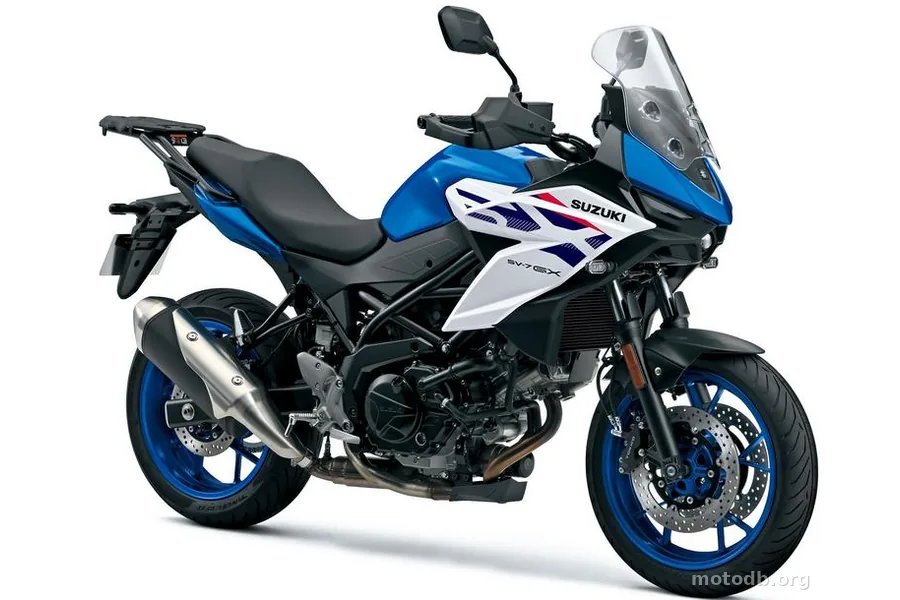
Key performance
Technical specifications
Engine
- Displacement
- 645 cc
- Power
- 73.0 ch @ 8500 tr/min (53.7 kW)
- Torque
- 64.0 Nm @ 6800 tr/min
- Engine type
- Bicylindre en V à 90°, 4 temps
- Cooling
- liquide
- Compression ratio
- 11.2 : 1
- Bore × stroke
- 81 x 62.6 mm
- Valves/cylinder
- 4
- Camshafts
- 2 ACT
- Fuel system
- Injection Ø nc
- Starter
- électrique
- Euro standard
- Euro 5+
Chassis
- Frame
- cadre treillis tubulaire en acier
- Gearbox
- boîte à 6 rapports
- Final drive
- Chaîne
- Front suspension
- Fourche téléhydraulique Ø 41 mm, déb : 125 mm
- Rear suspension
- Mono-amortisseur, déb : 129 mm
Brakes
- Front brakes
- Freinage 2 disques Tokico Ø 290 mm, étrier 4 pistons
- Rear brakes
- Freinage 1 disque Ø 240 mm
- Front tyre
- 120/70-17
- Rear tyre
- 160/60-17
Dimensions
- Seat height
- 795.00 mm
- Seat type
- Selle biplaces
- Fuel capacity
- 17.40 L
- Weight
- 211.00 kg
- New price
- 9 500 €
Overview
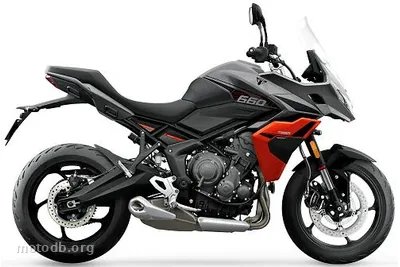
It’s so obvious that you wonder why SV fans haven’t asked for it sooner. Its engine is one of the most fun Suzuki has ever created, and its ease of use is legendary. The brand attempts the surprising and bold crossover of its large GSX-S1000GX trail-sport-tourer and the SV 650 roadster to create the crossover SV7-GX.
Right away, the machine exudes sympathy. Its fork head resembles that of the large GX but with rounded effects and a more mischievous frame, immediately giving it a small, playful side. We won’t go so far as to say the face is elegant—but simply abandoning the duo of stacked-lens headlights makes the identity expression much less complicated.
The most striking thing is its frame. The SV7-GX is truly compact, giving it a particularly light air and completely opposite to some productions that intimidate you with their mere presence. No, the Suz’ invites you to discover it. It, its cheerfulness, and its equipment.
Because it’s not enough to dress up. When you present yourself with a road-going appearance, the least you can do is enrich your equipment in that direction. First, there’s its fairing, which promises very correct protection. At least at the level of a Sport-GT. This fight against the elements will also be the action of the handguards and the 3-position, 50mm-adjustable bubble, standard. Adjustable… with tools. It’s difficult to accept these days to pull out a 6mm Allen key and mess with 4 screws when most adjustable bubbles are adjustable with one hand or electrically.
Let’s move on, because the 650 SV7-GX has other assets. Like its low seat at 695 mm from the ground, a quickshifter, a 17.4-liter fuel tank (2.9 liters more than the SV), a 10mm thicker seat, a well-integrated USB-C port next to its 4.2-inch color TFT screen, and a luggage rack. It’s a shame that its crude steel tube design isn’t more qualitative. All this is extra weight, isn’t it!?! Yes, impossible to cut it. 14 kg more, or 211 kg on the scale. A little more than a Tracer 7 and almost the same as the cousin DL 650 V-Strom.
Is it a trail like him? Its appearance approaches it but not its capabilities. Moreover, it absolutely does not seek to overshadow it. First, physically, you realize that it is more sporty. Also, the riding position is higher than on the SV 650 but less than on the V-Strom. The SV7-GX seeks the middle ground. Compared to the roadster, the feet are 10 mm lower, the handlebars 17 mm higher, and 24 mm closer to the rider. Which gives a relaxed but still dynamic position. The slightly wide handlebars also contribute to comfort while providing a larger lever arm for better engagement of the bike.
Why call it SV7 when the engine is 645 cm3? It’s more valorizing, and it joins the naming system of the GSX-8 (S, R, T, TT) and DR-4 (Set SM). So, no 700 underneath, but the good old 90° V-twin of the SV and V-Strom. The engine block exceeds a quarter of a century of existence without caring. It has its own character, the availability of the drive, and 73 horsepower when 8,500 rpm are reached. Suzuki is evolving it to be up to date. Already, the arrival of ride-by-wire will allow it to pair with plenty of electronics. Then, the intake has been revised to improve low-speed torque, whose maximum is 6.6 mkg, and above all to give more presence to the power in the high speeds. The catalytic converter and exhaust system have also been optimized. Note also the modernization of the alternator and some gearbox gears.
Well, what is this ride-by-wire story? It does exist a bit everywhere, doesn’t it? Indeed, but not yet on the SV. The 7-GX is the first in the family to receive it. No more throttle cable, more possibilities for electronics. So, the quickshifter can be active on upshifts and downshifts. The little crossover introduces STCS traction control at 3 levels and switchable, as well as 3 Riding Modes to modify the power distribution.
As a good Suzuki, the SV7-GX also has the Easy Start assist and the Low RPM Assist.
With 4.2 inches, the dashboard screen seems quite small. We get too used to more generous tablets, which only grow. It is still a size that corresponds to the mischievousness of the SV7-GX. Well presented, well arranged, the display shows you everything you need; plus turn-by-turn navigation, the weather, allows you to pilot the music and calls... once you have connected the smartphone. Also, the screen lighting adapts and switches depending on the brightness.
Its chassis is extremely close to the roadster, with its simple, proven elements and its steel trellis frame. Some elements have been retouched to adapt to its profile of a small traveler, such as the reinforcement of the supports and fixing points to hold the fairing and luggage. Then, the suspensions are recalibrated for use adequate to its missions. Which do not change, namely a 41 mm fork and a mono rear shock.
The same goes for the brakes, the SV trusting Tokico 4-piston calipers on 290 mm discs. They are sufficient and effective but lack feel and power in engaged use. The rear consists of a 240 mm disc with two pistons in the caliper. The swingarm is also identical, and a jarring low-end appearance that clashes with the general presentation. The wheels are new, however, with a 10-spoke profile.
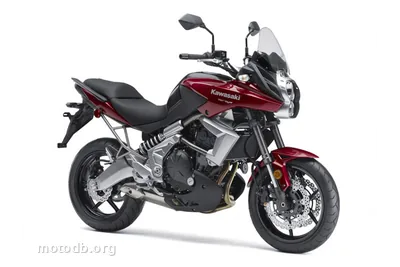
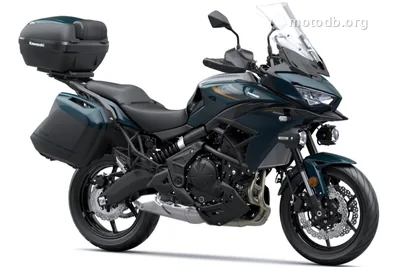
Not bad as an idea to transform the SV 650 into a crossover. This allows to offer a GX in a less imposing format and at a much more accessible price. Suzuki wants to launch it in the wheels of the Tracer 7 – hope for a price calibrated just below its radar, towards 9,500 euros. Nothing is played against a well-established Yamaha and a delightfully turbulent CP2 engine or a Kawasaki 650 Versys at a much lower price. The Suzuki will be able to count on its different engine architecture and not sad, its equipment and its offbeat freshness. It will be necessary to wait for the second semester of 2026 to discover it - it is far away….
M.B. - Photos constructeur
Standard equipment
- Assistance au freinage : ABS
- Nombre de mode de conduite : 3
- Taille de l'écran TFT couleur : 10,67 cm / 4.2 pouces
- Prise USB
- Contrôle de traction
- Shifter
- Aide au démarrage
- Indicateur de vitesse engagée
- Pare brise réglable
- Porte-paquet
- Protège-mains
- Bluetooth
- Jantes aluminium
Practical info
- Véhicule accessible au permis A2 ou bridable à 47.5ch / 35 Kw
- La moto est accessible aux permis : A, A2
- Pays de fabrication : Japon
Reviews & comments
No reviews yet. Be the first to share your opinion!