Key performance
Technical specifications
Engine
- Power
- 200.0 ch (147.1 kW)
- Engine type
- 4 cylindres en ligne, 4 temps
- Cooling
- liquide
- Valves/cylinder
- 4
- Camshafts
- 2 ACT
- Fuel system
- Injection
Chassis
- Frame
- périmétrique en alu
- Gearbox
- boîte à 6 rapports
- Final drive
- Chaîne
- Front suspension
- Fourche téléhydraulique inversée BPF Ø 43 mm
- Rear suspension
- Mono-amortisseur
Brakes
- Front brakes
- Freinage 2 disques Brembo, fixation radiale, étrier 4 pistons
- Rear brakes
- Freinage 1 disque , étrier simple piston
Dimensions
- New price
- 17 000 €
Overview
When Suzuki plays spoiler, it starts with a concept. Not a motorcycle available at dealerships, not a machine you can try on the track, but a promise displayed under showroom spotlights, surrounded by barriers and smiling communicators. The message, however, is clear: the GSX-R 1000 is back, it wants its crown, and it has done its homework.
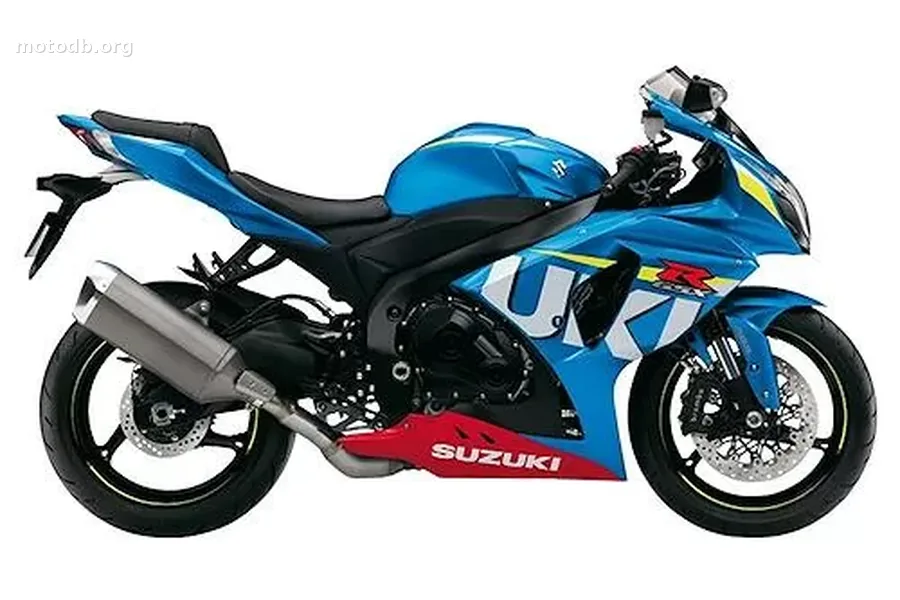
The design doesn’t induce vertigo. You immediately recognize the silhouette, the flanks, the blue and white DNA of the GSX-Rs of all time. The front optical unit wavers between several influences, the air intakes recall the SRAD heritage, and the rear gains clarity, perhaps at the expense of character. Less visually aggressive than its direct predecessors, the newcomer risks disappointing some track riders. But the competitors — ZX-10R, R1, CBR1000RR — won’t judge it on its bodywork. They will judge it on the lap times.
And there, the GSX-R has serious arguments to advance. The inline four-cylinder engine with a displacement of 999 cm3 announces 200 horsepower, a common ceiling for all high-end Japanese production and an 8% gain over the previous generation. What makes this engine unique in its category is the adoption of VVT, variable valve timing on the intake camshaft. No oil pressure like on the Kawasaki, but a centrifugal mechanism: steel balls housed in the camshaft gear migrate into grooves as the engine speed rises, thereby modifying the valve lift. The announced result is an engine that breathes better at low speeds and pulls higher in the rev range. The cams now work via bucket tappets, which pushes the rev limiter to 14,500 rpm, five hundred revolutions higher than before. The dual-body injection system, present since 2005, has also evolved, with a ramp relocated in the airbox that activates at mid-range. The SET-A system manages the exhaust gas outlet via three exhaust valves positioned at the junctions of the manifolds. Every gram of performance has been tracked, every optimization axis exploited.
Regarding structure, Suzuki promises the lightest and most aerodynamic of all GSX-R 1000s, across six generations combined. The K5 and K6 weighed in at 200 kg fully fueled, so the perimeter aluminum frame will aim to be under that limit. The suspension relies on Showa with the BPF 43 mm cartridge, the same solution as the recent ZX-10R, a technology directly inherited from competition. The front wheel stops on Brembo radial four-piston calipers, serious hardware, even if Kawasaki plays in another league with its M50 calipers and 330 mm discs mounted on aviation hoses. Here, the hoses remain standard, a small drawback on a machine announced at €17,000.
The electronics catch up on the accumulated delay, and this is the real fundamental novelty. Ten-level traction control — the competition peaks at eight — adjustable while riding, ABS, bidirectional quickshifter, launch assistant, three engine maps via the S-DMS. The dashboard switches to tablet format, functional but a little austere for a motorcycle of this price, especially when a color TFT screen would have been welcome. The lighting is completely LED, from the license plate to the daytime running lights.
This concept is still an open construction site. Suzuki has not communicated on all the technical details, the date of commercialization remains vague, and this status of "almost-ready" legitimately irritates fans of the brand. But behind the carefully measured communication, the substance is solid: a revolutionary engine for its category, a serious chassis platform, an electronics package that is finally up to the mark. Superbikes have reason to be wary. The GSX-R has never been so well armed to reclaim what it considers to be its own.
Standard equipment
- Assistance au freinage : ABS
Practical info
- La moto est accessible aux permis : A
Reviews & comments
No reviews yet. Be the first to share your opinion!