Technical specifications
Chassis
- Frame
- structure monocoque en aluminium
- Final drive
- Courroie
- Front suspension
- Fourche de type Fior
- Rear suspension
- Monobras et Mono-amortisseur
Brakes
- Front brakes
- Freinage
- Rear brakes
- Freinage 1 disque
Overview
Some names don't die. The 103 is one of those machines etched in the French collective memory, the one that offered millions of kids their first taste of independence between 1971 and 2006. No license needed, no extravagant pocket money required: just a little engine sputtering and a road ahead. Peugeot knew how to do that, to build popular icons. Then the brand disappeared from the two-wheeled landscape, leaving the field to the Japanese, the Italians, and the Chinese electrics. Thirty years later, the lion bares its claws, and it does so electrically.
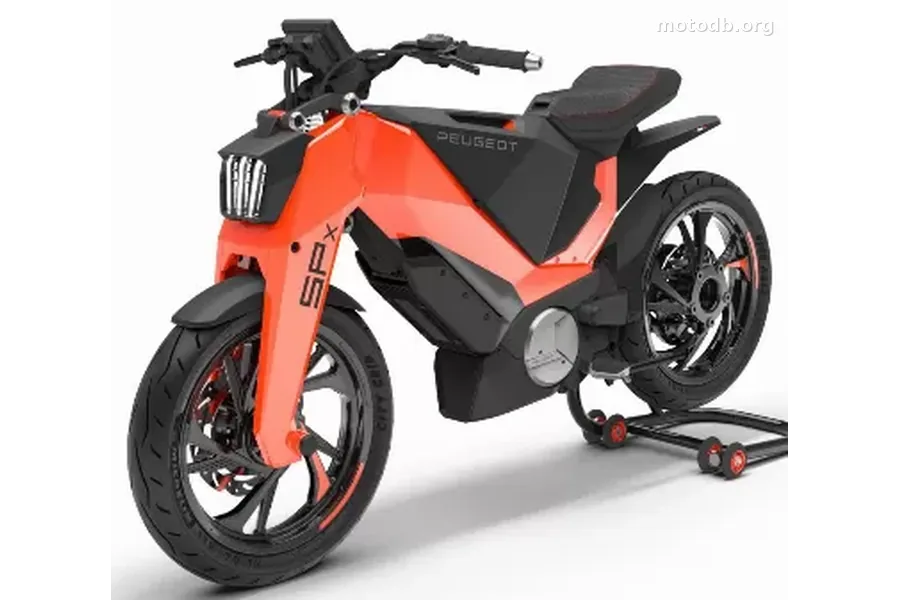
The SPx concept plays the madeleine card with a lot of restraint, which is rather good news. Too many revivals drown in folklore to the point of resembling costumes. Here, the lineage is readable without being loud: one recognizes the spirit without the machine being a nostalgic drip-fed copy. The headlight, in particular, reprises the light signature that Peugeot develops on its automobiles, already seen on the PM-01 prototype. It's consistent, it's familial, it's well done.
What is more impressive is the quality of the chassis announced for this prototype. A monocoque aluminum structure, a Fior-type fork at the front, a right-side monobras with a single shock absorber, and a belt to transmit torque. On a mid-range thermal motorcycle, one would pay dearly for this kind of chassis. On an equivalent 50 or 125 electric urban model, it is frankly audacious. Sochaux specifies from the outset that the base version will probably not include these premium solutions, but that the platform is designed for multiple variations. Modular architecture is precisely the central argument of the project.
And ideas are not lacking. The height-adjustable saddle via a telescopic stem, the optional battery pack that fits into the triangle between the handlebars and saddle, the accessories designed to transform the machine into a pseudo-scooter according to needs: Peugeot is clearly thinking of an ecosystem, not just a motorcycle. It's the logic of the electric bicycle transposed to motorized two-wheeled vehicles, with an after-market approach that could prove judicious if prices remain reasonable. The two removable batteries standard equipment are in the right direction for daily practicality, and the announced target of 80 kilograms on the scale would be, if achieved, a serious performance in the category.
The problem is that we know almost nothing about the actual performance. No power figures, no range data, no price. French production is mentioned, as are recyclable materials, along with the usual litany of formulas about the mobility of tomorrow that we have been reading everywhere for ten years. This vagueness is understandable for a concept, but Peugeot is targeting a commercial launch in 2025 and the market will not wait. Honda, Silence, Vmoto, and a few others already have homologated, delivered, tested machines. The SPx arrives in a segment that already exists. For the lineage with the 103 to hold the road beyond emotion, one thing will be needed that the lion has not yet revealed: a price that does not betray the popular vocation of the original.
Standard equipment
- Assistance au freinage : ABS
Practical info
- La moto est accessible aux permis : A
Reviews & comments
No reviews yet. Be the first to share your opinion!