Key performance
Technical specifications
Engine
- Displacement
- 998 cc
- Power
- 200.0 ch (147.1 kW)
- Engine type
- 4 cylindres en ligne, 4 temps
- Cooling
- liquide
- Compression ratio
- 13 : 1
- Bore × stroke
- 76 x 55 mm
- Valves/cylinder
- 4
- Camshafts
- 2 ACT
- Fuel system
- Injection Ø 47 mm
Chassis
- Frame
- double poutre périmétrique en alu
- Gearbox
- boîte à 6 rapports
- Final drive
- Chaîne
- Front suspension
- Fourche téléhydraulique inversée Öhlins FGR 700 Ø 43 mm
- Rear suspension
- Monoamortisseur Öhlins TTX
Brakes
- Front brakes
- Freinage 2 disques Ø 310 mm, fixation radiale, étrier 4 pistons
- Rear brakes
- Freinage 1 disque Ø 220 mm, étrier simple piston
- Front tyre
- 120/70-17
- Rear tyre
- 190/55-17
Dimensions
- Fuel capacity
- 24.00 L
- Weight
- 178.00 kg
- New price
- 100 000 €
Overview
We often talk about sacred monsters, but this one doesn't come from a fairy tale. It comes straight from the bowels of the Kawasaki factory, with a single idea in mind: to devour lap times on endurance circuits. In 2011, when the third generation of ZX-10R arrived, it sent a clear message to the competition. Under its fairing, a 998 cm3 inline four is ready to cheerfully unleash its 200 horsepower, all wrapped in a chassis designed for Superbike racing and loaded with electronics. The Ninja wasn't here to play a cameo role among Japanese hypersport bikes.
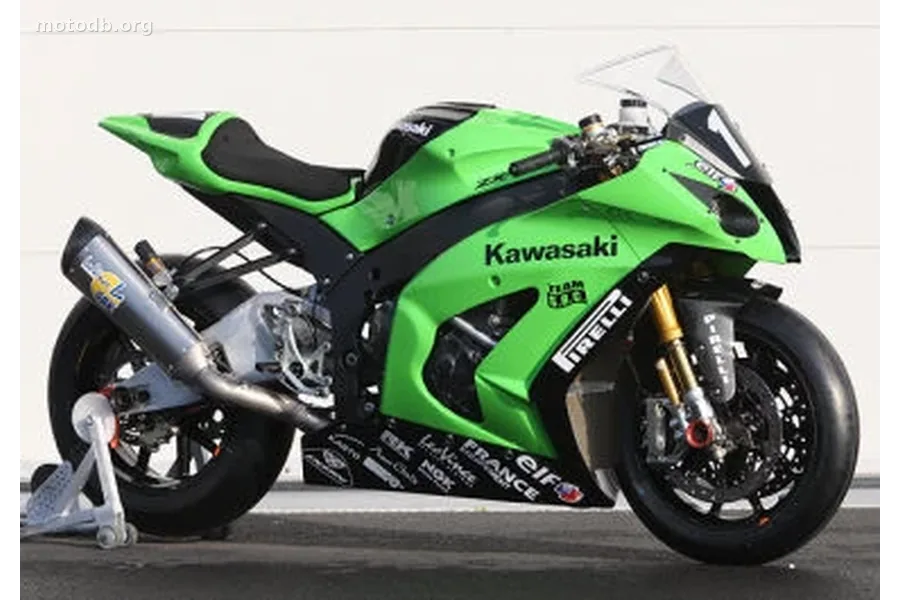
However, the true baptism of fire, this EWC version underwent at the Bol d’Or, an event that separates the wheat from the chaff. Prepared by the GSR team of Gilles Stafler, the green beast didn’t tremble. It swallowed the 24 hours to finish second, just six laps from the winner. It owes this result not to a simple aesthetic makeover. It's a surgical transformation. All the superfluous is thrown in the trash, lightening the machine by about twenty kilos. The engine, prepared by Team SRC, gains even more bite, cheerfully exceeding the advertised 200 horsepower mark. We are here in the realm of a pure race machine.
The chassis also undergoes a radical rejuvenation. The original suspensions are gone, making way for high-end Öhlins. At the front, the pressurized FGR 700 fork, equipment from MotoGP, offers a setting and braking of surgical precision. At the rear, the TTX mono ensures the same level of requirement. The 16.5-inch Marchesini rims are dizzyingly light, and the Nissin braking system, with its Staübli quick connectors, allows for caliper changes in the blink of an eye. Every detail is optimized for racing, like the LeoVince exhaust which releases the breath and lightens the whole.
But an endurance motorcycle is not just about pure speed. It's a war logistics. The standard tank is replaced by a 24-liter model with quick valves, allowing for one-hour relays and lightning-fast refueling in 15 seconds. The quick wheel change system, although artisanal, is crucial. Grappling a second at each stop may seem insignificant, but over 24 hours, it transforms into a decisive advantage. It is these details, painstakingly crafted by the teams, that make the difference between second place on the podium and victory.
This ZX-10R EWC is obviously not made for the road. At €100,000, it is a pure competition instrument, a weapon designed to dominate the longest and most demanding events. It is aimed at professional teams who live to the rhythm of the 24 Hours of Le Mans or the Bol d’Or. For the amateur rider, it is a fantasy object, proof that at Kawasaki, the madness of scale translates into brutal and effective engineering. It has only one goal: to go fast, turn, and win. The rest is just literature.
Practical info
- La moto est accessible aux permis : A
Reviews & comments
No reviews yet. Be the first to share your opinion!