Key performance
Technical specifications
Engine
- Displacement
- 636 cc
- Power
- 124.0 ch @ 13000 tr/min (91.2 kW)
- Torque
- 68.6 Nm @ 10800 tr/min
- Engine type
- 4 cylindres en ligne, 4 temps
- Cooling
- liquide
- Compression ratio
- 12.9 : 1
- Bore × stroke
- 67 x 45.1 mm
- Valves/cylinder
- 4
- Camshafts
- 2 ACT
- Fuel system
- Injection Ø 38 mm
- Starter
- électrique
Chassis
- Frame
- périmétrique en aluminium
- Gearbox
- boîte à 6 rapports
- Final drive
- Chaîne
- Front suspension
- Fourche téléhydraulique inversée Ø 41 mm, déb : 120 mm
- Rear suspension
- Mono-amortisseur, déb : 151 mm
Brakes
- Front brakes
- Freinage 2 disques Nissin Ø 310 mm, fixation radiale, étrier 4 pistons
- Rear brakes
- Freinage 1 disque Ø 220 mm, étrier simple piston
- Front tyre
- 120/70-17
- Rear tyre
- 180/55-17
Dimensions
- Seat height
- 830.00 mm
- Seat type
- Selle biplaces
- Fuel capacity
- 17.00 L
- Weight
- 198.00 kg
- New price
- 11 699 €
Overview
What do we have as a track bike today? Plenty! Desmo RR 1000s, R1s, Panigales, Norton V4 SVs, CBR 1000s, RSV4s, etc... All big bruisers with a minimum of 200 hp in the package; except for the British one, which doesn't play the same game. But what if we want something softer, like something other than a superbike on the road!? Easy: an R7, a CBR 650 R, a Ninja 650....
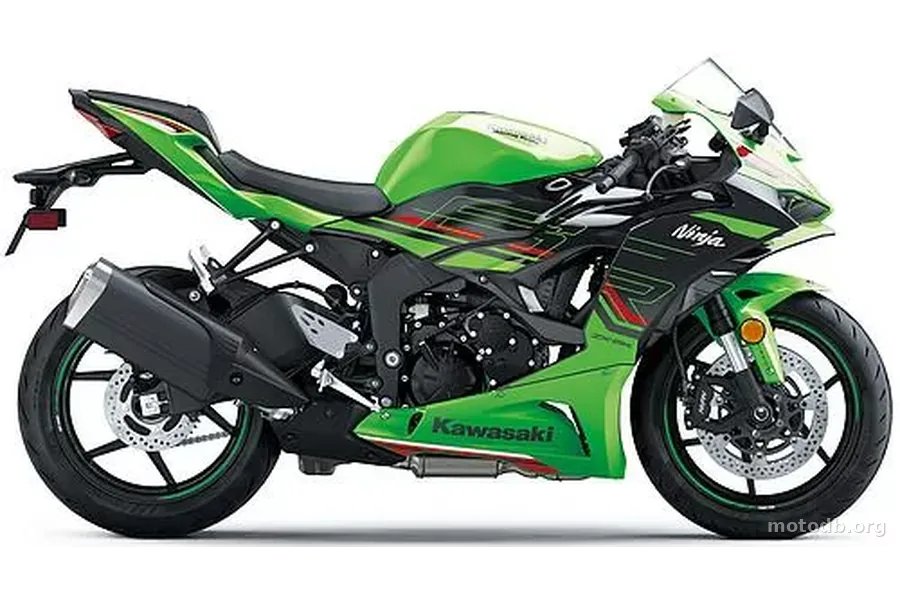
No, no, you haven't understood... A sporty bike with a good dose of power but reasonable, a thing that screams in the revs, that goes on track and (a little) on the road, that you have to wring out, pilot. A ZX-6R, that's it! Fans were heartbroken when this Kawa disappeared from dealerships in 2020. But surprise! The firm of Akashi isn't abandoning it and has relaunched it under a new version in 2024.
Which relies entirely on its lineage to remodel its face. The headlights become more discreet, leaving priority for the design to aerodynamic appendages carefully integrated. Kawasaki also works on winglets for its sportbikes but unlike the competition. From MotoGP to hypersports, spoilers have seeded on the sides of the fairing. Not with the ZX-Rs. The 1000 pioneered a very particular placement, directly in the fork head. The ZX-6R does the same, with aerodynamic channels embedded under the corner of the headlights.
Small tweaks for the panels and the belly pan, a few elements painted in black, a new bubble, hybrid projector/reflector LED headlights - This will be the essence of the design evolutions. For the rest, the 636 ZX-6R relies in large part on the design of its predecessor. But to be able to ride on our roads, the inline 4-cylinder had to accept certain conditions. And as a result, revise its internals.
What happened to that old fire-breather!? It received good driving instruments: ACT cam profiles reworked, intake and exhaust manifolds revised. The goal was not to gain power but to limit the damage when obtaining Euro5. The ZX-6R 636 loses 6 horsepower in the process. Its engine now distributes 124 horsepower at 13,000 rpm, or 129 with forced air intake. The torque also takes a small beating but still offers 7 Nm at 10,800 rpm. Kawa worked on more efficiency at low and mid-revs to compensate for this loss of power. Coincidence of genesis: this 636 cm3 displacement was chosen in 2002 to offer more responsiveness to this engine than the 600 block of its monozygotic sister, and to outdo the other 600s on the market.
This engine has been the darling of the 6R and defends a thrilling philosophy that is becoming rare. To move this mechanicals, the perimeter aluminum frame and the large swingarm are renewed without the need to evolve. Same for the 41 mm Showa SFF-BP inverted fork and its rear damper counterpart, both fully adjustable. We only note a change on the brakes. The 310 mm discs are no longer petal-shaped (Kawa had launched the trend in the 2000s) but perfectly round, with no roughness on the edges. The calipers remain 4-piston radial Nissin, controlled by a radial master cylinder as well. They will have no trouble calming the 198 kilos of the Ninja. Two more than the previous generation. Not bad but.... More time passes and more it gets heavier. It weighed 7 less in the '10s. Ah, I forgot. The tires have also changed. The Italians are on board, with Pirelli Diablo Rosso IV envelopes.
To keep up with the trend in the sector, Kawasaki could not compromise on a color TFT dashboard. Almost all motorcycles of the latest generation have one now. The 109 mm dashboard takes over the graphic charter now well established with the greens. It is pleasant, clear, precise; it connects to the smartphone via Bluetooth, and it allows you to supervise the Riding Modes. This is the electronic novelty finally adopted by the ZX-6R. It previously had (2) power modes and a 3-level traction control. All is now modulated by the 4 Riding Modes that are Sport - Road - Rain - or Rider (customizable). A quickshifter (for upshifts) and an ABS with anti-stoppie function complete the electronic assistance.
The anxiety will not be with the motorcycle's efficiency but with its price. The latest version was made accessible, with a choice of price reduction. Given the global inflation and the dance of torments on the labels, the ZX-6R is obliged to ask for more euros. 900 to be exact - but there is no doubt that without the troubled period we are going through, the price would not have moved.
To market a 600 Supersport in Europe these days, you simply have to have faith. The E4 and E5 standards, as well as the climate of obsessive repression, have ruined the market for sportbikes. (except at Ducati). But not the market for fire-breathing roadsters. If we still find 600 GSX-Rs and the whole gang on other continents, the old one is only entitled to R6s limited to track use; let's salute Honda's poker move in re-introducing the CBR 600 RR last year - and the renewal of the ZX-6R! The best enemy of the Yamaha is back in the fight with a new look, more electronics and a sport spirit almost extinct. Let's salute, dream, dare; and as Fox Mulder would say: "I want to believe".
M.B - Photo manufacturer
Standard equipment
- Assistance au freinage : ABS
- Nombre de mode de conduite : 4
- Taille de l'écran TFT couleur : 10,92 cm / 4.3 pouces
- Jantes aluminium
- Shifter
- Indicateur de vitesse engagée
- Bluetooth
- Contrôle de traction
- Embrayage anti-dribble
Practical info
- La moto est accessible aux permis : A
- Pays de fabrication : Japon
Reviews & comments
No reviews yet. Be the first to share your opinion!