Key performance
Technical specifications
Engine
- Displacement
- 636 cc
- Power
- 124.0 ch @ 13000 tr/min (91.2 kW)
- Torque
- 68.6 Nm @ 10800 tr/min
- Engine type
- 4 cylindres en ligne, 4 temps
- Cooling
- liquide
- Compression ratio
- 12.9 : 1
- Bore × stroke
- 67 x 45.1 mm
- Valves/cylinder
- 4
- Camshafts
- 2 ACT
- Fuel system
- Injection Ø 38 mm
Chassis
- Frame
- périmétrique en aluminium
- Gearbox
- boîte à 6 rapports
- Final drive
- Chaîne
- Front suspension
- Fourche téléhydraulique inversée Ø 41 mm, déb : 120 mm
- Rear suspension
- Mono-amortisseur, déb : 151 mm
Brakes
- Front brakes
- Freinage 2 disques Ø 310 mm, fixation radiale, étrier 4 pistons
- Rear brakes
- Freinage 1 disque Ø 220 mm, étrier simple piston
- Front tyre
- 120/70-17
- Rear tyre
- 180/55-17
Dimensions
- Seat height
- 830.00 mm
- Fuel capacity
- 17.00 L
- Weight
- 198.00 kg
- New price
- 12 849 €
Overview
Forty candles for the Ninja lineage, and Kawasaki chooses to blow them out with one of the last mid-displacement sportbikes still in the catalog. The ZX-6R 636 40th Anniversary edition lands in 2024 as a living reminder of an era when 600 Supersports made the paddocks tremble. While Honda and Suzuki have shelved their GSX-R and CBR 600, the green machine persists. You have to respect the stubbornness.
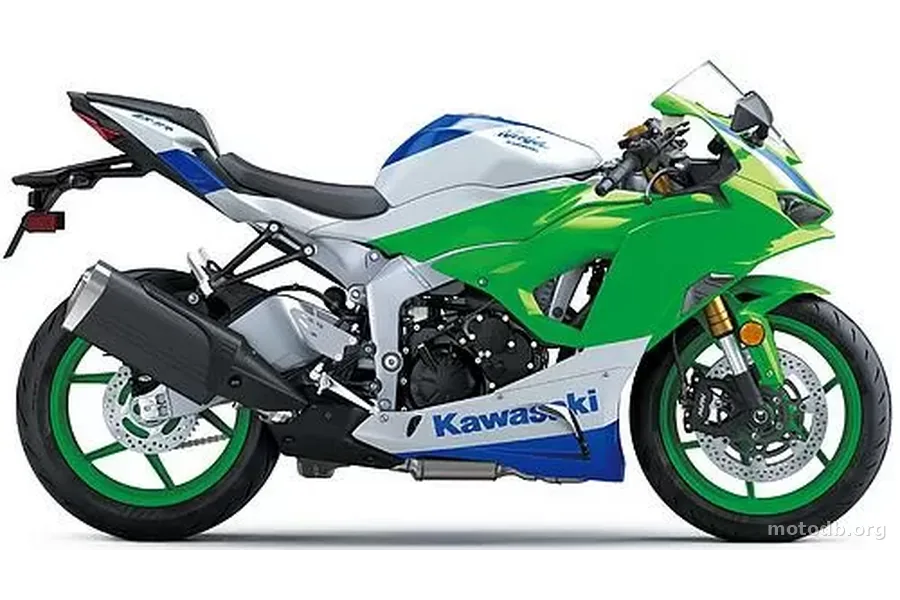
This 636 cc inline four-cylinder develops 124 horsepower at 13,000 rpm with 68.6 Nm of torque at 10,800 rpm. On paper, it seems modest compared to today's hypersportbikes. In reality, it's an engine that gives nothing below 8,000 rpm then literally explodes into the upper rev range. The kind of character that the Yamaha R7 and its docile twin simply cannot offer. Here, you have to go hunt for the power, earn it. The 12.9:1 compression ratio and the short 67 mm bore paired with a 45.1 mm stroke confirm the calling: this engine is built to scream. Riders accustomed to big twins or naked bikes will be thrown off. Pure sensation enthusiasts, on the other hand, will rediscover the original Supersport thrill.
The anniversary livery pays tribute to the ZXR 750 Stinger, the bike that launched Kawasaki into the World Superbike and Endurance racing scene. The signature green returns on the wheels and part of the fairing, paired with blue and white stripes that seriously pop. The aluminum perimeter frame and swingarm ditch their usual black for a raw metal finish, a direct nod to the sportbikes of the 80s and 90s. The 41 mm inverted fork sports gold-finished outer tubes, an unabashed reference to the ZXR 400 and 250 of yesteryear. A 40th anniversary badge sits proudly on the 17-liter tank. The whole package is cohesive, sincere, never gimmicky.
On the chassis side, the recipe is proven. Aluminum perimeter frame, 198 kg wet weight, seat height perched at 830 mm. The riding position is aggressive — wrists low, knees tucked in. This is not a machine for devouring highway miles. It's a scalpel built for corners, hard braking on the twin 310 mm discs with four-piston radial calipers, and snappy acceleration thanks to the six-speed gearbox fitted with a quickshifter. The rear brake, handled by a single 220 mm disc, does the bare minimum. The 2024 electronics temper the raw character: traction control, four riding modes, KIBS intelligent ABS, a 4.3-inch color TFT display, and smartphone connectivity. The essentials, with no superfluous gadgets.
At 12,849 euros, the Ninja ZX-6R 636 40th Anniversary sits in a segment it occupies virtually alone. The R7, more affordable, plays in a different category with its twin. The 1000 cc sportbikes, more powerful, are also heavier, pricier, and more intimidating. This Kawasaki is aimed at regular track riders who want an exploitable machine without needing 200 horsepower, at those nostalgic for the four-cylinder Supersport era, and at experienced riders who know that the thrill sometimes lies in an engine you have to wring out to extract its very best. It's not perfect: the ergonomics punish on long rides, the tank limits range, and the direct competition has simply vanished. But that may be precisely what makes it precious. When the last four-cylinder 600 disappears from the catalogs, it will be too late for regrets.
Standard equipment
- Assistance au freinage : Standard sport ABS
- Nombre de mode de conduite : 4
- Taille de l'écran TFT couleur : 10,92 cm / 4.3 pouces
- Jantes aluminium
- Shifter
- Indicateur de vitesse engagée
- Bluetooth
- Contrôle de traction
- Embrayage anti-dribble
Practical info
- La moto est accessible aux permis : A
Reviews & comments
No reviews yet. Be the first to share your opinion!