Key performance
Technical specifications
Engine
- Displacement
- 998 cc
- Power
- 310.0 ch @ 14000 tr/min (228.0 kW)
- Torque
- 165.0 Nm @ 12500 tr/min
- Engine type
- 4 cylindres en ligne, 4 temps
- Cooling
- liquide
- Compression ratio
- 8.3 : 1
- Bore × stroke
- 76 x 55 mm
- Valves/cylinder
- 4
- Camshafts
- 2 ACT
- Fuel system
- Injection Ø 50 mm + compresseur
- Starter
- électrique
Chassis
- Frame
- périmétrique en tubes acier
- Gearbox
- boîte à 6 rapports
- Final drive
- Chaîne
- Front suspension
- Fourche téléhydraulique inversée Ø 43 mm, déb : 120 mm
- Rear suspension
- Mono-amortisseur Öhlins TTX36 et monobras, déb : 135 mm
Brakes
- Front brakes
- Freinage 2 disques Brembo Ø 330 mm, fixation radiale, étrier 4 pistons
- Rear brakes
- Freinage 1 disque Ø 250 mm, étrier 2 pistons
- Front tyre
- 120/600-17
- Front tyre pressure
- 2.20 bar
- Rear tyre
- 190/650-17
- Rear tyre pressure
- 2.60 bar
Dimensions
- Seat height
- 830.00 mm
- Fuel capacity
- 17.00 L
- Weight
- 196.00 kg
- Dry weight
- 196.00 kg
- New price
- 58 000 €
Overview
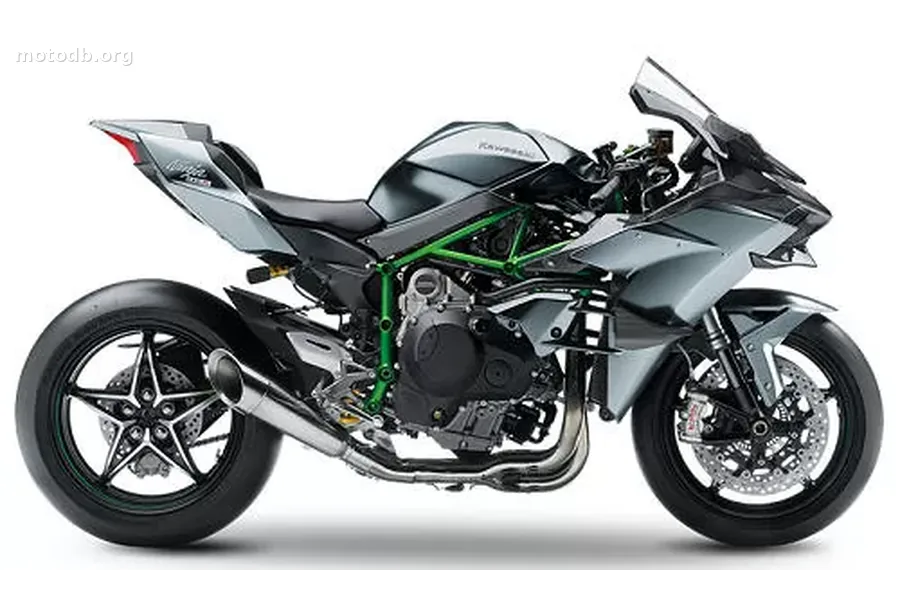
More than 10 years since the Kawasaki H2R was released, and no one has dared to get in its way regarding speed. The one that defied and shattered the laws of speed remains at the top of a temple that no other manufacturer has dared to threaten. The only production motorcycle capable of rivaling a Formula 1 car or a fighter jet (in acceleration). No matter the years, this Kawa will never feel the passage of time. Only the ordering process imposes temporal laws: to get a 2026 model, orders can be placed until October 20, 2025.
While 2021 saw the H2's sister take a break, she continues her career without worrying about the fate of her younger sibling. Unable to be ridden on public roads, she doesn't care about mandatory standards. The H2SX and Z H2 have taken over as the supercharged motorcycle for "public" use; the H2R retains its explosive potential under pressure.
All superlatives have been used to define the H2R. During its career, a few minor evolutions will struggle to find an echo in the aura of this exceptional motorcycle. They are nevertheless present, discreet but effective. A multi-axis inertial unit, an Öhlins TTX36 damper replacing the Kayaba, and a shifter that also works when downshifting are invited aboard. Aerodynamic concerns have been pushed a little further by perforating the brake and clutch levers. This avoids the high-speed air pushing these rods. It is true that unreasonable km/h and insane accelerations are the passion of this Kawasaki.
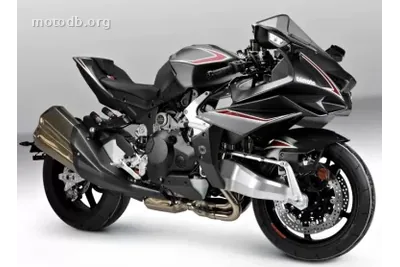
Some motorcycles had flirted with or reached the stage of madness. The Kawasaki Ninja H2R surpasses all of that. With this totally surreal sportbike, the Akashi firm dares to market a delirious machine. A radical sportbike far more powerful than a MotoGP machine!
326 horsepower! In dynamic mode under the effect of forced air – 310 in static mode! A true dragster! A rocket! A crazy thing. The H2R is so crazy that it is reserved for use on a track (a more sensible H2, amputated of a hundred horsepower, was there to support it on the road). Kawasaki has installed a 998 cm3 four-cylinder engine boosted by a specific supercharger in the H2R – enough to offer extraordinary acceleration. This motorcycle could provoke fear, indignation, the odor of madness. It mainly exerts fascination. Its strange design contributes to it, as does its engine. How did Kawasaki manage to achieve such power? Let's discover the entrails of this bolide capable of exceeding 350 km/h. Or displaying 400 km/h – the pilot Kenan Sofuoglu superbly did so on his native lands.
For once, the most exciting part of a motorcycle is not its engine but the supercharger itself. Kawa has brought together the efforts of its Motorcycle, Aerospace, Gas Turbine, and Internal Technologies divisions to develop this motorcycle. One of the advantages of this type of supercharging is the response time. Unlike a turbocharger, which uses exhaust gas energy and must undergo inertia, the supercharger is directly driven by the engine. It therefore starts to push very early, until it becomes completely crazy. A planetary gear train drives a turbine machined from an aluminum block. A true piece of 69 mm jewelry, with 12 blades at its base and 17 at its top. Contrary to expectations, an H2R is not really light. No less than 216 kilos once the tank is full. With this weight, its construction, and its geometry, this Ninja will not be as effective as a hypersport on a track. But that is not its purpose. It just wants to atomize everything that rolls. And it does.
Taking control of an H2R could be likened to boarding a fighter jet. The motorcycle can indeed keep pace with it during takeoff. Grasp the moment, get on the saddle, enjoy a ray of sunshine on the Kawasaki River Mark logo (and not the Kawasaki Motors logo), and settle into a seat/footrest/handlebar triangle that is not so radical. Very sporty, of course, but less than on a ZX-10R. The monoplace seat is embedded in a structure that helps retain the hip when it is shifted by speed. The hip supports located on either side of the seat are adjustable over 15 mm. The moment arrives to start the beast, to bring a high-tech dashboard to life. A digital window grouping the onboard data (angle taken by the motorcycle, speed, gear, compressor activation pictograms, consumption, temperature, etc.) is bitten by a surprising large tachometer. The engine speed numbers only light up as the needle reaches them. And it reaches them quickly. A ring of symbols (neutral, oil indicator, riding assistance, reserve, and others) completes the block. This combination is only the gateway to a world where electronics rule the ride. Fortunately, given the bomb we are sitting on.
The H2R is lavishly equipped, with an Up&Down shifter, a Bosch 6-axis IMU, an Öhlins steering damper, and Kawasaki's own control solutions. Some already exist on other models but the IMU improves them. - The 9-level KTRC traction control maximizes grip and acceleration while allowing a certain level of slip depending on the riding conditions. It calms the engine when needed and above all analyzes its environment all the time. Thus, it takes into account the orientation of the bike, the banking, the wheel speed and calibrates itself according to the tire wear, their profile, and various factors to "predict" when grip will be compromised. This allows it to manage power distribution "in advance." - The KLCM launch assist allows for standing starts, according to 3 modes. It deactivates when passing 150 km/h or when passing third gear. - The KIBS anti-lock braking system. As its name suggests, it prevents the wheels from locking during hard braking or in dubious conditions. It also modulates the action of the brakes in corners, prevents the rear end from lifting, reduces the rebound phenomenon, and allows for better control of the rear brake by taking into account the action of the counter-couple. - The KEBC engine braking control allows you to choose a certain level of its action. All of this is supervised by the KCMF. It monitors the parameters of the engine and the chassis throughout the corner (entry, apex, exit), modulating the braking force and engine power to smooth the acceleration/braking transition, and then the throttle, helping the rider to follow the desired trajectory throughout the corner.
The price to access this prodigious motorcycle is crazy. Already allowing to select its clientele, prohibiting its piloting to hotheads, and is justified by its exceptional nature. If it is twice the price of the civil H2 and displaying triple that of a hypersport, it is nevertheless not so extravagant when compared to some MV-Agusta or luxury productions (Ecosse, Bimota, NCR,...). A price that in any case has no consideration when thinking about the machine created by Kawasaki. The only production motorcycle capable of astonishing the most extreme power fantasies. The ultimate missile, devouring 1 km in 11 seconds!
M.B - Photo manufacturer
Standard equipment
- Assistance au freinage : ABS
- ABS Cornering
- Jantes aluminium
- Shifter
- Amortisseur de direction
- Indicateur de vitesse engagée
- Aide au départ arrêté (Launch Control)
- Contrôle de traction
- Contrôle anti wheeling
- Carénage carbone
- Embrayage anti-dribble
- Contrôle du frein moteur
Practical info
- La moto est accessible aux permis : A
- Pays de fabrication : Japon
Reviews & comments
No reviews yet. Be the first to share your opinion!