Key performance
Technical specifications
Engine
- Displacement
- 498 cc
- Power
- 46.0 ch @ 7000 tr/min (33.8 kW)
- Torque
- 45.1 Nm @ 6000 tr/min
- Engine type
- Bicylindre en ligne, 4 temps
- Cooling
- liquide
- Compression ratio
- 10.2 : 1
- Bore × stroke
- 74 x 58 mm
- Valves/cylinder
- 4
- Camshafts
- 2 ACT
Chassis
- Frame
- double berceau tubulaire en acier
- Gearbox
- boîte à 6 rapports
- Final drive
- Chaîne
- Front suspension
- Fourche téléhydraulique Ø 41 mm, déb : 150 mm
- Rear suspension
- 2 amortisseurs latéraux, déb : 100 mm
Brakes
- Front brakes
- Freinage 1 disque Ø 300 mm, étrier simple piston
- Rear brakes
- Freinage tambour Ø 180 mm
- Front tyre
- 100/90-19
- Front tyre pressure
- 2.00 bar
- Rear tyre
- 140/90-15
- Rear tyre pressure
- 2.50 bar
Dimensions
- Seat height
- 715.00 mm
- Fuel capacity
- 15.00 L
- Weight
- 214.00 kg
- Dry weight
- 199.00 kg
- New price
- 5 335 €
Overview
Starting in custom without breaking the bank — that's often the dilemma facing the newcomer drawn to low lines and chrome. The Kawasaki EN 500 Classic answers that question with disarming consistency, offering for 5,335 euros a machine that borrows its aesthetic codes from American production without slavishly copying their flaws.
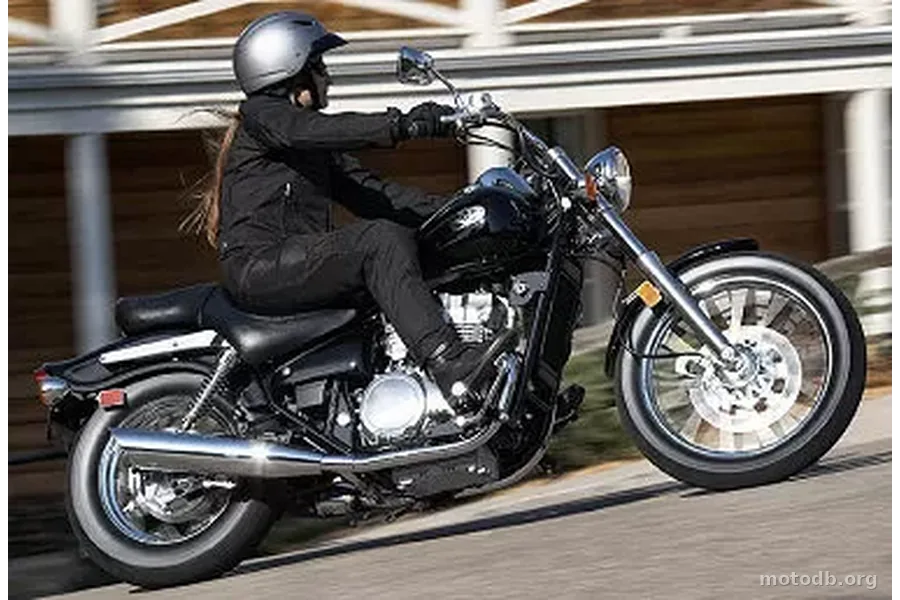
The silhouette was reworked in depth for this 2000 version. The tank stretches and gains volume, spoke wheels replace the old cast units, the bevel-cut exhausts visually lengthen the machine. The seat cowl is removed, the turn signals repositioned, the tail light slimmed down. The result speaks for itself: the bike looks longer, more taut, with that lowered rear section and that 41 mm diameter fork rake that evoke a low rider rolled out of the Milwaukee workshops. Except here, it's Akashi signing the work. And the detail that betrays the Japanese origins is that parallel twin sitting in the steel double-cradle frame, where the Americans would have fitted a V-twin. The character of the bike is different for it — less temperamental, smoother.
The engine is derived from the old GPZ 500 and delivers 46 horsepower at 7,000 rpm for 45 Nm of torque at 6,000 rpm. On paper these are modest figures, but the mapping has been revised to bring the power on earlier in the rev range, making the whole package more usable in real-world riding. It's nothing like a big American twin that scorches the tarmac from idle, but for a 498 cc machine aimed at learning the custom ropes, the engine shows convincing smoothness. The 6-speed gearbox, accessible and well-spaced, handles Sunday rides and daily commutes alike without complaint. Chain final drive replaces the old belt, which simplifies maintenance but severs one of the sensations that brought this little Japanese bike closer to the big Americans.
At 214 kg fully fuelled and a seat height of 715 mm, the bike remains accessible for a rider of average build. The seat height reassures, as does the relaxed riding position. The chassis, however, reveals its limits as soon as the road deteriorates. The suspension — 150 mm of travel up front and 100 mm at the rear — handles broken surfaces poorly and faithfully transmits every imperfection to the rider. No surprise on a custom, but it's worth saying plainly. Braking, entrusted to a single 300 mm disc up front and a 180 mm drum at the rear, is adequate for relaxed use but shows its limits when pushed harder.
Who is this machine really aimed at? Beginners who want to enter the custom world without mortgaging their financial future, and urban riders in search of a bike with a strong look without the complexity of a large displacement machine. Against the Honda Shadow 600 or the Suzuki Intruder 600, the Kawasaki plays the card of price accessibility with a style that has gained in maturity. It makes no attempt to ape the Harley-Davidson; it offers a credible and honest alternative on which to build experience.
Practical info
- La moto est accessible aux permis : A
Reviews & comments
No reviews yet. Be the first to share your opinion!