Key performance
Technical specifications
- Displacement
- 249 cc → 250 cc
- Power
- 23.0 ch @ 8500 tr/min (16.9 kW) → 22.8 ch @ 8500 tr/min (16.6 kW)
- Torque
- 21.6 Nm @ 7000 tr/min → 22.0 Nm @ 7000 tr/min
- Engine type
- Monocylindre, 4 temps → Single cylinder, four-stroke
- Cooling
- liquide → Liquid
- Compression ratio
- 10.7 : 1 → 10.7:1
- Bore × stroke
- 76 x 55 mm → 76.0 x 55.0 mm (3.0 x 2.2 inches)
- Valves/cylinder
- 4 → —
- Camshafts
- 2 ACT → —
- Fuel system
- Injection Ø 36 mm → Injection. PGM-FI, 36mm throttle body
- Valve timing
- — → Double Overhead Cams/Twin Cam (DOHC)
- Lubrication
- Wet sump → —
- Ignition
- Full-transistor battery ignition → Computer-controlled digital transistorized with electronic advance
- Frame
- Double poutre en acier avec simple berceau dédoublé → Semi double cradle
- Gearbox
- boîte à 6 rapports → 6-speed
- Final drive
- Chaîne → Chain (final drive)
- Front suspension
- Fourche téléhydraulique inversée Ø 43 mm, déb : 250 mm → 43mm inverted fork
- Rear suspension
- Mono-amortisseur, déb : 240 mm → Pro-Link® single shock with spring; 9.4 inches travel
- Front wheel travel
- — → 61 mm (2.4 inches)
- Rear wheel travel
- — → 61 mm (2.4 inches)
- Front brakes
- Freinage 1 disque Ø 296 mm, étrier 2 pistons → Single disc. Two-piston calipers.
- Rear brakes
- Freinage 1 disque Ø 220 mm, étrier simple piston → Single disc
- Front tyre
- 110/70-17 → 110/70-17
- Rear tyre
- 130/70-17 → 130/70-17
- Seat height
- 855.00 mm → 881.00 mm
- Wheelbase
- — → 1445.00 mm
- Ground clearance
- — → 225.00 mm
- Length
- — → 2125.00 mm
- Width
- — → 815.00 mm
- Height
- — → 1150.00 mm
- Fuel capacity
- 7.70 L → 7.57 L
- Weight
- 145.00 kg → 146.00 kg
- New price
- 4 740 € → —
Engine
- Displacement
- 250 cc
- Power
- 22.8 ch @ 8500 tr/min (16.6 kW)
- Torque
- 22.0 Nm @ 7000 tr/min
- Engine type
- Single cylinder, four-stroke
- Cooling
- Liquid
- Compression ratio
- 10.7:1
- Bore × stroke
- 76.0 x 55.0 mm (3.0 x 2.2 inches)
- Fuel system
- Injection. PGM-FI, 36mm throttle body
- Valve timing
- Double Overhead Cams/Twin Cam (DOHC)
- Ignition
- Computer-controlled digital transistorized with electronic advance
- Starter
- Electric
Chassis
- Frame
- Semi double cradle
- Gearbox
- 6-speed
- Final drive
- Chain (final drive)
- Clutch
- Wet multiplate with coil springs
- Front suspension
- 43mm inverted fork
- Rear suspension
- Pro-Link® single shock with spring; 9.4 inches travel
- Front wheel travel
- 61 mm (2.4 inches)
- Rear wheel travel
- 61 mm (2.4 inches)
Brakes
- Front brakes
- Single disc. Two-piston calipers.
- Rear brakes
- Single disc
- Front tyre
- 110/70-17
- Rear tyre
- 130/70-17
Dimensions
- Seat height
- 881.00 mm
- Wheelbase
- 1445.00 mm
- Ground clearance
- 225.00 mm
- Length
- 2125.00 mm
- Width
- 815.00 mm
- Height
- 1150.00 mm
- Fuel capacity
- 7.57 L
- Weight
- 146.00 kg
Overview
When Honda decides to release an accessible supermotard, the Japanese manufacturer doesn't start from a blank sheet of paper. It starts from a proven base, the CRF250L, and applies targeted sporty modifications. The result is the Honda CRF250M, a machine designed to bite into urban asphalt without ruining its owner or intimidating them on the first handlebar turn.
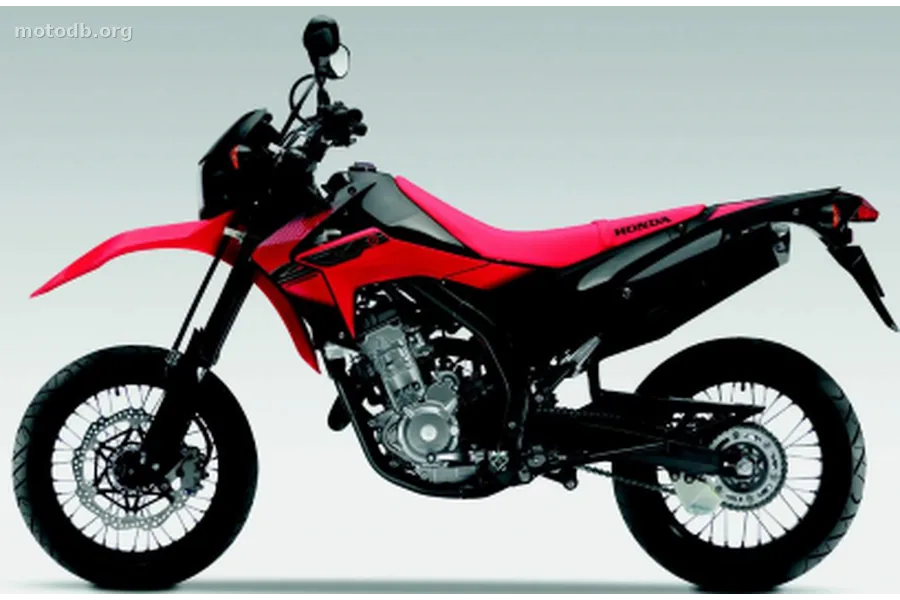
The recipe is simple, almost surgical. The 249 cc four-valve single-cylinder engine is retained, along with its 23 horsepower delivered at 8500 rpm and its 21.6 Nm of torque available from 7000 rpm. This engine doesn't claim to compete with high-performance sportbikes, but it doesn't need to. Its final gearing has been shortened compared to the original trail model, giving it more responsive acceleration and reactivity better suited to sprints between traffic lights. The six-speed gearbox does the rest, and the announced fuel consumption of under 3 liters per 100 km puts the smallness of the 7.7-liter tank into perspective.
What really changes compared to the L is the rolling chassis. Both wheels switch to 17-inch sizes with road tires, 110/70 at the front and 130/70 at the rear, mounted on spoked rims. The 43 mm inverted fork and the single rear shock absorber are carried over but fitted with stiffer springs, which lowers the seat height to 855 mm, twenty millimeters below that of the trail model. For a rider of average build, this is a significant difference. The braking follows the same sporty logic: a 296 mm front disc gripped by a two-piston caliper, against 256 mm on the L. All this for a wet weight of 145 kg, reasonable for the category.
Facing direct competition from the time, the Honda CRF250M 2014 positions itself as a serious alternative to small European supermotards. A KTM Duke 200 or a Husqvarna SMS 125 target a similar profile, but Honda plays the card of Japanese reliability and a contained price of 4740 euros. This is not the most aggressive positioning on the market, but it is consistent for a machine intended for a young A2 license holder or someone returning to motorcycling. The power, limited to 23 horsepower, perfectly fits within the progressive license limits without feeling penalized.
The real subject is the philosophy of the project. Honda had attempted a mainstream supermotard with the 650 FMX, a commercial failure that cooled the manufacturer's ambitions for several years. With the CRF250M, the bet is different: no machine designed from scratch, no excessive budget, but an intelligent derivative of an existing platform. The result is honest. This is not a machine that will turn a beginner into a Sunday track rider, and it doesn't seek to do so. It offers accessible fun, intuitive handling, and maintenance that shouldn't cost a fortune in the long run. For an urban rider who wants to slalom between traffic jams with a touch of style and lightness, it is a proposition that holds up.
Reviews & comments
No reviews yet. Be the first to share your opinion!