Key performance
Technical specifications
- Fuel system
- Carburettor. Bing 22mm → Carburettor
- Starter
- Kick → —
Engine
- Displacement
- 174 cc
- Power
- 8.5 ch @ 4500 tr/min (6.2 kW)
- Engine type
- Single cylinder, two-stroke
- Cooling
- Air
- Bore × stroke
- 58.0 x 66.0 mm (2.3 x 2.6 inches)
- Fuel system
- Carburettor
Chassis
- Final drive
- Chain (final drive)
- Front suspension
- Telescopic
Brakes
- Front brakes
- Expanding brake (drum brake)
- Rear brakes
- Expanding brake (drum brake)
- Front tyre
- 3-19
- Rear tyre
- 3-19
Dimensions
- Fuel capacity
- 13.00 L
- Dry weight
- 118.00 kg
Overview
In post-war Germany, where rebuilding was more important than showing off, the idea of manufacturing a sport motorcycle must have seemed almost incongruous. Yet, the small Nuremberg firm, Hercules, dared to do so. The 314 of 1952 is that gamble, a two-stroke of 174 cc that claimed the status of a sport machine, with all the lightness and ambition that implied for the time.
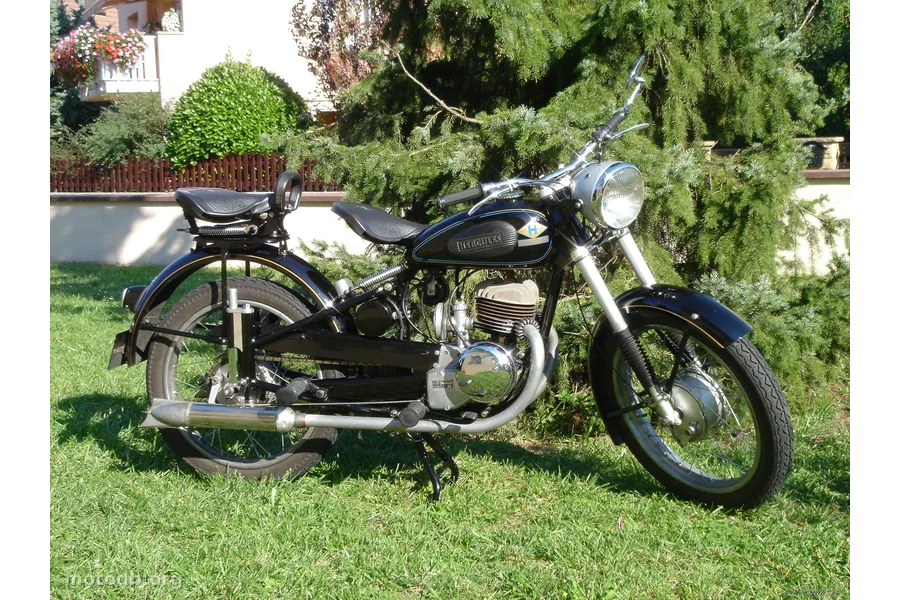
Its two-stroke single-cylinder engine, with a bore of 58 mm and a stroke of 66 mm, produced 8.5 horsepower at 4500 rpm. Figures that provoke a smile today, but which, on a chassis weighing only 118 kg dry, promised sensations. The top speed announced, 85 km/h, is not the point. The essence lay in the liveliness that this simple, carbureted engine could offer. Air cooling and final chain drive completed a mechanical picture of absolute honesty, without embellishment.
The chassis, for its part, played the card of robust simplicity. A telescopic fork at the front, a drum brake on each wheel shod with 3-19 tires, and a frame whose geometry prioritized agility. With a 13-liter tank, this Hercules 314 did not aim for long rallies, but for winding country roads, where its featherweight and modest power could be fully expressed. One can imagine the rider leaning on the tank, seeking to extract every tenth of a horsepower from this vibrant single-cylinder.
Faced with the NSU Quickly or the first Italian scooters that were flooding the cities, the Hercules 314 offered another path: that of pure, almost raw driving pleasure. It did not rival the large British displacement engines, but it offered a young, rebuilding European population a first taste of affordable sportiness. It was a machine for the novice rider, for those who wanted to feel the mechanics more than dominate them.
Today, this Hercules is a poignant collector's item. It embodies a lost philosophy: that of the minimalist sport motorcycle, where every kilogram counted, where one dialogued directly with the road and the engine. Riding it is to understand an era when progress was measured by the smile that a simple machine could provoke, long before figures and electronics came to blur this essential relationship.




Reviews & comments
No reviews yet. Be the first to share your opinion!