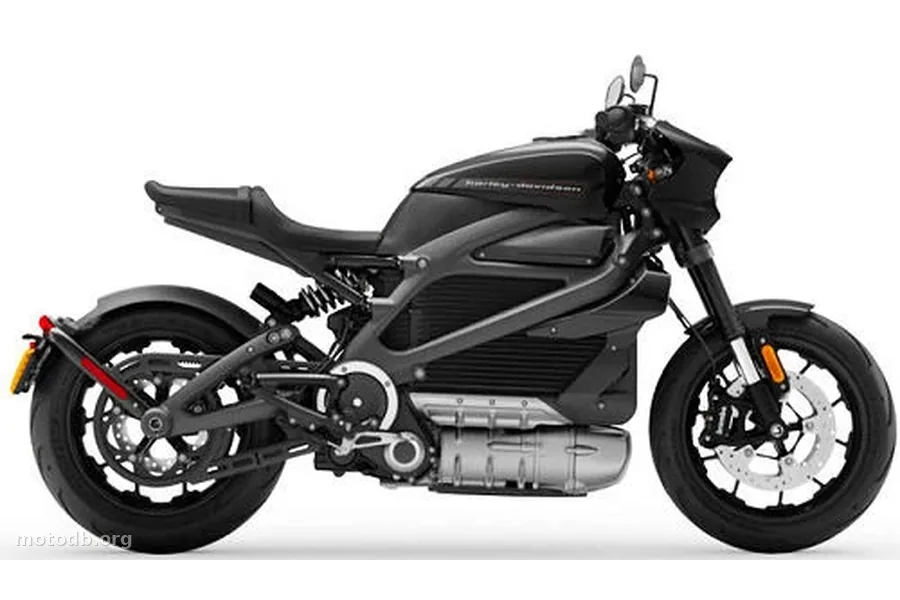
Key performance
Technical specifications
Engine
- Power
- 105.0 ch (76.6 kW)
- Torque
- 116.6 Nm
- Engine type
- Electric
- Cooling
- Air
- Starter
- Electric
Chassis
- Frame
- structure en aluminium
- Final drive
- Courroie
- Front suspension
- SHOWA® SFF-BP (Separate Function front Fork-Big Piston)
- Rear suspension
- SHOWA® BFRC™ (Balanced Free Rear Cushion-lite) mono-shock
Brakes
- Front brakes
- Double disc. ABS. 4-piston monoblock radial mount.
- Rear brakes
- Single disc. ABS. 2-piston. Brembo.
- Front tyre
- 120/70-ZR17
- Rear tyre
- 180/55-ZR17
Dimensions
- Seat height
- 762.00 mm
- Wheelbase
- 1491.00 mm
- Ground clearance
- 130.00 mm
- Length
- 2136.00 mm
- Weight
- 249.00 kg
- Dry weight
- 251.00 kg
- New price
- 33 900 €
Overview
The conservatives will have nightmares. The curious will be stunned. The Harley-Davidson badge will discover new values, unknown flavors. This shock is the LiveWire. Milwaukee’s first electric motorcycle. Conceived as a concept in 2015, this roadster spent several years in an experimentation phase, gathering data, opinions, sensations, and impressions before its definitive launch in 2019. It is ready, it feels the wind turning, and it announces a transition capable of shaking up the Harley universe.
In the land of Uncle Sam, an electric motor always seems surprising. Even if Tesla and Zero Motorcycles are seriously encroaching on the territory, American culture has spent decades indulging in enormous, inefficient engines (for the most part). The LiveWire seems to have been isolated from these traditions. Its design, equipment, and powertrain are unlike anything Harley-Davidson has produced. Except for the belt drive, a very American style search, and a sense of value that is only found in productions from the MoCo. For the first time, nothing will be communicated about the vibrations or character of the twin. Now, we will talk about sound, speed, technology, and performance.
The concept test had already given us a striking glimpse of the torque and availability that the manufacturer planned for its game-changer. We expect something significant, and an initial figure will reassure everyone. As a performance preview, this Harley is capable of sprinting from 0 to 100 km/h in 3 seconds. The 11.9 mkg of torque is 100% available all the time and instantly. Impressive, the LiveWire asserts itself as one of the most powerful Harleys with 105 horsepower in electrons. But it would be more accurate to speak in kilowatts and to count them at 78. The mechanics, if we can call it that, wants to stand out. Encapsulated in a metal-clad shell located beneath the entire motorcycle, it focuses the gaze while ensuring a low center of gravity. Agility seems to have been the object of a lot of attention. The very structure of the LiveWire proves it, and surprises.
Between the project and the series, the motorcycle has retained its style while incorporating many modifications. We regret that the headlight has become more subdued, that the mirrors and turn signals no longer coexist, that purified look that the front used to exude. The LiveWire has still managed to retain that wildness as much as its technical aspects. Its chassis will appeal to sports enthusiasts. Its perimeter aluminum frame firmly holds a serious front end. It asserts itself with an inverted 43 mm Showa BFRC-lite (Balanced Free Rear Cushion-lite) fork. The shock absorber comes from the same manufacturer, an SFF-BP (Separate Function Fork-Big Piston) model – the kind of equipment found on a Japanese sportbike. Equally robust, the brakes consist of 300 mm tracks gripped by Brembo monobloc 4-piston radial-mount calipers. A true sports roadster, very but then far from Harley conventions. Italian brakes, Japanese suspensions... "Made in America" takes a hit; in your face, Trump!
There was a time when the brand didn't even want to hear about ABS. It will be present on the LiveWire as on all other models, but this is just a taste. The electronic equipment announces traction control, adaptive cornering anti-lock braking, a torque slip control system, and no less than 7 riding modes; 4 defined by the factory and 3 customizable. The minimalist display with a needle, let's not even talk about it. Above the handlebar is a 4.3-inch (10.9 cm) color TFT screen, inclinable if you please. It informs of all the necessary information, complemented by Bluetooth functions to pilot a Smartphone. This technology is called Connect Service H-D. It is coupled with connectivity and cloud services, making the LiveWire the first cellular-connected electric motorcycle on the North American market. Thanks to H-D Connect, data is collected and transferred to the application to offer a whole host of data:
Motorcycle status: you can control the battery charge level and available range from anywhere where a cellular signal is available. It will be possible to locate a charging station thanks to an integrated geolocation system in the H-D application. Vehicle alerts and location: H-D Connect indicates the location of the LiveWire when parked and alerts can be sent to the smartphone if the motorcycle is vandalized or moved. GPS vehicle theft tracking allows you to track the motorcycle's position (requires police assistance. Available in some markets). Service reminders and notifications: service requirements and other vehicle maintenance notifications will be sent through the H-D application. In addition, LiveWire owners will receive automated service reminders. The service will be offered for the first year; then, you'll have to pay a subscription.
For a first electric episode, Harley wants to show that it is not limited to city rides. The LiveWire can ride for 235 km; a range that increases to 152 km in combined cycle. As for recharging, Harley takes care of it. It can recover energy during braking to inject amperes back into the stock. In the LiveWire, there are 2 batteries. A small 12V one to power lights, controls, dashboard and horn. The other, a substantial one, to power the motor. To recharge this main unit, a cable (hidden under the seat) can connect the plug on the tank to a household outlet. Dealers selling this machine will offer a charging station. Also, the bike can be recharged at any compatible station. It identifies the recharge according to 3 levels: Level 1 (household outlet): 20 kilometers of range per hour of charge. Level 2: The LiveWire can be connected to a Level 2 charging unit but will be charged at Level 1 speed. Level 3 (Rapid DC Charge): 30 kilometers of range per hour of charge.
The most innovative and perhaps most shocking of Milwaukee's productions weighs 249 kilograms on the scale. A weight equivalent to that of the 1200 Iron or CX Sportster Roadster. The LiveWire will arrive in August. For pre-orders, it will be in February. For fans of the brand, the future begins here.
We expected a surge of power... It was indeed the case but not in the best way. Hardly on the market, production and deliveries of the LiveWire were suspended by the Milwaukee factory, in mid-October 2020. The cause was a defect in the battery charging in slow mode. That is to say, at home; a cruel irony. Harley advises owners to only charge on professional-level rapid DC chargers. A problem that lasted only a week. Harley quickly reacted and conducted a series of adequate tests. This Harley would have done well without this publicity, especially since its beginnings struggle to convince.
M.B - Photos constructeur
Standard equipment
- Assistance au freinage : ABS
- Bluetooth
Practical info
- La moto est accessible aux permis : A
Reviews & comments
No reviews yet. Be the first to share your opinion!