Key performance
Technical specifications
Engine
- Displacement
- 1198 cc
- Power
- 180.0 ch @ 9750 tr/min (132.4 kW)
- Torque
- 134.4 Nm @ 7750 tr/min
- Engine type
- Bicylindre en L à 90°, 4 temps
- Cooling
- liquide
- Compression ratio
- 12.8 : 1
- Bore × stroke
- 106 x 67.9 mm
- Valves/cylinder
- 4
- Camshafts
- 2 ACT
- Fuel system
- Injection
Chassis
- Frame
- treillis en tubes d\'acier
- Gearbox
- boîte à 6 rapports
- Final drive
- Chaîne
- Front suspension
- Fourche téléhydraulique inversée Öhlins Ø 43 mm, déb : 120 mm
- Rear suspension
- Mono-amortisseur Öhlins, déb : 127 mm
Brakes
- Front brakes
- Freinage 2 disques Ø 330 mm, fixation radiale, étrier 4 pistons
- Rear brakes
- Freinage 1 disque Ø 245 mm, étrier 2 pistons
- Front tyre
- 120/70-17
- Rear tyre
- 190/55-17
Dimensions
- Seat height
- 820.00 mm
- Fuel capacity
- 15.50 L
- Dry weight
- 165.00 kg
- New price
- 35 000 €
Overview
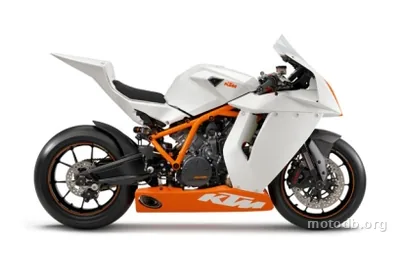
Do you remember that era when a production sportbike could strike you down just by looking at its speedometer? We are in 2009, and Ducati releases the 1098 R onto the market, a true Swiss army knife designed for the track, but homologated for the road. This isn't a simple evolution; it's a declaration of war against the rules, a piece of competition disguised as a production item. With 180 horsepower drawn from a 1198 cm³ L-twin and a dry weight announced at 165 kg, the power-to-weight ratio borders on obscenity. For comparison, a Japanese bike of the time, however sharp it may be, seemed almost reasonable next to this Italian fury.
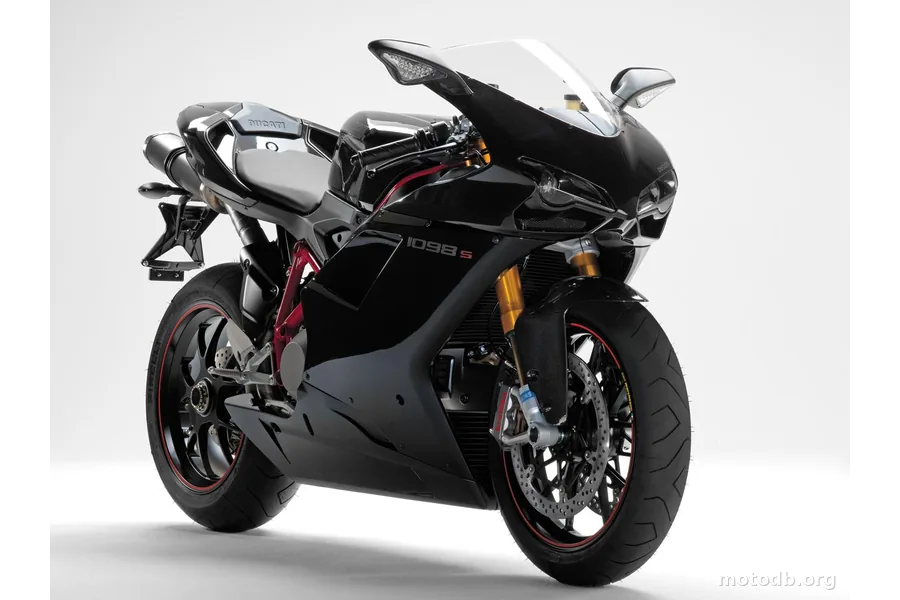
The magic happens as soon as you scratch the surface. The Testastretta Evoluzione engine was gutted and rebuilt with parts from the 1098 F08 entered in Superbike. Titanium valves, magnesium cylinder heads, lightweight pistons: every gram saved was converted into pure violence. The torque of 134.4 Nm arrives like an uppercut at 7750 rpm, and the power curve isn’t a progressive rise; it’s a cliff. On the track, the sensation is brutal. The competition, whether it was the inline four Japanese bikes or other European models, had to re-evaluate their designs in the face of such a concentration of racing technology.
The chassis, for its part, is up to the standard of the engine. The traditional trellis frame accommodates an Öhlins inverted fork of 43 mm and a TTXr monoshock from the same brand, directly from MotoGP. The braking system, with its radial Brembo monoblock calipers and 330 mm discs, is of a ferocity that will take your eyes off the road. This is far from a versatile sportbike; everything here is calibrated for extreme performance. The seat height of 820 mm and the rider position are proof: this machine was not designed for Sunday drives.
Who is it for? Clearly for the seasoned track rider, for those seeking the ultimate track tool without having to go through the preparation stage. For 35,000 euros at the time, it even offered the DDA system to analyze your data on a PC, a serious gadget for those who really want to progress. It was the ultimate weapon, a ready-to-use Superbike, far more radical than a simple 1098 S. Its drawback? A total lack of compromise made it demanding, even intimidating, for an average rider. But that was also its greatest strength: it didn't cheat. The 1098 R was the materialization of controlled madness, a milestone in the history of sportbikes. Today, it remains a witness to a bygone era when excess still had its place on the asphalt.
Practical info
- La moto est accessible aux permis : A
Reviews & comments
No reviews yet. Be the first to share your opinion!