Technical specifications
Engine
- Engine type
- Monocylindre incliné vers l'arrière, 4 temps
- Cooling
- liquide
- Valves/cylinder
- 4
Chassis
- Final drive
- Chaîne
- Front suspension
- Fourche téléhydraulique inversée Ø nc
- Rear suspension
- Mono-amortisseur
Brakes
- Front brakes
- Freinage 1 disque , fixation radiale, étrier 4 pistons
- Rear brakes
- Freinage 1 disque , fixation radiale, étrier 4 pistons
Overview
When BMW decides to play with gravity, the result isn't a tame roadster or a well-behaved adventure bike. It's the Concept Stunt G 310, unveiled in grand premiere at the most important motorcycle show in South America — a machine engineered from the ground up to defy the laws of physics on asphalt. The project didn't emerge from a design office disconnected from reality: Chris Pfeiffer, four-time World and European stunt champion, had his hands in the project from the very start. And it shows.
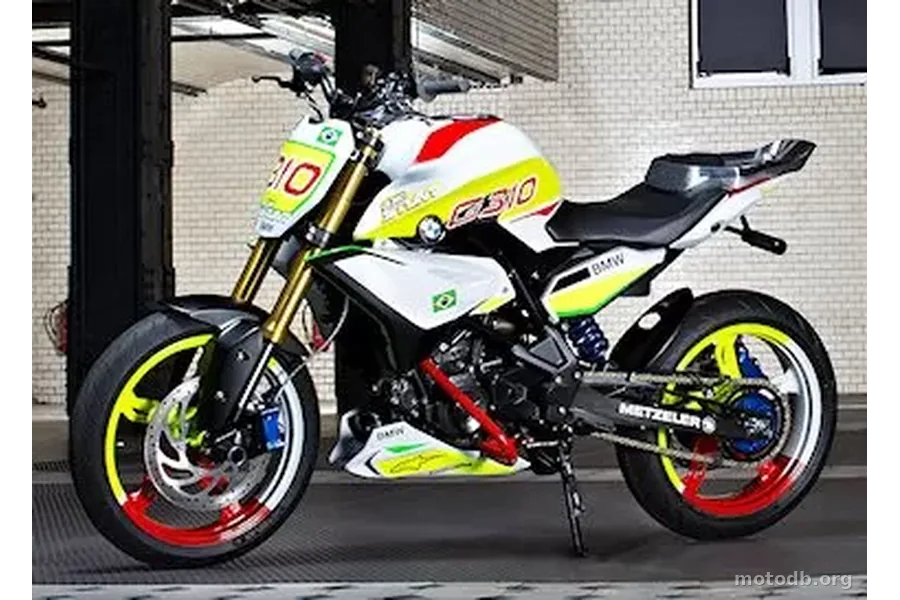
The heart of the concept is a four-stroke single-cylinder with a genuinely original architecture. The cylinder is tilted rearward while the cylinder head has been rotated 180 degrees, allowing the intake to sit on the front face of the engine and the exhaust on the rear side. The direct result: the silencer finds its place under the seat, wedged between the shock absorber and the engine block, protected from impacts and completely clear of the rider's movements. This compact layout allows for a very short wheelbase paired with a long swingarm — a combination that promotes razor-sharp handling without sacrificing stability during tricks. The lowered front end and raised tail further reinforce this aggressive geometry. On paper, it's pure, uncompromising stunt.
The dedicated equipment leaves no doubt about the intentions. The throttle locks to hold the throttle open hands-free, the gearbox ratios have been specifically calibrated to optimize power transfer to the rear wheel during wheelies, and the rear brake is literally doubled: a second caliper is added to the rear disc, operated by a master cylinder mounted on the left side of the handlebar, right next to the clutch lever. The rider can thus brake the rear wheel even when his right foot is floating in the air. Additional footpegs at the front axle and near the seat provide alternative footholds for the most acrobatic positions. Everything is protected by a distinctive red tubular cage, and a machined aluminum piece at the rear — the "stunt rail" — features a central opening so the rider can slide a foot through it during stand-up tricks at the back of the bike.
The design is consistent with the ambition. The silhouette dips toward the front, every line pointing toward the front wheel as if anticipating the next stoppie. The voluminous side panels around the tank give an impression of mass concentrated at the center, while the rear section tapers sharply away. BMW played the color card with a Motorsport white base, blue and red referencing Brazilian colors for the occasion, and touches of fluorescent green and yellow that stand out without tipping into garish. The darkened engine block visually lowers the center of gravity — a styling detail that genuinely works to the eye.
This concept is obviously not aimed at the weekend rider. It's a statement of intent from BMW on its ability to take the G 310 into worlds far removed from calm urban mobility. Does it announce a production version? Nothing confirms that at this stage. But the technical credibility of the engine architecture and the precision of the solutions developed with Pfeiffer show that Munich isn't just going through the motions. A niche machine, conceived for an ultra-specialized audience, that proves the 310 cc platform holds more potential than its measured beginnings suggested.
Practical info
- La moto est accessible aux permis : A
Reviews & comments
No reviews yet. Be the first to share your opinion!