Key performance
Technical specifications
- Power
- 98.0 ch @ 8250 tr/min (71.5 kW) → 98.0 ch @ 8500 tr/min (71.5 kW)
- Torque
- 97.0 Nm @ 6250 tr/min → 90.0 Nm @ 6250 tr/min
- Fuel system
- Injection → Injection. Integrated electronic engine management system. Indirect multi-point electronic fuel injection. 57 mm diameter throttle bodies. 10.3 litre airbox with Air Runner ram air intake.
- Valve timing
- — → Double Overhead Cams/Twin Cam (DOHC)
- Frame
- double poutre alu-magnésium → Double Wave Twin Beam frame in aluminium-magnesium alloy.
- Final drive
- Chain (final drive) → Chaîne
- Clutch
- — → Multiple disk in oil bath with patented PPC power-assisted hydraulic control. Freudenberg clutch line.
- Front suspension
- Fourche téléhydraulique Ø 50 mm, déb : 175 mm → Marzocchi 50 mm hydraulic fork.
- Rear suspension
- Mono-amortisseur, déb : 175 mm → Sachs hydraulic monoshock with adjustable rebound and spring preload
- Front brakes
- Dual disc → Double disc. Bremo stainless steel semi-floating disks.
- Rear brakes
- Single disc → Single disc. Bremo stainless steel disk.
- Wheelbase
- 1560.00 mm → 1544.00 mm
- Length
- 2310.00 mm → 2290.00 mm
- Width
- 830.00 mm → 876.00 mm
- Height
- 1440.00 mm → 1436.00 mm
Engine
- Displacement
- 998 cc
- Power
- 98.0 ch @ 8500 tr/min (71.5 kW)
- Torque
- 90.0 Nm @ 6250 tr/min
- Engine type
- V2, four-stroke
- Cooling
- Liquid
- Compression ratio
- 10.4:1
- Bore × stroke
- 97.0 x 67.5 mm (3.8 x 2.7 inches)
- Valves/cylinder
- 4
- Camshafts
- 2 ACT
- Fuel system
- Injection. Integrated electronic engine management system. Indirect multi-point electronic fuel injection. 57 mm diameter throttle bodies. 10.3 litre airbox with Air Runner ram air intake.
- Valve timing
- Double Overhead Cams/Twin Cam (DOHC)
Chassis
- Frame
- Double Wave Twin Beam frame in aluminium-magnesium alloy.
- Gearbox
- 6-speed
- Final drive
- Chaîne
- Clutch
- Multiple disk in oil bath with patented PPC power-assisted hydraulic control. Freudenberg clutch line.
- Front suspension
- Marzocchi 50 mm hydraulic fork.
- Rear suspension
- Sachs hydraulic monoshock with adjustable rebound and spring preload
- Front wheel travel
- 175 mm (6.9 inches)
- Rear wheel travel
- 185 mm (7.3 inches)
Brakes
- Front brakes
- Double disc. Bremo stainless steel semi-floating disks.
- Rear brakes
- Single disc. Bremo stainless steel disk.
- Front tyre
- 110/80-VR19
- Front tyre pressure
- 2.20 bar
- Rear tyre
- 150/70-VR17
- Rear tyre pressure
- 2.50 bar
Dimensions
- Seat height
- 820.00 mm
- Wheelbase
- 1544.00 mm
- Length
- 2290.00 mm
- Width
- 876.00 mm
- Height
- 1436.00 mm
- Fuel capacity
- 25.00 L
- Dry weight
- 215.00 kg
- New price
- 11 499 €
Overview
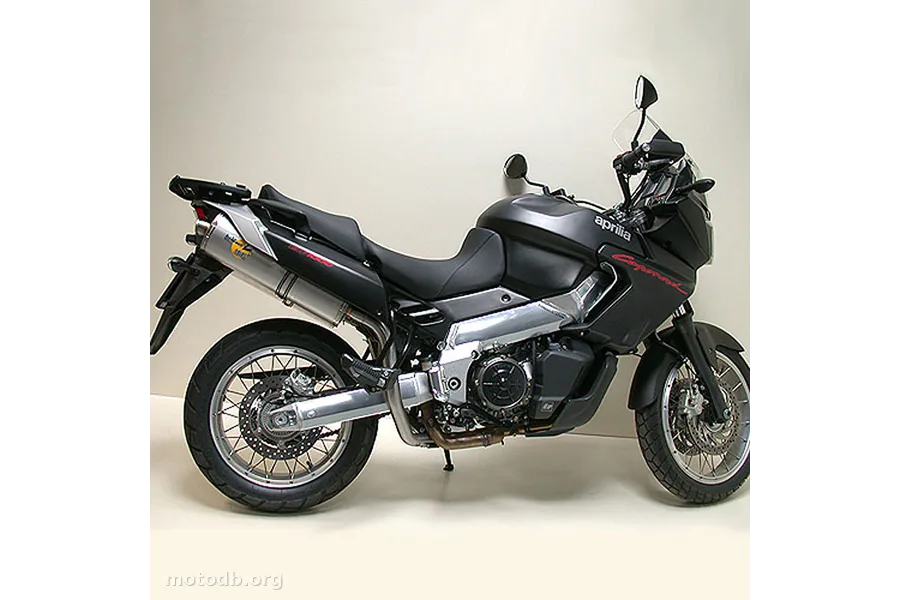
Who would have bet, in the early 2000s, that Aprilia, a brand forged in competition, would decide to tackle the market for large road touring bikes with a V2 derived from the RSV? Yet, that was the bold gamble of the ETV 1000 Caponord, a machine that wanted to compete with the Honda Varadero and other Suzuki V-Stroms. The first generation, launched in 2001, establishes its setting: a perimeter aluminum-magnesium frame, an architecture usually reserved for sportbikes, mounted on a reworked 998 cc engine for travel. The idea was clear: to create a trail that doesn't just play a cameo role in corners.
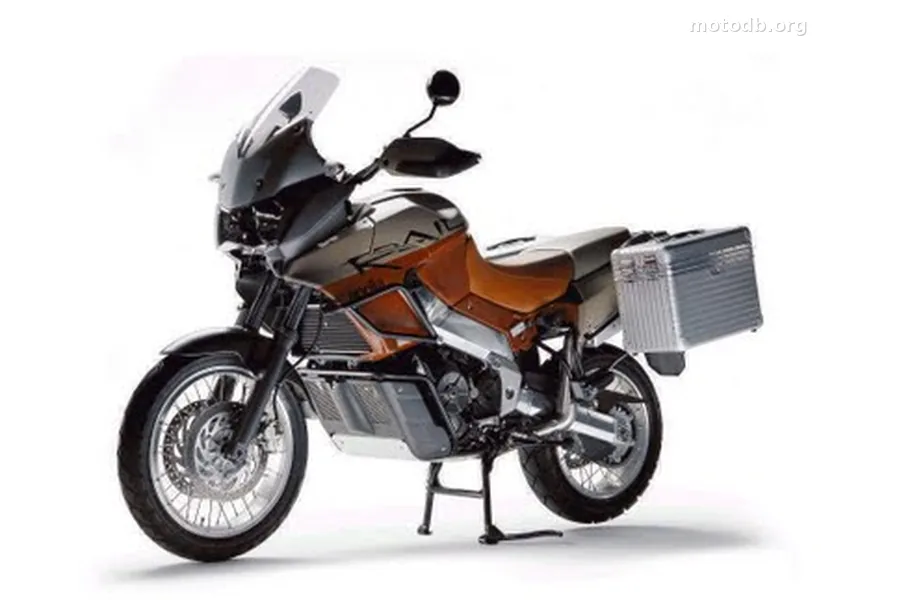
This 60° V-twin, derived from the Mille, has been profoundly modified. Engineers sacrificed some horsepower at high RPM to gain flexibility, with 90 Nm of torque available relatively early. The result is an elastic engine, which proves very civilized between 4000 and 7000 RPM, ideal for long straight roads or mountain climbs. However, when pushed, especially in acceleration in the higher gears, it sometimes lacks punch compared to some competitors. With 98 horsepower for 215 kg dry weight, the 2007 Caponord is not a brute, but it offers accessible performance, a significant argument for touring riders considering moving up to a large displacement without being intimidated.
The real surprise comes from its chassis. This Twin Beam frame provides exceptional rigidity which, combined with a geometry designed for the road, gives an almost sporty agility. In a series of corners, it handles with a precision that makes you forget its size and its 19-inch tires at the front. But this pleasure is tempered by a known weakness from specialist forums: its suspension. The 50 mm Marzocchi fork, non-adjustable on this version, is often judged too soft, limiting handling when the terrain becomes truly sporty or simply bumpy. This is a compromise that orients the machine towards a serene road touring experience, far from off-road adventures.
In 2004, Aprilia responded to a growing demand for safety with the introduction of an ABS system. This option becomes standard on models from 2006, like the 2007 version presented here. This evolution is crucial for a touring trail designed to cover long distances in all conditions. With a 25-liter tank, an 820 mm seat height, and a price of around €11,500 at the time, the Caponord positioned itself as an Italian, technological, and stylish alternative to the more massive Varadero and the V-Strom, then more economical. It finds its audience among riders seeking a unique character, a touch of aesthetic aggression, and honest road performance, without seeking to be the most versatile or the most powerful in the segment.
Today, finding an Aprilia ETV 1000 Caponord used is a way to acquire a touring trail with a well-tempered character. Road tests at the time highlighted its ease of handling and effective turning radius, qualities for the city or narrow roads. But before jumping in, consulting forums to learn about recurring problems, especially on the first generations (2001 to 2003), is a necessary step. This Caponord remains a machine with a strong identity, proving that Aprilia could infuse its sporty DNA into a then very conventional field.
Standard equipment
- Assistance au freinage : ABS de série
Practical info
- La moto est accessible aux permis : A
Indicators & positioning
Similar bikes
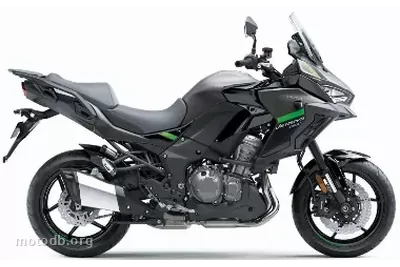
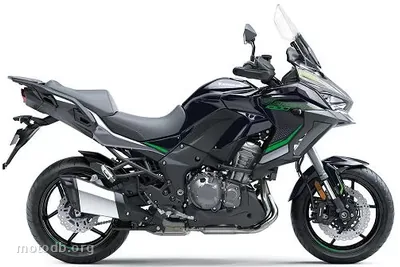
Versys 1000 SE
Reviews & comments
No reviews yet. Be the first to share your opinion!